
What this worksheet helps children practise
Have your child say both partial products out loud before writing the final addition sentence.
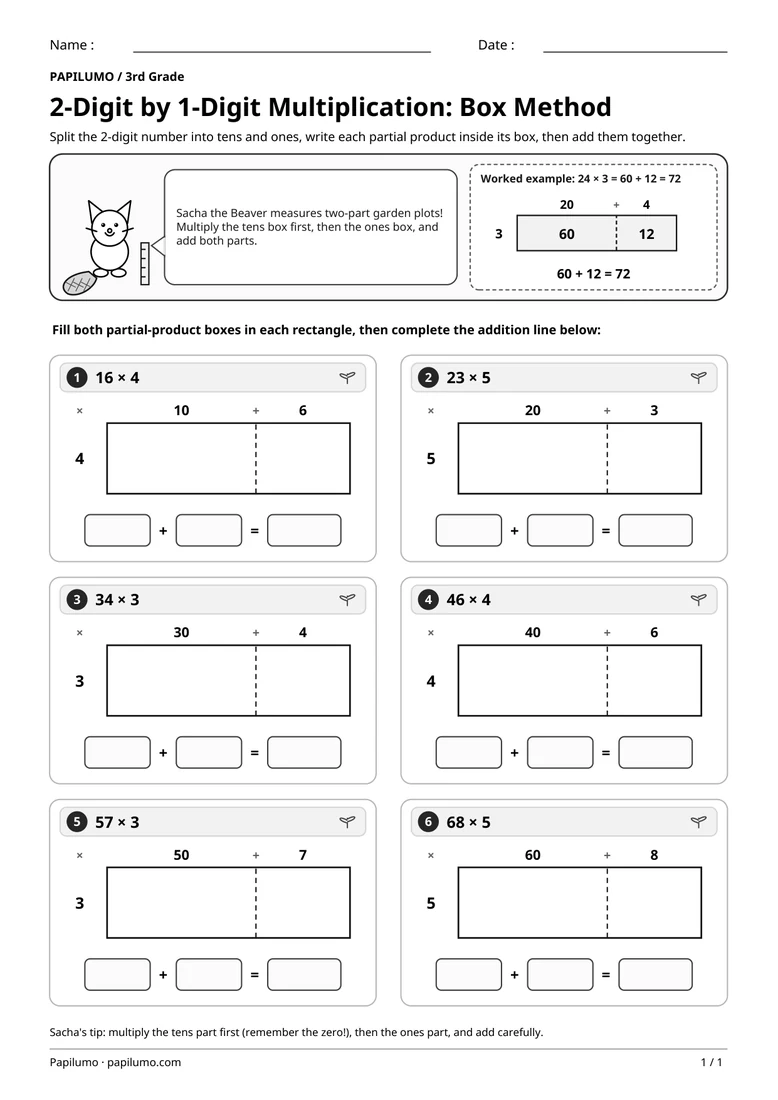
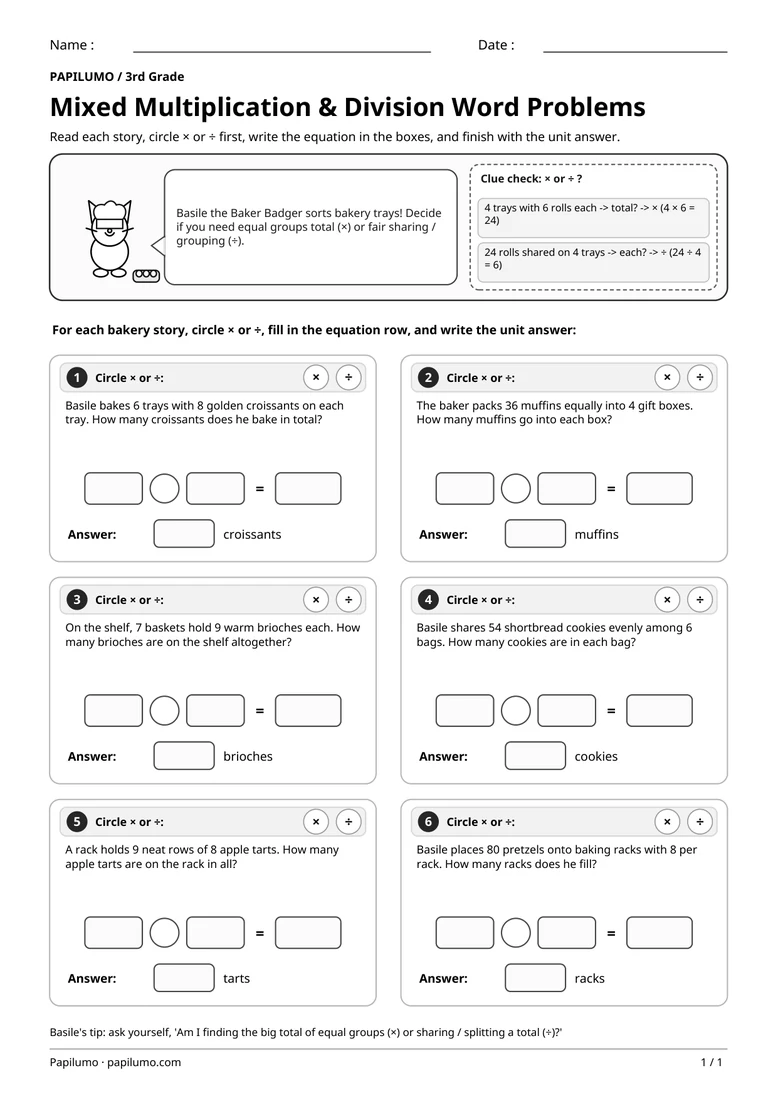
This worksheet strengthens foundational distributive-property reasoning and multi-digit number sense in 3rd Grade. By separating every two-digit number into a multiple of ten and remaining ones, children discover directly why 46 × 4 equals (40 × 4) + (6 × 4), turning an intimidating problem into 160 + 24. Practicing partial products reinforces multiplying multiples of ten cleanly, prevents common regrouping errors where tens are treated as single digits, and lays durable groundwork for multi-digit area models in fourth grade. For a related skill, use Mixed Multiplication & Division Word Problems Within 100 with Basile: Read each story, circle × or ÷ first, write the equation in the boxes, and finish with the unit answer.
Preparing a short session
Print the student page at 100% scale on plain white A4 or letter paper, along with a sharpened pencil and an eraser for neat adjustments. Keep the separate one-page answer key out of sight while your child works through the puzzles. Before starting the six garden cards, ask your child to trace the wide tens box and the narrower ones box in the top banner example, and rehearse multiplying multiples of ten out loud—reminding them how 3 × 30 becomes 90 and 5 × 60 becomes 300.
A concrete example to get started
Inside the top banner next to smiling Sacha the Beaver, the worked example illustrates 24 × 3 on a clean two-part garden rectangle. The left side shows the single-digit factor 3, while the top edge splits 24 into 20 above the wider left box and 4 above the right box. Inside the two sections, bold partial products show 60 and 12 clearly. Directly underneath, the completed addition equation 60 + 12 = 72 demonstrates exactly how students copy and sum both parts without rushing.
Supporting the activity
Below the banner sit six spacious numbered garden-plot cards progressing gently from 16 × 4 and 23 × 5 through 34 × 3, 46 × 4, 57 × 3, and 68 × 5. Each card prints the split tens and ones labels cleanly along the top edge (such as 10 and 6 for 16, up to 60 and 8 for 68) and the single-digit multiplier along the left edge. Students write the two partial products inside the roomy white boxes, copy them onto the structured addition line below, and compute the final product. To vary the practice, try Adding and Subtracting Decimals to Hundredths with Mina: Keep the decimal points lined up under O, t, h, record carry or borrow marks at the top, and compute each answer.
What to notice and how to check
Once all six problems are finished, place the separate one-page answer key beside the student sheet to review every partial product and final total step by step together. Confirm each pair of box values and totals carefully: 40 + 24 = 64, 100 + 15 = 115, 90 + 12 = 102, 160 + 24 = 184, 150 + 21 = 171, and 300 + 40 = 340. When an error appears, check calmly whether a zero was dropped in the tens box or if regrouping slipped during the final addition step.
Making the task easier
Remind learners that 20 × 3 is just 2 × 3 with one place-value zero at the end to make 60.
Keep the learning aim, but reduce how much the child has to handle at once. Cover part of the page with another sheet and reveal one task at a time. Demonstrate a separate example, then leave a real opportunity to work something out. An answer reached with support is still a useful attempt; it does not yet show that the same task can be completed independently.
Taking the idea beyond the worksheet
Challenge fast finishers to sketch their own two-box garden plot for 48 × 6 or 75 × 4.
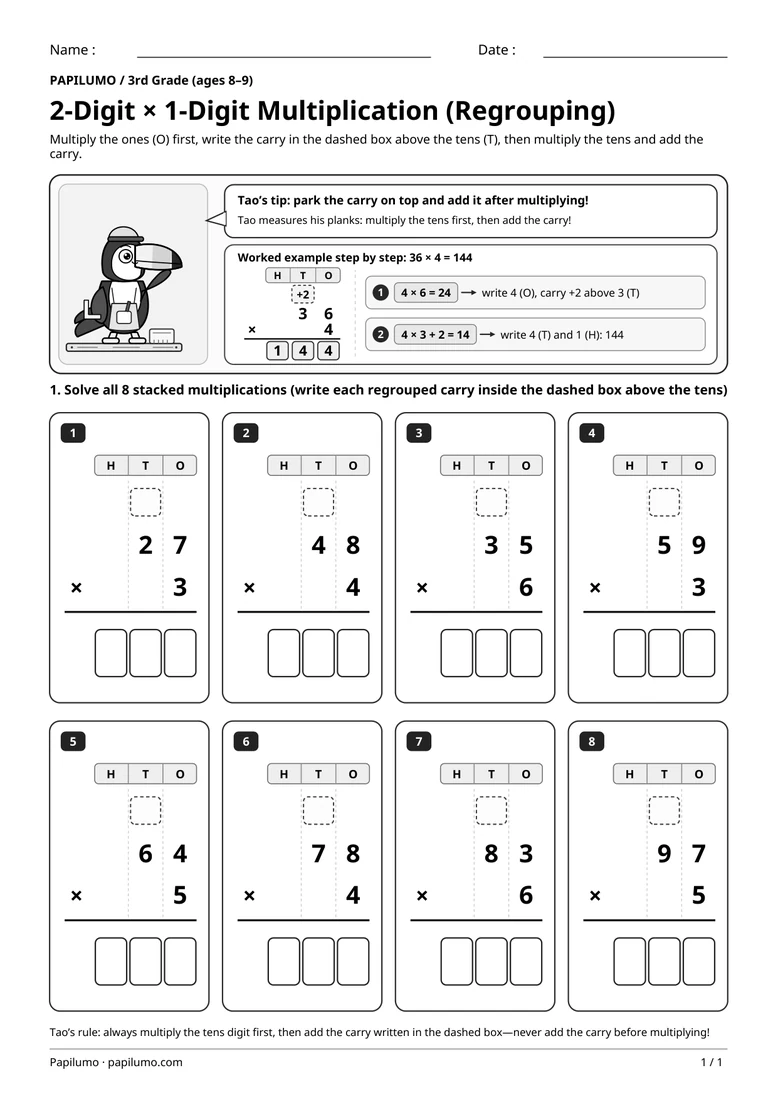
Use the follow-up to meet the same idea in a different setting. Offer it once the first task makes sense, without insisting that the whole page must be perfect. The child might explain a strategy, make an example or set a challenge for an adult. Return to the worksheet only when it helps connect the two situations. A short conversation or a practical activity can be enough to finish the session. To continue exploring, use 2-Digit by 1-Digit Multiplication with Regrouping (Tao): Multiply the ones (O) first, write the carry in the dashed box above the tens (T), then multiply the tens and add the carry.
Downloading and printing the PDF
This free PDF contains one worksheet designed for A4 paper. Download the file using the button on this page and open it in your PDF reader. Choose actual size or a 100% scale, check the orientation in the print preview and turn off any browser headers or footers. The illustrations use vector lines, so their outlines stay sharp when printed. Check the margins on one copy before preparing several sheets for a group. The level shown on the page is a guide, rather than a requirement to complete the activity at a particular age.