
What this worksheet helps children practise
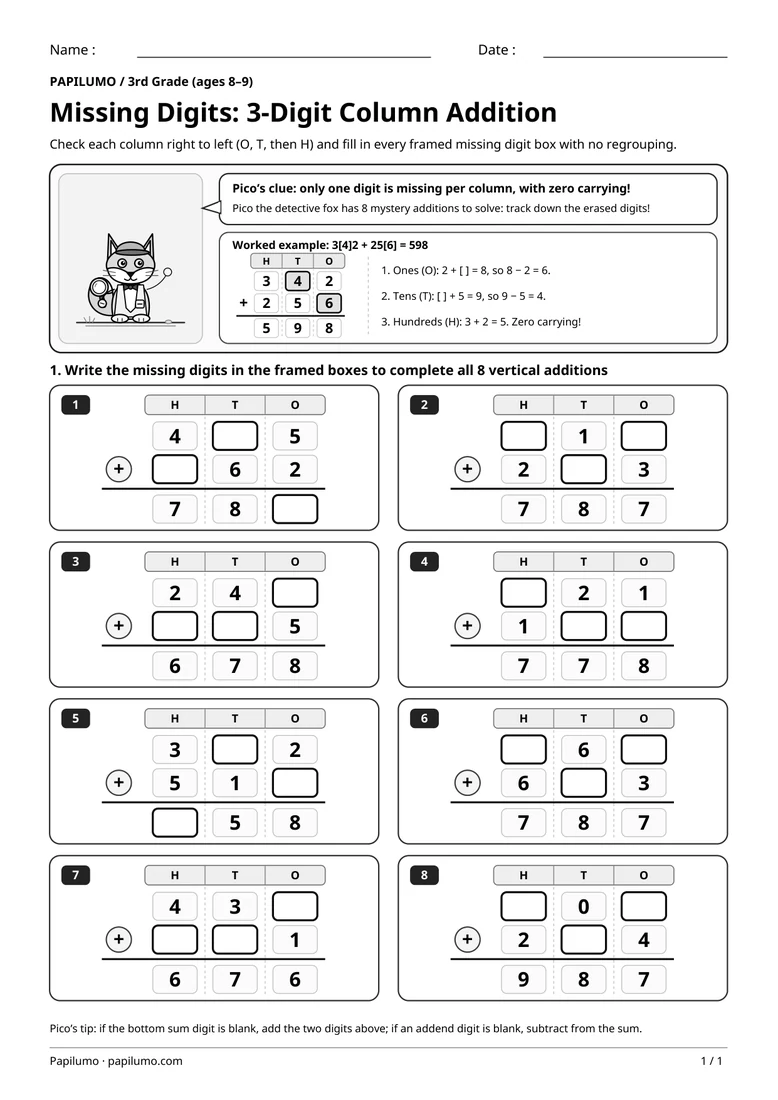
Inspect one column at a time: add straight down if the sum box is empty, or subtract from the sum if an addend digit is missing!
Missing-digit column addition pushes learners beyond rote downward adding to connect addition and subtraction inside place value. Because none of these eight puzzles involve carrying or trading between columns, every place-value rank works independently and yields one guaranteed single-digit answer. Students practice choosing the right strategy on the spot: adding the two given addends when the bottom sum box is empty, or finding the missing part by subtracting from the total when a framed blank box sits in the top or middle row. For a related skill, use Three-digit addition without regrouping: Add each pair. Write one digit in each answer box.
Preparing a short session
Print the student worksheet at actual size (100%) on plain white letter or A4 paper without shrinking the margins, and set out a sharpened pencil and eraser. Before diving into the eight mystery cards, read Pico the detective fox’s worked example together aloud, tracing from ones (O) to tens (T) to hundreds (H) so the column logic clicks immediately. Keep the separate one-page answer key PDF tucked out of sight while your student solves the sheet independently.
A concrete example to get started
In the top banner beside Pico the detective fox, the worked model 3[4]2 + 25[6] = 598 shows both detective moves side by side. In the ones column (O), 2 + [ ] = 8 gives 8 − 2 = 6. In the tens column (T), [ ] + 5 = 9 gives 9 − 5 = 4. In the hundreds column (H), 3 + 2 = 5 is already complete. Reading back down every column confirms 342 + 256 = 598 with zero carrying needed.
Supporting the activity
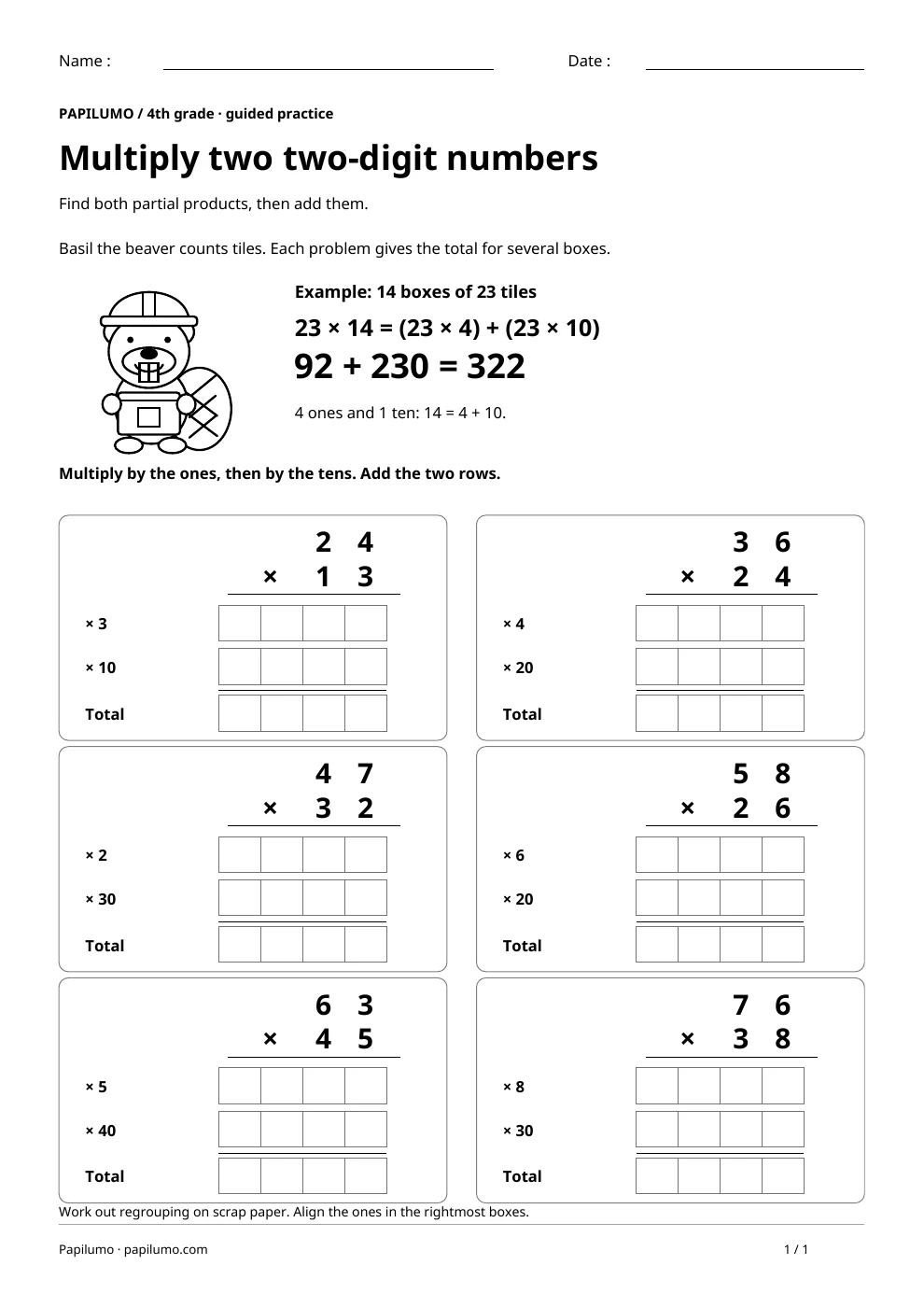
Each of the eight numbered cards hides three single digits—always strictly one blank per column across the top addend, bottom addend, and sum so every puzzle is uniquely solved: card 1: 4[2]5 + [3]62 = 78[7] (2, 3, 7); card 2: [5]1[4] + 2[7]3 = 787 (5, 7, 4); card 3: 24[3] + [4][3]5 = 678 (4, 3, 3); card 4: [6]21 + 1[5][7] = 778 (6, 5, 7); card 5: 3[4]2 + 51[6] = [8]58 (8, 4, 6); card 6: [1]6[4] + 6[2]3 = 787 (1, 2, 4); card 7: 43[5] + [2][4]1 = 676 (2, 4, 5); and card 8: [7]0[3] + 2[8]4 = 987 (7, 8, 3), featuring a clear zero tens clue. To vary the practice, try Two-digit by two-digit multiplication with partial products: Find both partial products, then add them.
What to notice and how to check
When checking finished work with the separate one-page answer key PDF, ask your learner to read each completed stack back down column by column to self-check. If a student writes 9 instead of 3 on card 1 or 7 instead of 1 on card 6, they likely added the sum and known addend together instead of finding the difference. Reviewing that single column with Pico quickly reinforces inverse thinking and solid 3-digit place-value fluency up to 999.
Making the task easier
Cover the other two columns with an index card so you can focus on just one vertical column from right to left.
Keep the learning aim, but reduce how much the child has to handle at once. Cover part of the page with another sheet and reveal one task at a time. Demonstrate a separate example, then leave a real opportunity to work something out. An answer reached with support is still a useful attempt; it does not yet show that the same task can be completed independently.
Taking the idea beyond the worksheet
Create two original 3-digit additions with no carrying and erase one digit per column for a partner to solve.
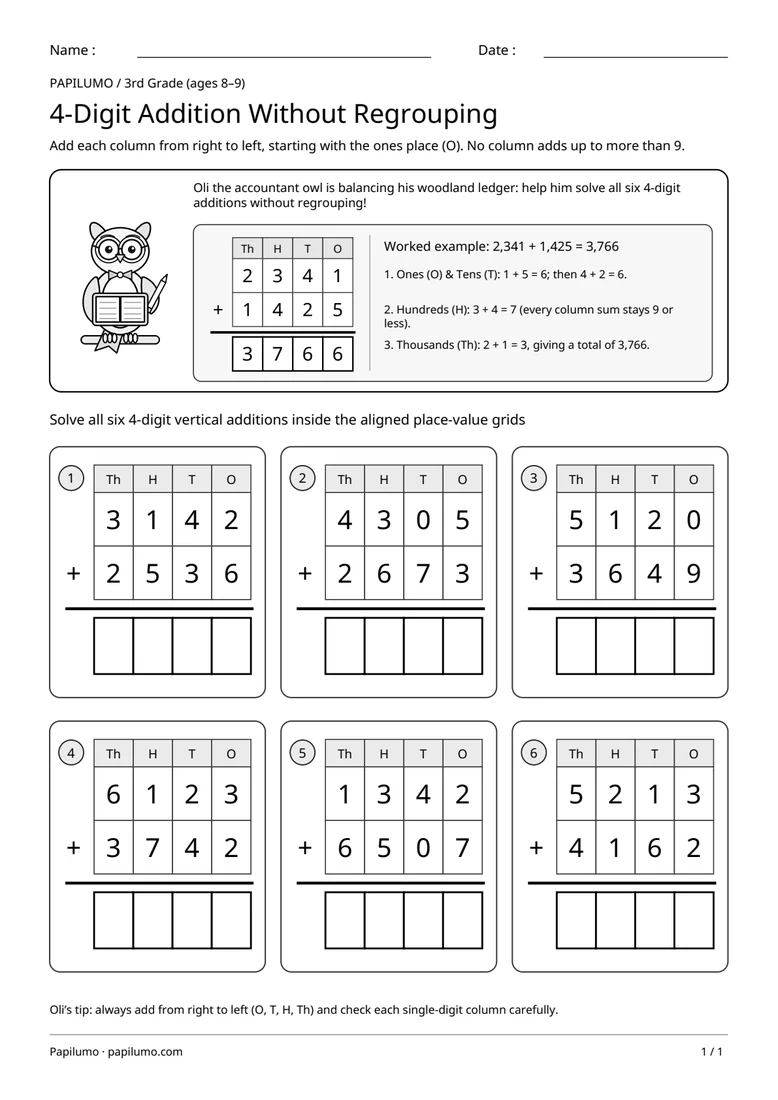
Use the follow-up to meet the same idea in a different setting. Offer it once the first task makes sense, without insisting that the whole page must be perfect. The child might explain a strategy, make an example or set a challenge for an adult. Return to the worksheet only when it helps connect the two situations. A short conversation or a practical activity can be enough to finish the session. To continue exploring, use 4-Digit Addition Without Regrouping with Oli the Accountant Owl: Add each column from right to left, starting with the ones place (O). No column adds up to more than 9.
Downloading and printing the PDF
This free PDF contains one worksheet designed for A4 paper. Download the file using the button on this page and open it in your PDF reader. Choose actual size or a 100% scale, check the orientation in the print preview and turn off any browser headers or footers. The illustrations use vector lines, so their outlines stay sharp when printed. Check the margins on one copy before preparing several sheets for a group. The level shown on the page is a guide, rather than a requirement to complete the activity at a particular age.