
What this worksheet helps children practise
Always begin in the ones column on the far right and work steadily left toward the thousands!
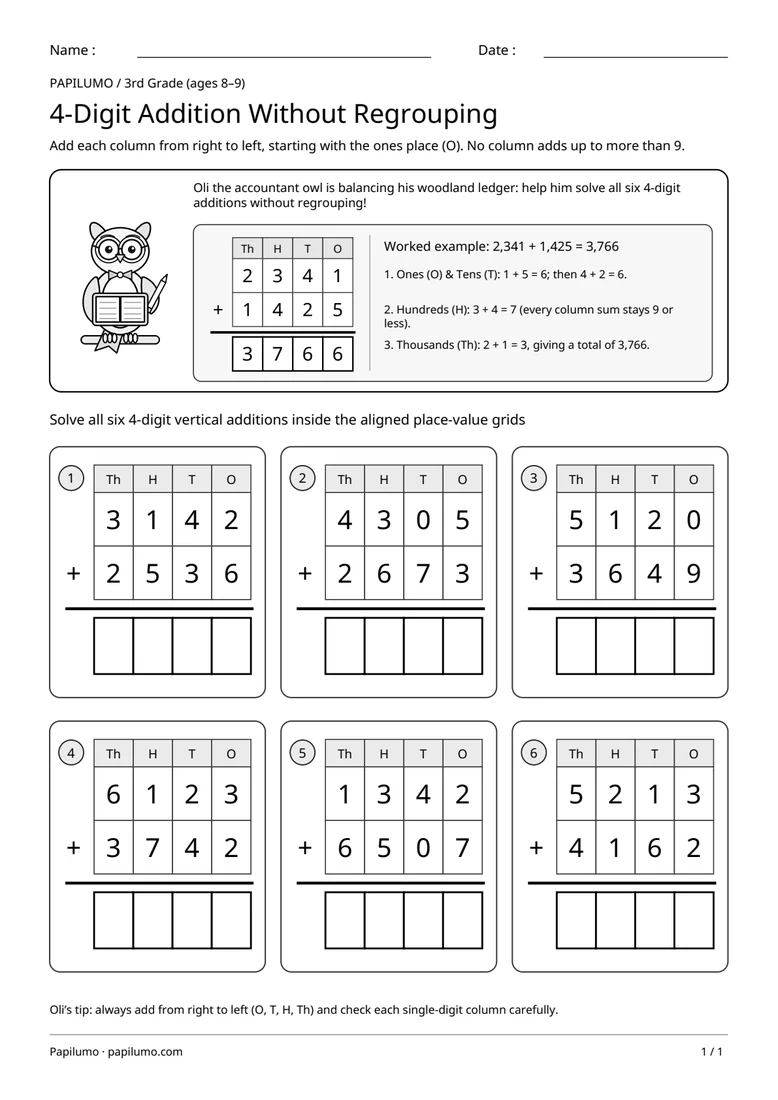
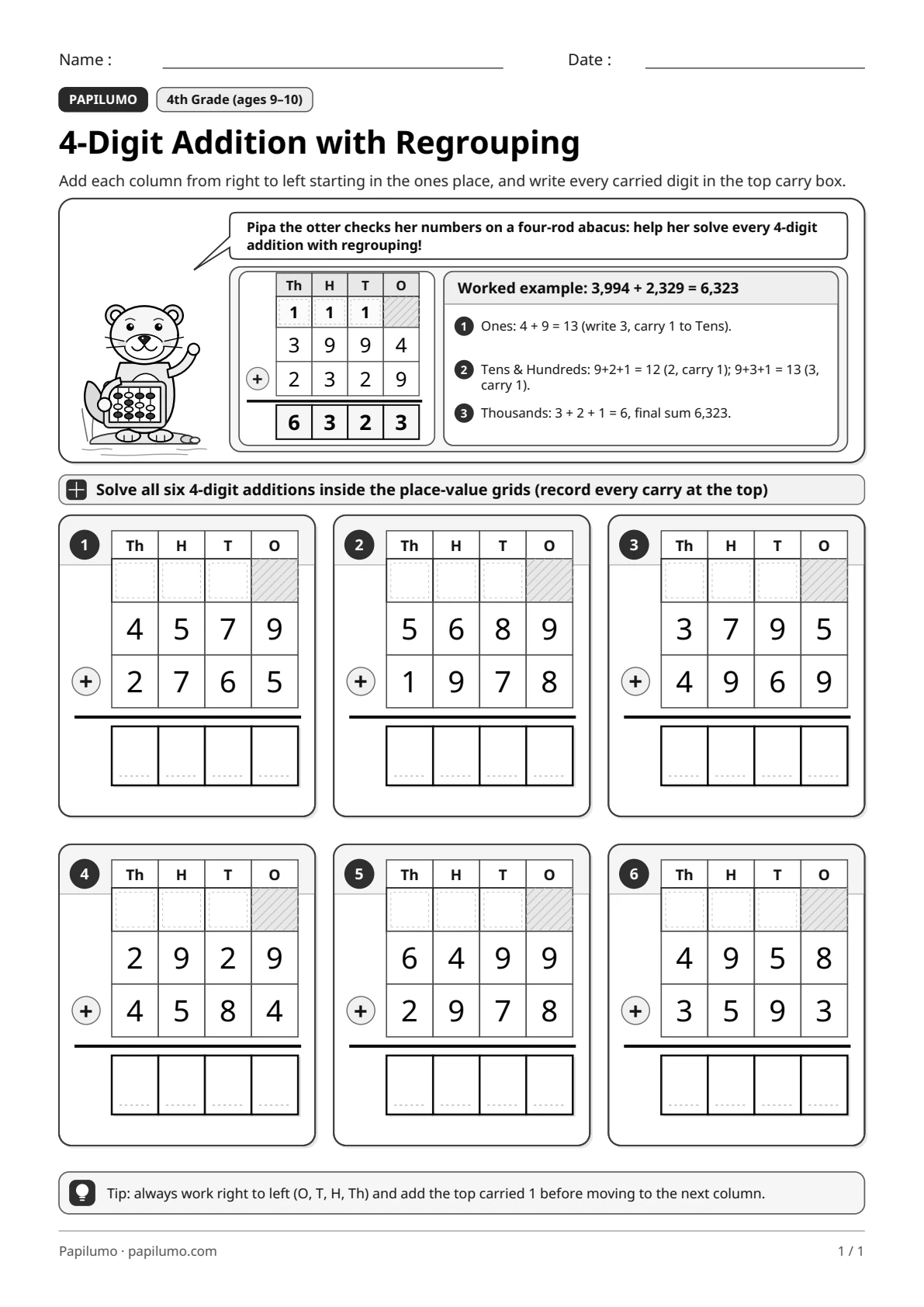
Practicing four-digit column addition with no regrouping builds lasting place-value confidence in third grade. Children see directly how each vertical column represents a distinct power of ten—ones, tens, hundreds, and thousands—while reinforcing the right-to-left solving routine required for all multi-digit algorithms. Because every column sum stays at nine or below, students can focus completely on clean vertical alignment, handling zero smoothly inside an addend, and recalling basic single-digit addition facts accurately before advancing to four-digit regrouping problems. For a related skill, use 4-Digit Addition with Regrouping with Pipa the Otter: Add each column from right to left starting in the ones place, and write every carried digit in the top carry box.
Preparing a short session
Print the student worksheet at actual size (100%) on plain white letter or A4 paper without shrinking the margins, and place a sharpened pencil and soft eraser within reach. Before starting the six grids, spend one minute tracing Oli the accountant owl’s worked example together from the ones column on the far right to the thousands column on the left, saying each column sum aloud. Keep the separate one-page answer key PDF set aside during practice so your learner fills in every four-digit total independently.
A concrete example to get started
In the top banner, Oli the accountant owl walks through 2,341 + 1,425 = 3,766 step by step inside a labeled place-value grid. Start in the ones column (O): 1 + 5 = 6, so write 6 in the rightmost box. Move left to the tens column (T): 4 + 2 = 6, so write 6. Next, in the hundreds column (H): 3 + 4 = 7, so write 7. Finally, in the thousands column (Th): 2 + 1 = 3, giving 3,766 with zero carrying needed anywhere.
Supporting the activity
Once the model makes sense, students complete the six independent grids arranged across two tidy rows, each carefully designed with zero carries in every column: problem 1 asks for 3,142 + 2,536 = 5,678; problem 2 practices 4,305 + 2,673 = 6,978 with a zero in the tens place; problem 3 presents 5,120 + 3,649 = 8,769 with a zero in the ones place; problem 4 solves 6,123 + 3,742 = 9,865; problem 5 computes 1,342 + 6,507 = 7,849; and problem 6 finishes with 5,213 + 4,162 = 9,375. To vary the practice, try Three-digit addition without regrouping: Add each pair. Write one digit in each answer box.
What to notice and how to check
When reviewing finished work against the separate answer key PDF, compare each digit from right to left rather than glancing only at the whole four-digit number. A mismatch in a single column usually points to a quick mental addition slip or a misread zero, whereas a larger shift may show that your child started adding from the thousands column instead of the ones. Invite your student to read the faulty column aloud top to bottom, fix the digit cleanly, and verify the answer by rounding to the nearest thousand.
Making the task easier
Slide a small index card over the left columns so your eyes focus on just one vertical column at a time.
Keep the learning aim, but reduce how much the child has to handle at once. Cover part of the page with another sheet and reveal one task at a time. Demonstrate a separate example, then leave a real opportunity to work something out. An answer reached with support is still a useful attempt; it does not yet show that the same task can be completed independently.
Taking the idea beyond the worksheet
Create your own 4-digit addition pair where every column adds up to 9 or less, then solve it and check your total.
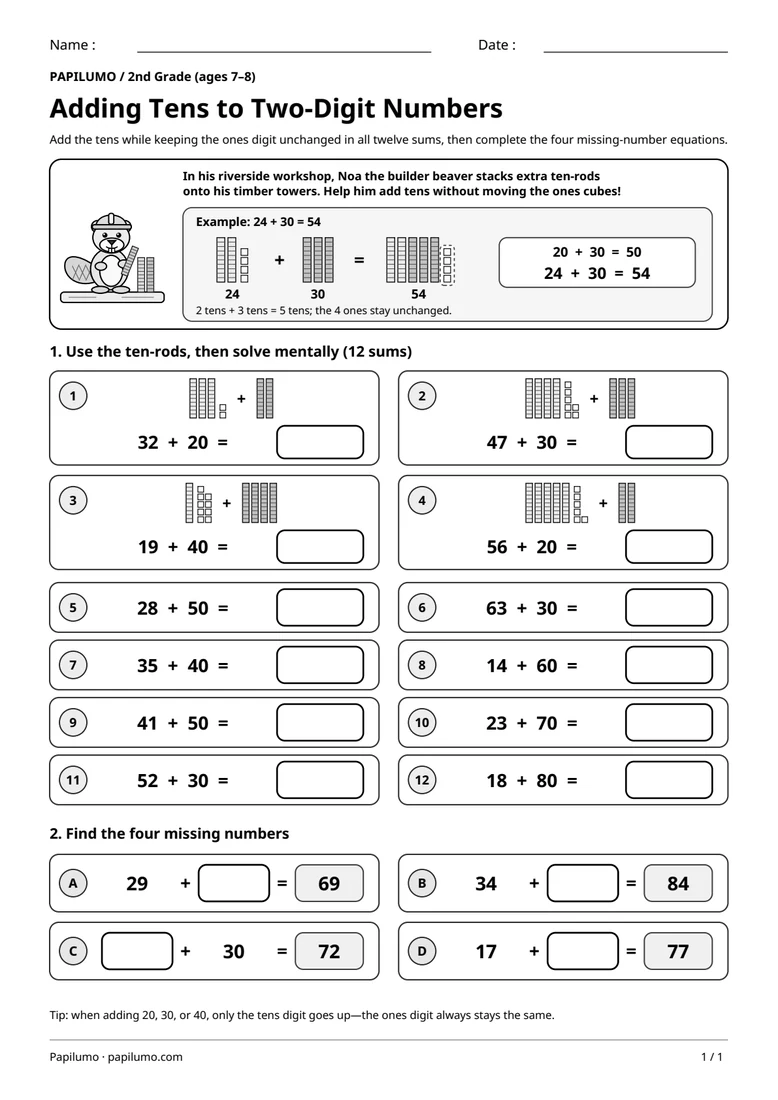
Use the follow-up to meet the same idea in a different setting. Offer it once the first task makes sense, without insisting that the whole page must be perfect. The child might explain a strategy, make an example or set a challenge for an adult. Return to the worksheet only when it helps connect the two situations. A short conversation or a practical activity can be enough to finish the session. To continue exploring, use Adding Tens to Two-Digit Numbers with Noa the Beaver: Add the tens while keeping the ones digit unchanged in all twelve sums, then complete the four missing-number equations.
Downloading and printing the PDF
This free PDF contains one worksheet designed for A4 paper. Download the file using the button on this page and open it in your PDF reader. Choose actual size or a 100% scale, check the orientation in the print preview and turn off any browser headers or footers. The illustrations use vector lines, so their outlines stay sharp when printed. Check the margins on one copy before preparing several sheets for a group. The level shown on the page is a guide, rather than a requirement to complete the activity at a particular age.