What this worksheet helps children practise
Add the two numbers you already know first, then count by tens up to the target!
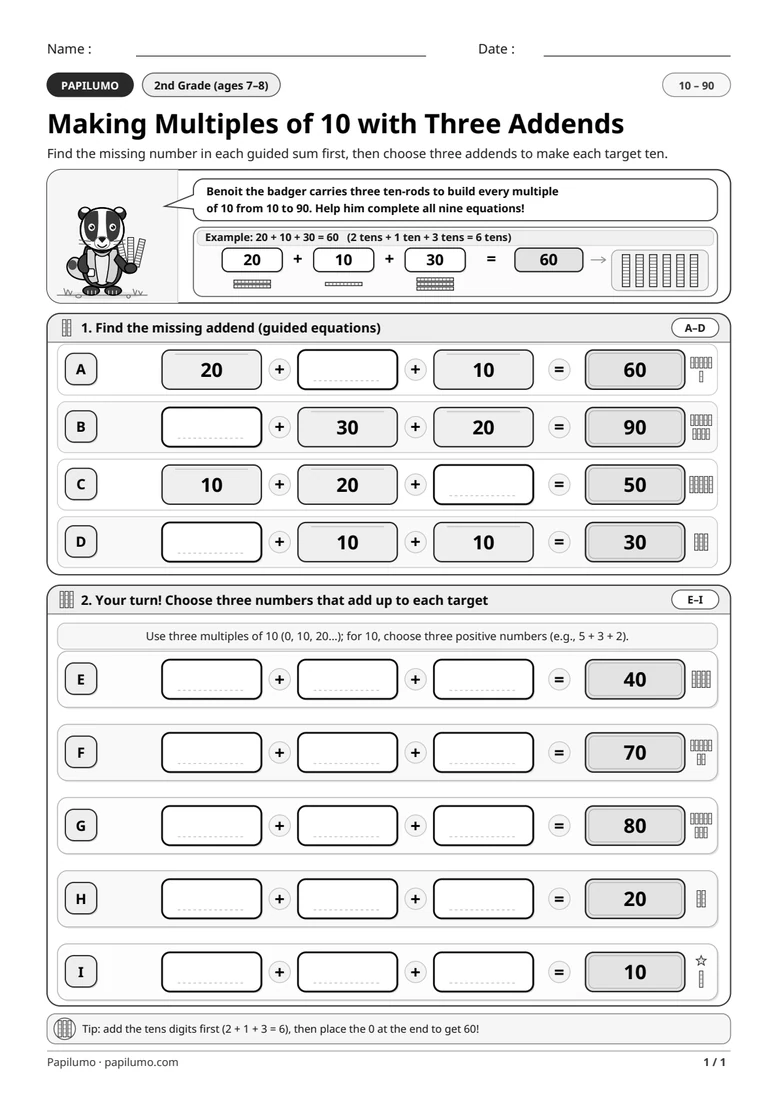
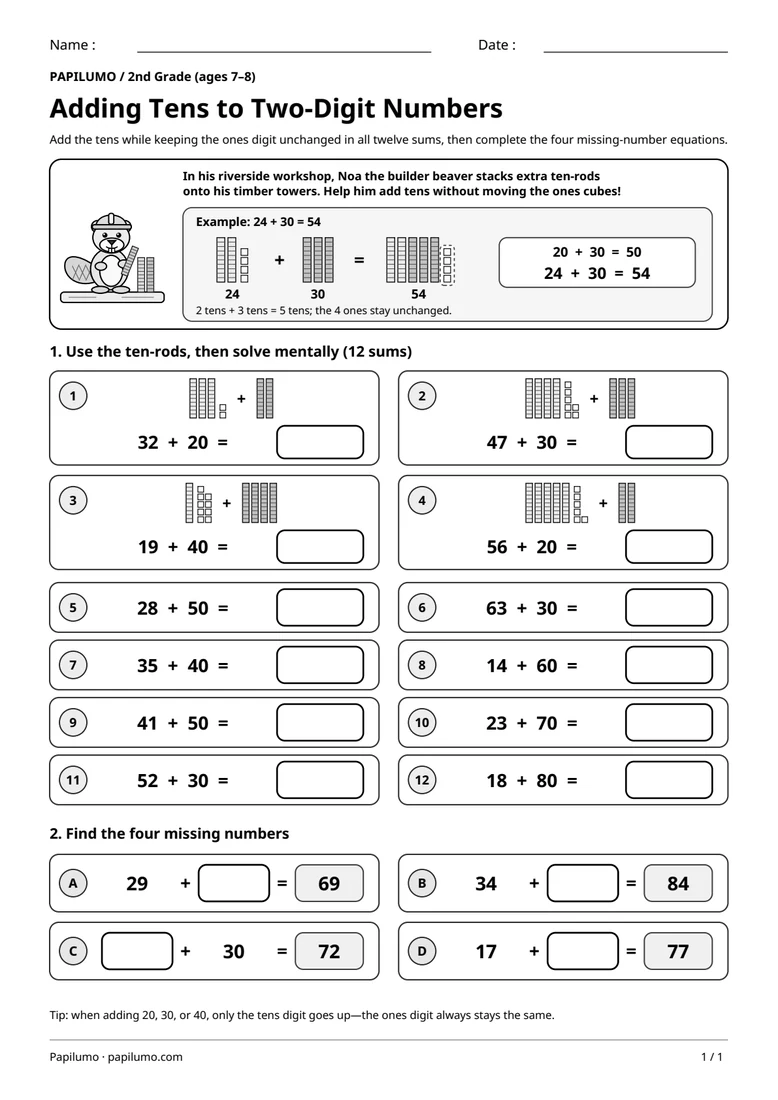
Solving and inventing three-term additions equal to multiples of 10 strengthens place-value reasoning and mental addition fluency in 2nd grade. Working directly with benchmark tens such as 10, 20, 30, and 40 helps students recognize that adding 20 + 10 + 30 works just like combining 2 tens + 1 ten + 3 tens to make 6 tens, or 60. Linking single-digit addition facts within 9 to multiples of 10 up to 90 builds flexible number decomposition, associative grouping, and reliable mental checking. For a related skill, use Adding Tens to Two-Digit Numbers with Noa the Beaver: Add the tens while keeping the ones digit unchanged in all twelve sums, then complete the four missing-number equations.
Preparing a short session
Print the student worksheet at actual size (100%) on plain white letter or A4 paper without shrinking page margins, and provide a sharpened pencil with an eraser. Before filling in any box, read the top worked example beside Benoit the badger together: count the tens in 20 + 10 + 30 = 60 by grouping 20 + 10 = 30 first and then adding 30 + 30 = 60. Keep the separate answer key tucked out of sight while learners invent their own valid decompositions in Part 2.
A concrete example to get started
Inside the top example panel, students see the complete strategy at a glance: three addend boxes combine to equal the target total 60 through 20 + 10 + 30. Adding the two known terms first (20 + 10 = 30) turns the puzzle into a simple missing-part step from 30 up to 60, giving 30. Modeling this two-step grouping prevents slow finger counting by ones and prepares children cleanly for both the guided missing-addend problems and the five open-ended target equations directly below.
Supporting the activity
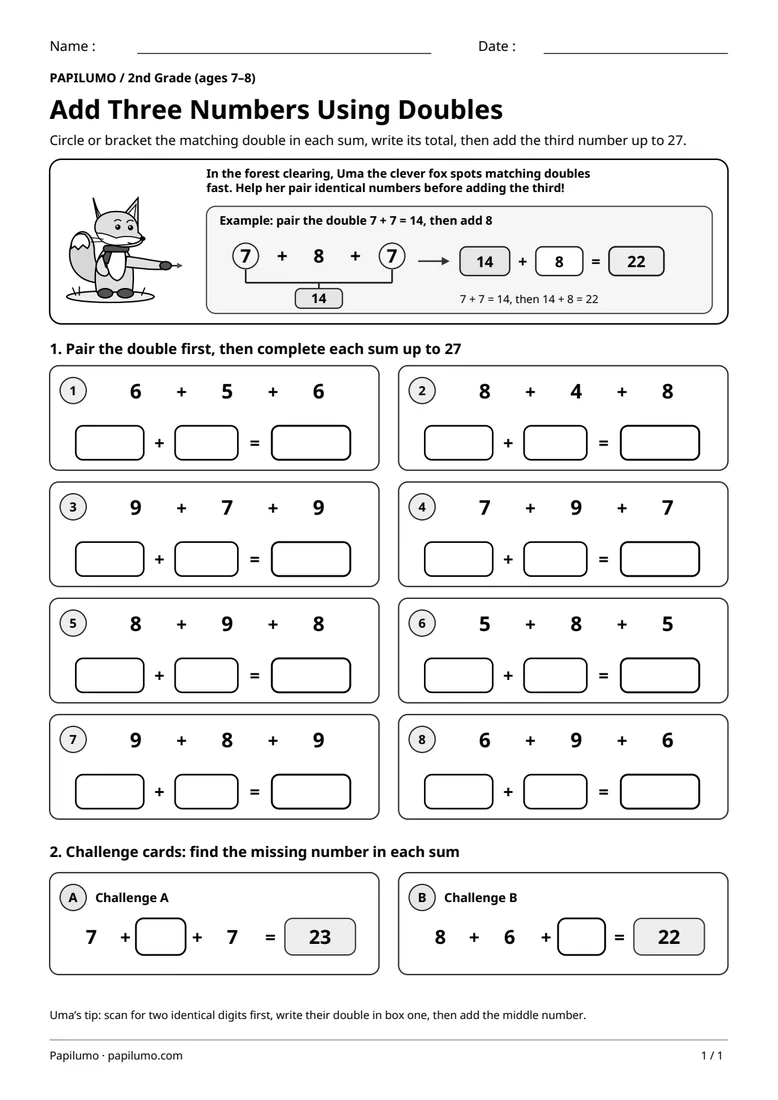
In Part 1 (rows A through D), learners find one missing addend per equation: 20 + [30] + 10 = 60, [40] + 30 + 20 = 90, 10 + 20 + [20] = 50, and [10] + 10 + 10 = 30. In Part 2 (rows E through I), they select three addends to reach 40, 70, 80, 20, and 10—for instance 10 + 10 + 20 = 40, 20 + 20 + 30 = 70, 30 + 20 + 30 = 80, 10 + 10 + 0 = 20, and 5 + 3 + 2 = 10. Every open equation accepts multiple valid three-number solutions. To vary the practice, try Add Three Single-Digit Numbers Using Doubles: Circle or bracket the matching double in each sum, write its total, then add the third number up to 27.
What to notice and how to check
When checking work with the separate PDF answer key, verify the four unique answers in Part 1 first (30, 40, 20, 10), then check Part 2 sums carefully: any trio of numbers that truly totals the target number is completely correct, even when it differs from the labeled sample solutions (“Ex.:”). If any sum lands ten away from the target, ask your learner to add the first two boxes aloud before adding the third.
Making the task easier
Draw quick ten-sticks beside the row: for 60, sketch 6 sticks and see how many more you still need.
Keep the learning aim, but reduce how much the child has to handle at once. Cover part of the page with another sheet and reveal one task at a time. Demonstrate a separate example, then leave a real opportunity to work something out. An answer reached with support is still a useful attempt; it does not yet show that the same task can be completed independently.
Taking the idea beyond the worksheet
For row E (40) or row G (80), find two other different ways to build the same target with three numbers.
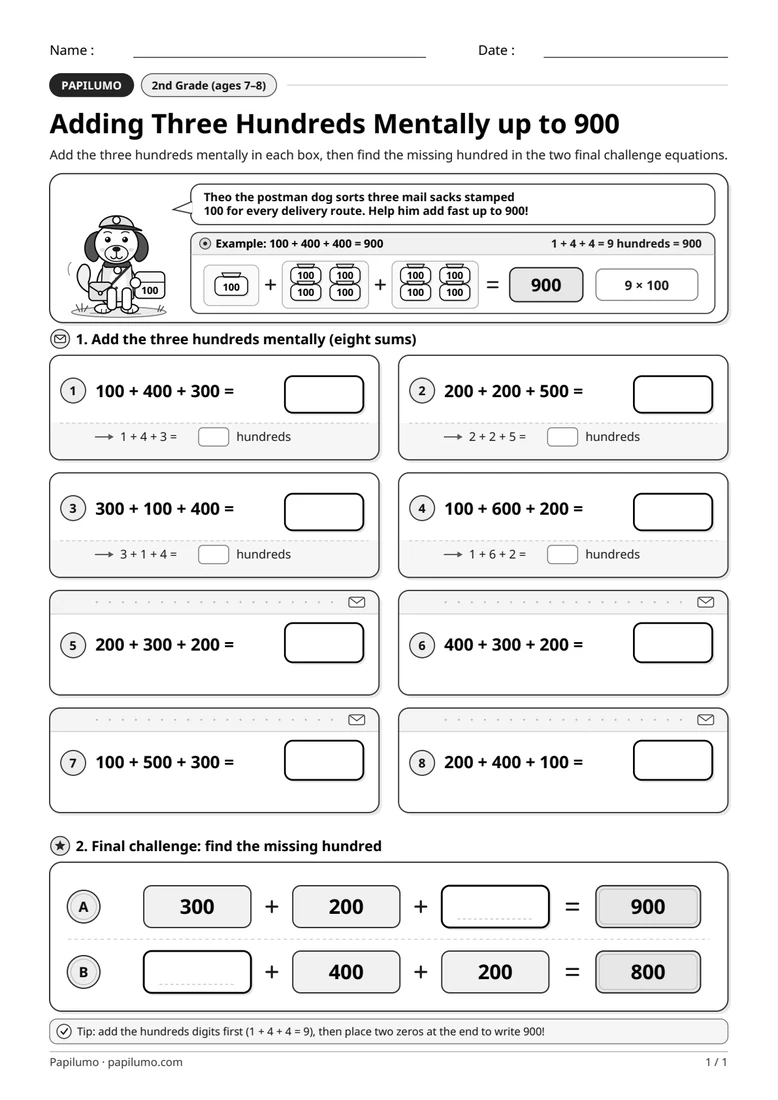
Use the follow-up to meet the same idea in a different setting. Offer it once the first task makes sense, without insisting that the whole page must be perfect. The child might explain a strategy, make an example or set a challenge for an adult. Return to the worksheet only when it helps connect the two situations. A short conversation or a practical activity can be enough to finish the session. To continue exploring, use Mental Addition of Three Hundreds up to 900 with Theo the Dog: Add the three hundreds mentally in each box, then find the missing hundred in the two final challenge equations.
Downloading and printing the PDF
This free PDF contains one worksheet designed for A4 paper. Download the file using the button on this page and open it in your PDF reader. Choose actual size or a 100% scale, check the orientation in the print preview and turn off any browser headers or footers. The illustrations use vector lines, so their outlines stay sharp when printed. Check the margins on one copy before preparing several sheets for a group. The level shown on the page is a guide, rather than a requirement to complete the activity at a particular age.