
What this worksheet helps children practise
Start every line at the bold black dot and keep your wrist relaxed as you cross each trellis diamond!
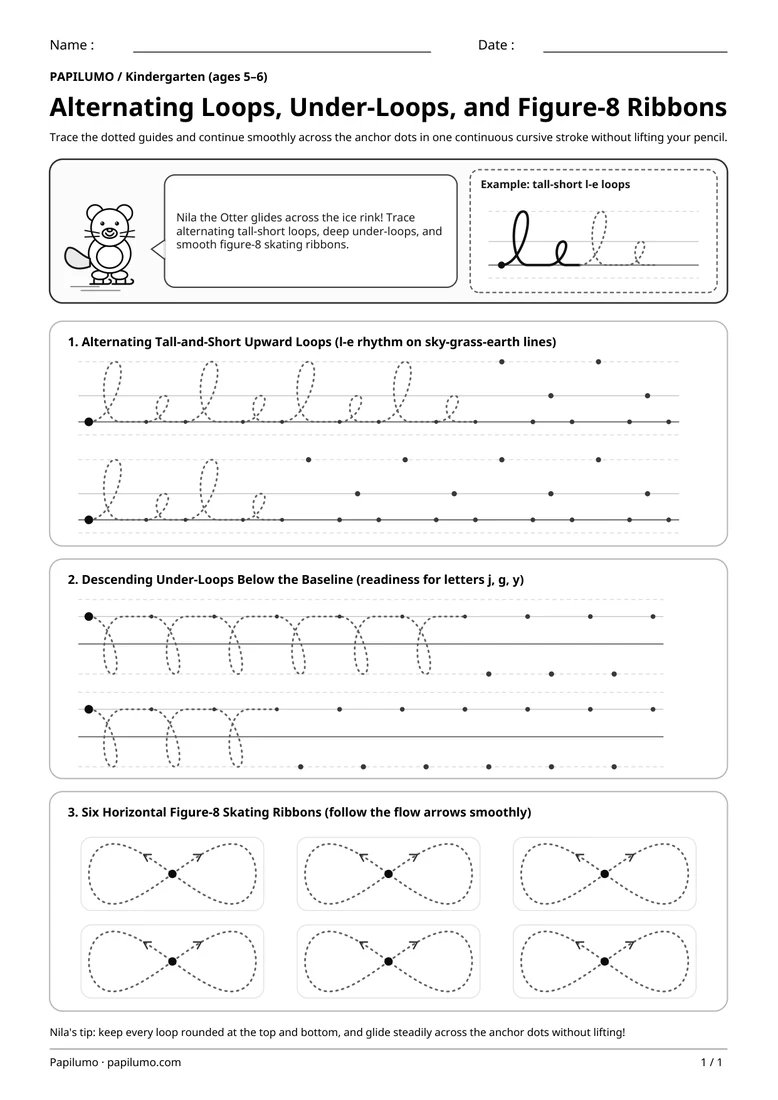
In Pre-K, transitioning from simple straight lines to intersecting diagonal paths builds essential spatial awareness, steady visual tracking, and directional wrist control. Tracing one full set of left-to-right slant bars and then crossing them cleanly with right-to-left diagonals strengthens parallel spacing, even hand pressure, and accurate line intersections. Meanwhile, alternating vertical sides and sharp peaks on the pointed picket fence sharpens corner stops, the V-shaped bunting pennants train smooth oblique pivots, and the oval stepping stones reinforce curved shape closure and alternating size perception across the full garden page. For a related skill, use Pre-Cursive Alternating Loops, Under-Loops, and Figure-8 Ribbons with Nila (Kindergarten): Trace the dotted guides and continue smoothly across the anchor dots in one continuous cursive stroke without lifting your pencil.
Preparing a short session
Print the student page at actual size (100%) on sturdy white A4 paper and sit together at a bright, clear table with a sharp triangular pencil or medium-tip washable marker. Keep the separate one-page answer key PDF tucked neatly out of sight during tracing. Before putting pencil to paper, talk through the four garden structures together: the wooden trellis for climbing vines, the backyard picket fence, the festive triangular pennant flags, and the curved stone border. Have your child trace one band slowly with a pointer finger from each bold start dot.
A concrete example to get started
Inside the rounded top banner beside Lumi holding his little garden trowel, a crisp speech bubble presents the story right above a worked two-diamond trellis cross-hatch model inside a miniature wooden frame. Solid black intersecting diagonals clearly show how upward and downward slanted bars cross at neat vertices to create two tidy diamond openings. Bold start dots at the top ends reveal exactly where the pencil begins, helping four- and five-year-olds grasp the two-direction cross-hatching pattern immediately before they begin Band 1 below.
Supporting the activity
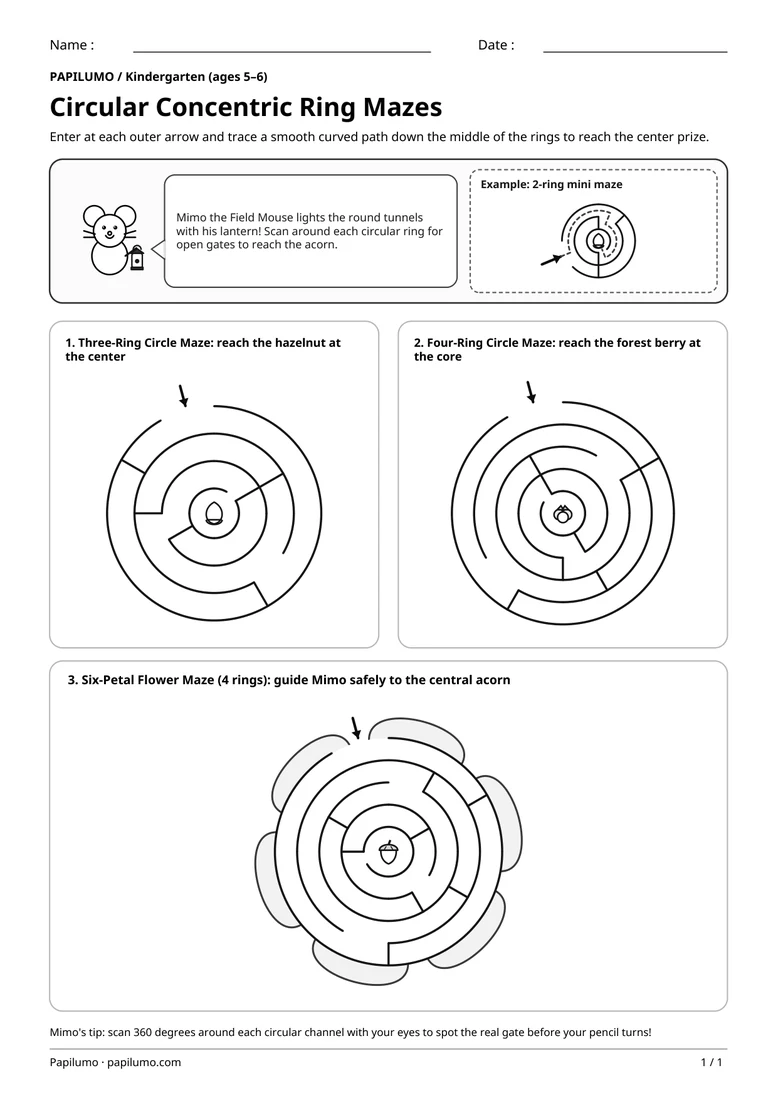
Four full-width horizontal garden bands guide young writers through a balanced, confidence-building graphisme progression from top to bottom. Band 1 presents a wide wooden trellis frame filled with dotted left-to-right and right-to-left diagonals ready to cross into crisp garden diamonds. Band 2 offers seven repeating peaked picket slats resting neatly across two long horizontal crossbars. Band 3 suspends six V-shaped triangular pennant flags along a gentle curved cord. Finally, Band 4 winds softly across the lower garden border with alternating big and small oval stepping stones. To vary the practice, try Circular Concentric Ring Mazes: Guide Mimo to the Center (Kindergarten): Enter at each outer arrow and trace a smooth curved path down the middle of the rings to reach the center prize.
What to notice and how to check
When all four garden bands are complete, lay the separate solid-line answer key beside your child's worksheet to celebrate steady pencil control together. Verify calmly that the trellis bars intersect cleanly into closed diamonds, all seven pointed pickets and both horizontal crossbars are traced, the bunting cord holds six crisp triangular flags, and every big and small oval stone closes neatly along the winding path. Afterward, invite young artists to draw climbing leaves, add patterns to the bunting flags, or color Lumi's garden fence.
Making the task easier
Trace all the slanted bars going one way first, pause to shake out your fingers, then trace the crossing diagonals.
Keep the learning aim, but reduce how much the child has to handle at once. Cover part of the page with another sheet and reveal one task at a time. Demonstrate a separate example, then leave a real opportunity to work something out. An answer reached with support is still a useful attempt; it does not yet show that the same task can be completed independently.
Taking the idea beyond the worksheet
Decorate the six bunting flags with stripes or dots, or draw small garden flowers climbing up Lumi's wooden trellis.
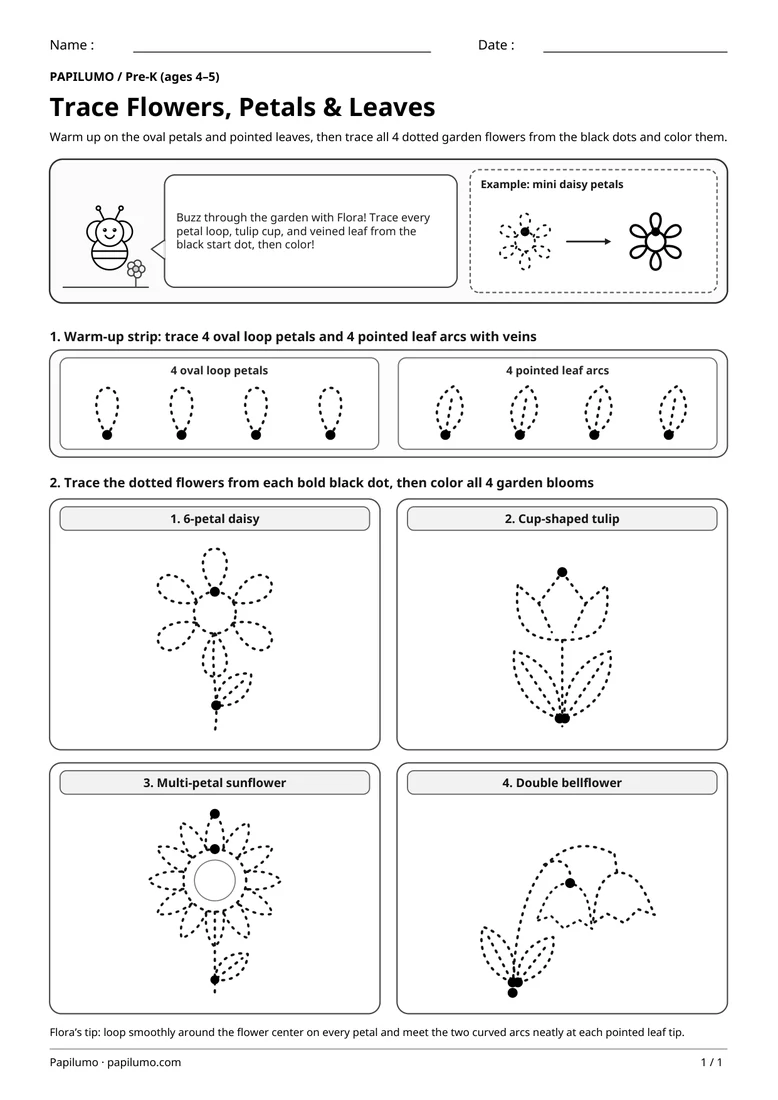
Use the follow-up to meet the same idea in a different setting. Offer it once the first task makes sense, without insisting that the whole page must be perfect. The child might explain a strategy, make an example or set a challenge for an adult. Return to the worksheet only when it helps connect the two situations. A short conversation or a practical activity can be enough to finish the session. To continue exploring, use Trace Flowers, Petals, and Leaves with Flora the Bee (Pre-K): Warm up on the oval petals and pointed leaves, then trace all 4 dotted garden flowers from the black dots and color them.
Downloading and printing the PDF
This free PDF contains one worksheet designed for A4 paper. Download the file using the button on this page and open it in your PDF reader. Choose actual size or a 100% scale, check the orientation in the print preview and turn off any browser headers or footers. The illustrations use vector lines, so their outlines stay sharp when printed. Check the margins on one copy before preparing several sheets for a group. The level shown on the page is a guide, rather than a requirement to complete the activity at a particular age.