
What this worksheet helps children practise
Look all the way around each ring with your eyes first so you know which gate leads closer to the center!
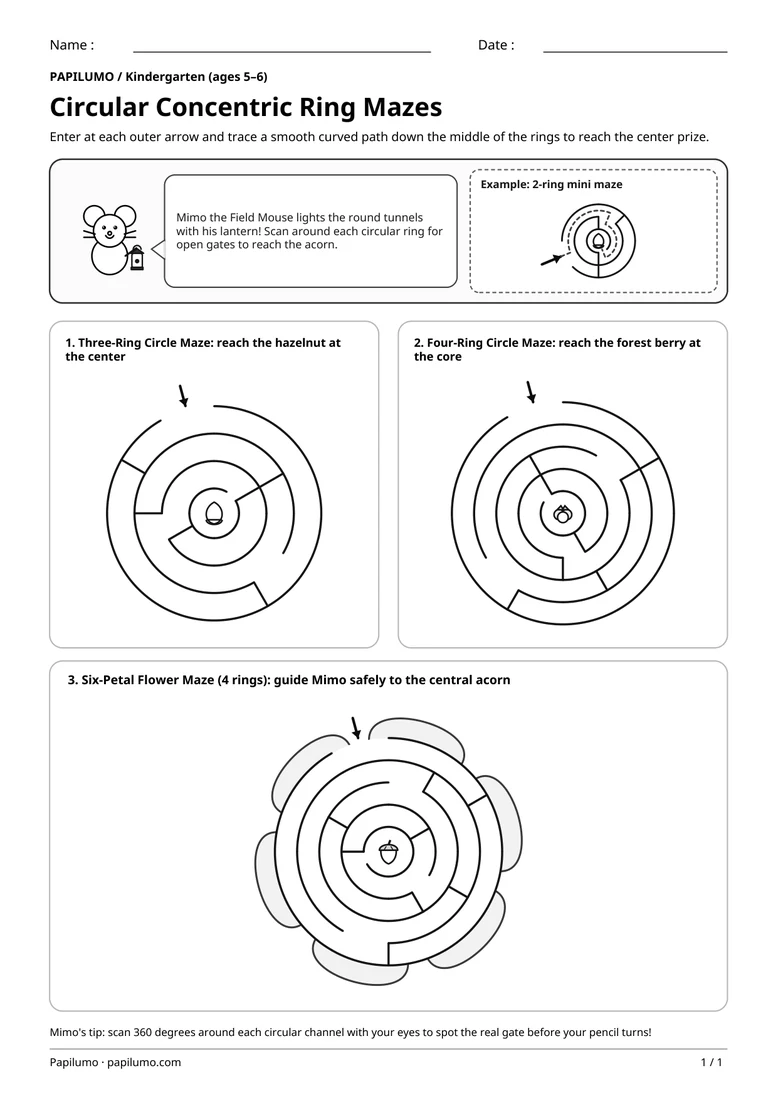
Navigating concentric circular ring mazes in Kindergarten builds smooth curved wrist control, full 360-degree visual scanning, and strategic impulse control around dead-end arcs. Rather than steering down straight horizontal or vertical hallways, five- and six-year-olds continuously adjust pencil curvature to stay centered between concentric ring walls while checking both clockwise and counterclockwise for the true inward radial opening. This full-circle planning sharpens spatial reasoning, sustained visual focus, patience, and careful self-checking before first grade. For a related skill, use One-Stroke Continuous Dot-to-Dot Figures Without Lifting the Pencil (Kindergarten): Begin at the circled START dot, follow the hint arrow, and trace each whole figure in one continuous stroke without retracing any line.
Preparing a short session
Print the student worksheet at actual size (100%) on plain white A4 paper and sit together at a clean, bright table with a sharpened graphite pencil or fine erasable marker. Keep the separate one-page answer key PDF neatly set aside while solving. Before tracing, look together at how concentric circles form curved ring lanes interrupted by radial divider walls and open gates, then invite your child to trace one complete route slowly with a pointer finger from the outer entry arrow inward.
A concrete example to get started
Inside the rounded top banner beside Mimo carrying his little explorer lantern, a cheerful speech bubble introduces the task right above a worked two-ring mini circular maze. A crisp outer entry arrow points through the outer ring gap, and a clean dashed curved trail winds smoothly around a short radial wall inward through the second opening straight to a tiny hazelnut resting in the middle. Young children immediately understand how circular gates and dead-end stops work before attempting the three larger puzzles below.
Supporting the activity
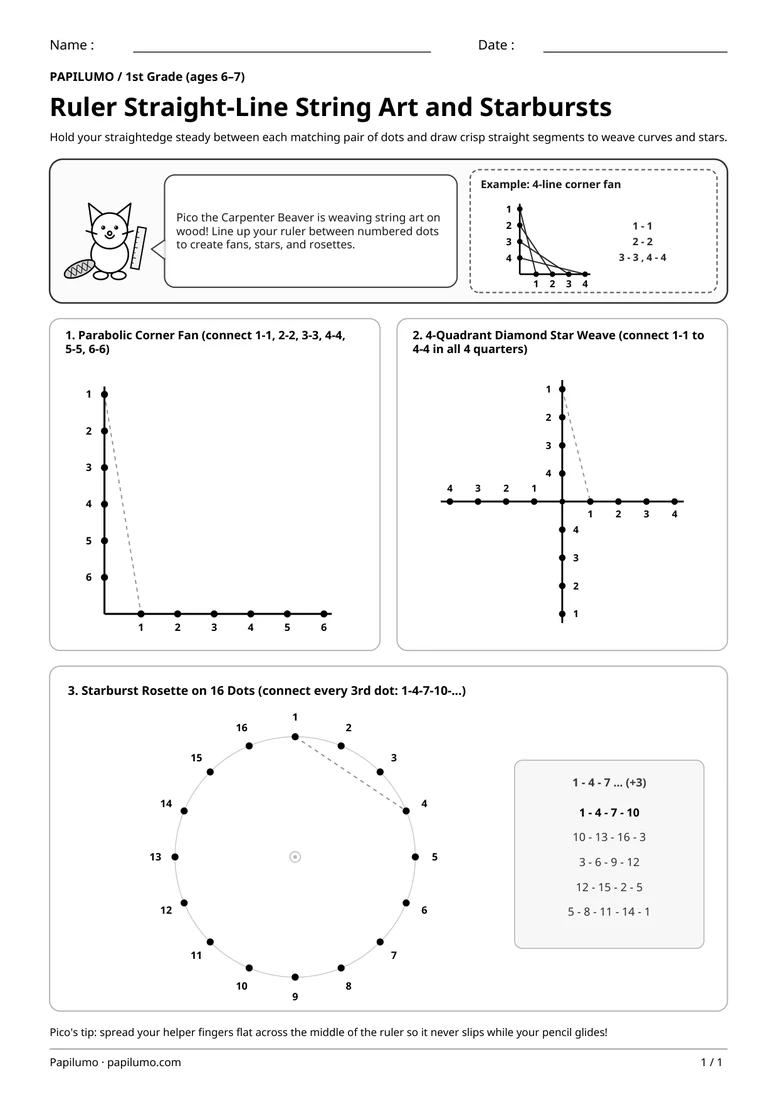
Three spacious circular mazes create a clear, confidence-building progression across the entire worksheet with plenty of open room for steady hands. Maze 1 features three concentric circular rings with two gentle dead-end arcs guiding young explorers inward to a crisp hazelnut. Maze 2 steps up to four concentric rings and three tricky dead-end turns on the way to a wild forest berry at the core. Below, wide Maze 3 frames four concentric rings inside a charming six-petal flower-shaped circular maze with four dead-end arcs leading Mimo safely all the way to the central acorn. To vary the practice, try Ruler Straight-Line String Art and Starbursts with Pico (1st Grade): Hold your straightedge steady between each matching pair of dots and draw crisp straight segments to weave curves and stars.
What to notice and how to check
Once all three circular ring mazes are solved, lay the separate bold-path answer key beside your child's worksheet to inspect every curved route together calmly and encouragingly. Verify step by step that each line enters cleanly at the outer entry arrow, glides smoothly down the middle of every open white ring lane without crossing any circular wall or radial divider, avoids every dead-end arc, and finishes neatly at the hazelnut, forest berry, and central acorn. Afterward, children can color the six-petal flower border, shade the concentric rings lightly, and brighten Mimo's cozy little explorer lantern with colorful crayons or pencils.
Making the task easier
Start with one finger on the center prize and trace backward outward to the entry arrow before picking up your pencil.
Keep the learning aim, but reduce how much the child has to handle at once. Cover part of the page with another sheet and reveal one task at a time. Demonstrate a separate example, then leave a real opportunity to work something out. An answer reached with support is still a useful attempt; it does not yet show that the same task can be completed independently.
Taking the idea beyond the worksheet
Shade each concentric ring in a different light pattern or color the six outer flower petals around Maze 3.
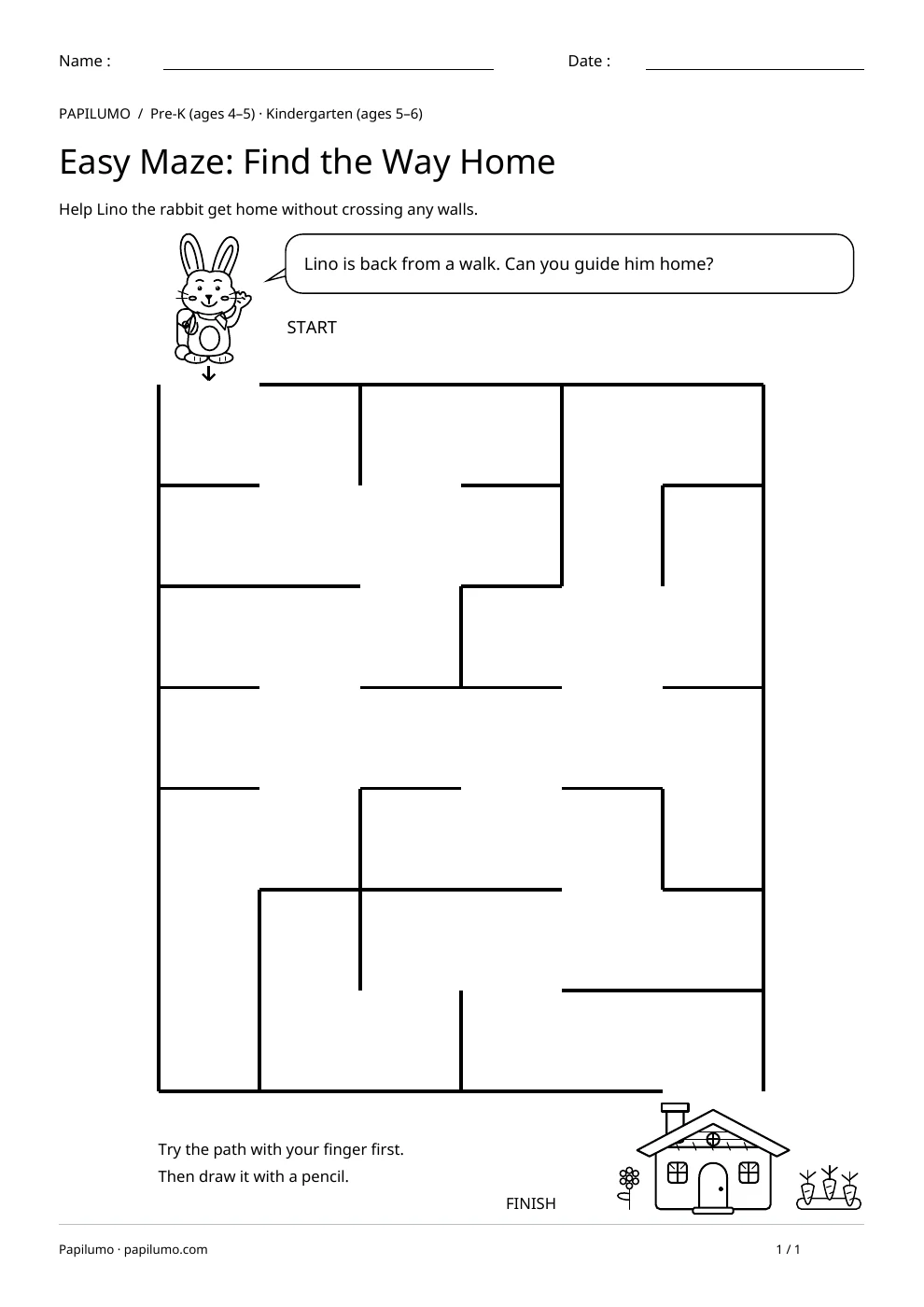
Use the follow-up to meet the same idea in a different setting. Offer it once the first task makes sense, without insisting that the whole page must be perfect. The child might explain a strategy, make an example or set a challenge for an adult. Return to the worksheet only when it helps connect the two situations. A short conversation or a practical activity can be enough to finish the session. To continue exploring, use Easy Maze: Find the Way Home: Help Lino the rabbit get home without crossing any walls.
Downloading and printing the PDF
This free PDF contains one worksheet designed for A4 paper. Download the file using the button on this page and open it in your PDF reader. Choose actual size or a 100% scale, check the orientation in the print preview and turn off any browser headers or footers. The illustrations use vector lines, so their outlines stay sharp when printed. Check the margins on one copy before preparing several sheets for a group. The level shown on the page is a guide, rather than a requirement to complete the activity at a particular age.