
What this worksheet helps children practise
Test the whole path with your finger from the START dot first before drawing a single pencil line!
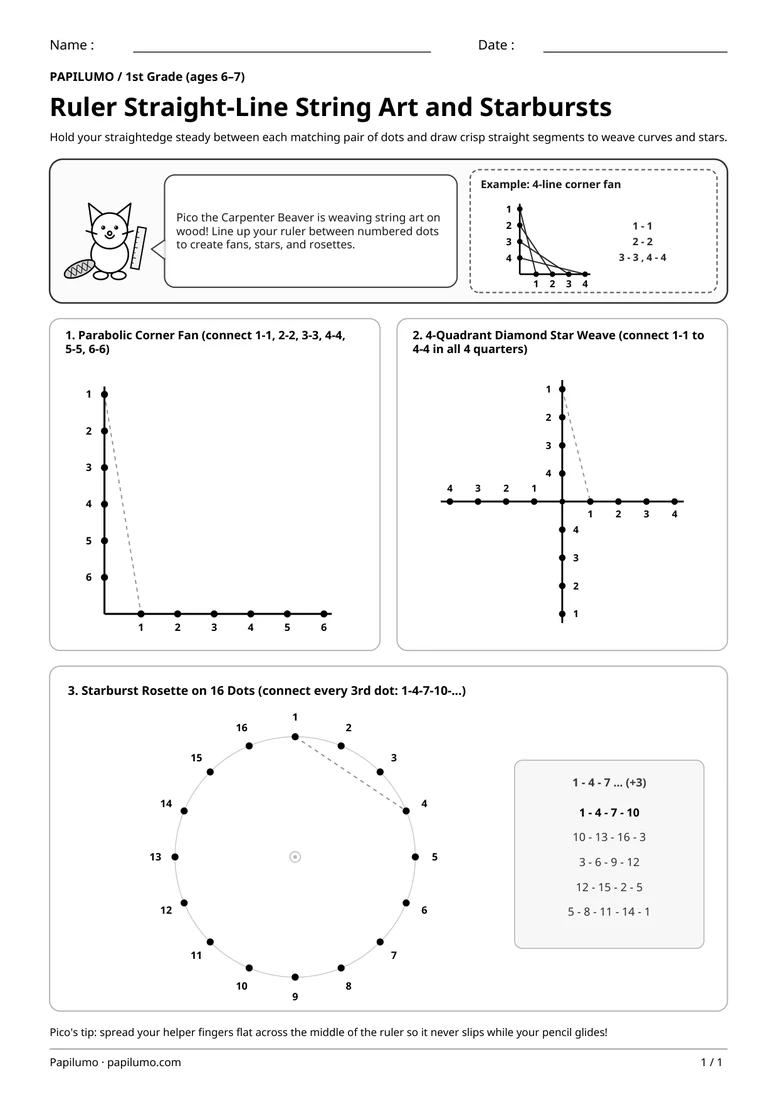
Tracing an uninterrupted Eulerian path through geometric figures in Kindergarten blends fine-motor fluency with genuine logical foresight. Instead of following rigid step-by-step numbers, five- and six-year-olds look closely at intersections and corners to plan which direction keeps all remaining segments reachable without doubling back or getting trapped. This thoughtful exercise strengthens multi-directional straight pencil lines, smooth angle pivots at bold vertices, working memory, sustained focus, and calm trial-and-error persistence while building early spatial problem-solving skills ahead of first grade. For a related skill, use Ruler Straight-Line String Art and Starbursts with Pico (1st Grade): Hold your straightedge steady between each matching pair of dots and draw crisp straight segments to weave curves and stars.
Preparing a short session
Print the student worksheet at actual size (100%) on smooth white A4 paper and sit together at a bright, uncluttered table with a sharpened graphite pencil and soft eraser or an erasable fine pen. Keep the separate one-page answer key PDF neatly tucked away while solving. Before touching pencil to paper, explain the single golden rule clearly: start right on the circled START dot, follow the small hint arrow along the very first segment, and test the complete route with a pointer finger first so every dotted segment is crossed once.
A concrete example to get started
Inside the rounded top banner beside Cosmo the Astronomer Fox gesturing toward his constellation chart, a worked mini bowtie model demonstrates the exact one-stroke rule visually. Numbered vertices 1 through 5 alongside small directional segment arrows trace cleanly from the top-left corner down to bottom-left, across diagonally to top-right, straight down to bottom-right, and diagonally back to close at 1 without ever lifting the pencil or repeating an edge. Children immediately grasp how continuous vertex transitions work before solving the four challenges below.
Supporting the activity
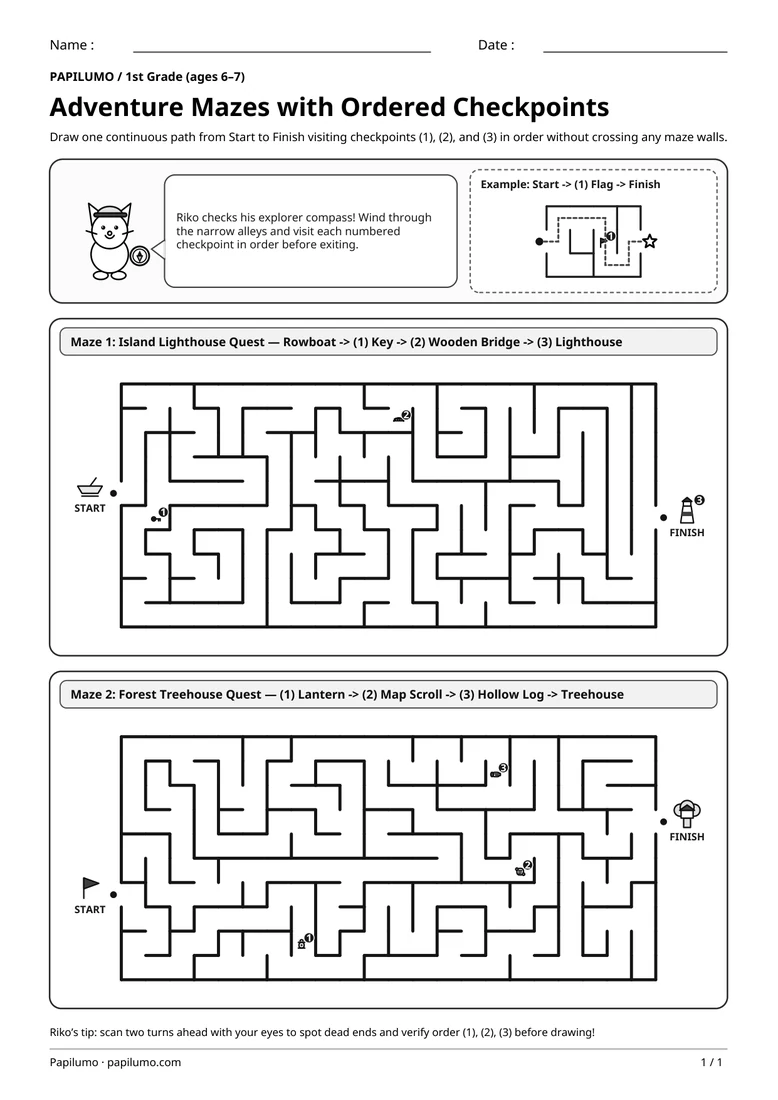
Four large framed challenge cards fill the page cleanly with generous spacing and crisp visual contrast. Each card displays the target figure in light dotted segments, bold black vertex dots, a circled START dot, and a subtle hint arrow on the opening segment. Card 1 presents the classic open envelope house with crossed interior diagonals. Card 2 invites children to trace a crisp five-pointed continuous star. Card 3 features an hourglass double-triangle bowtie meeting at a central waist vertex. Card 4 finishes with a geometric origami fish featuring a crossed tail. To vary the practice, try Multi-Path Adventure Mazes with Ordered Checkpoints with Riko (1st Grade): Draw one continuous path from Start to Finish visiting checkpoints (1), (2), and (3) in order without crossing any maze walls.
What to notice and how to check
When all four one-stroke puzzles are complete, set the separate solid-line answer key beside your child's sheet to verify each continuous path together calmly. The answer key displays all four figures in crisp solid black lines alongside subtle numbered vertex steps (1, 2, 3...) confirming a valid uninterrupted path with zero retraced edges. Celebrate every crisp corner and straight line, and invite eager solvers to try drawing the five-pointed star or origami fish freehand on blank scratch paper afterward without dotted guides.
Making the task easier
Trace each figure twice with your pointer finger, pausing briefly at every bold vertex dot to look where to turn next.
Keep the learning aim, but reduce how much the child has to handle at once. Cover part of the page with another sheet and reveal one task at a time. Demonstrate a separate example, then leave a real opportunity to work something out. An answer reached with support is still a useful attempt; it does not yet show that the same task can be completed independently.
Taking the idea beyond the worksheet
Try drawing the continuous five-pointed star on blank paper without dotted guides using the same one-stroke sequence.
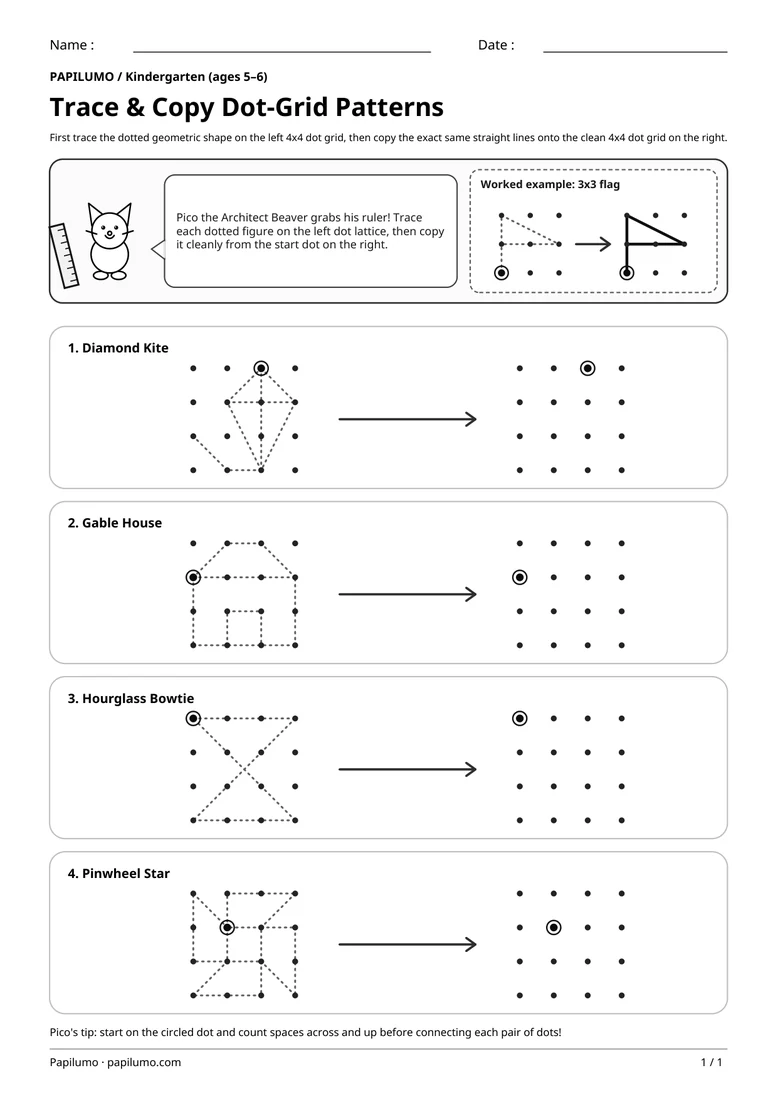
Use the follow-up to meet the same idea in a different setting. Offer it once the first task makes sense, without insisting that the whole page must be perfect. The child might explain a strategy, make an example or set a challenge for an adult. Return to the worksheet only when it helps connect the two situations. A short conversation or a practical activity can be enough to finish the session. To continue exploring, use Trace and Copy Dot-Grid Geometric Patterns with Pico (Kindergarten): First trace the dotted geometric shape on the left 4x4 dot grid, then copy the exact same straight lines onto the clean 4x4 dot grid on the right.
Downloading and printing the PDF
This free PDF contains one worksheet designed for A4 paper. Download the file using the button on this page and open it in your PDF reader. Choose actual size or a 100% scale, check the orientation in the print preview and turn off any browser headers or footers. The illustrations use vector lines, so their outlines stay sharp when printed. Check the margins on one copy before preparing several sheets for a group. The level shown on the page is a guide, rather than a requirement to complete the activity at a particular age.