What this worksheet helps children practise
Always count places from right to left (O, T, H, Th) and write a 0 whenever a base-10 column is empty!
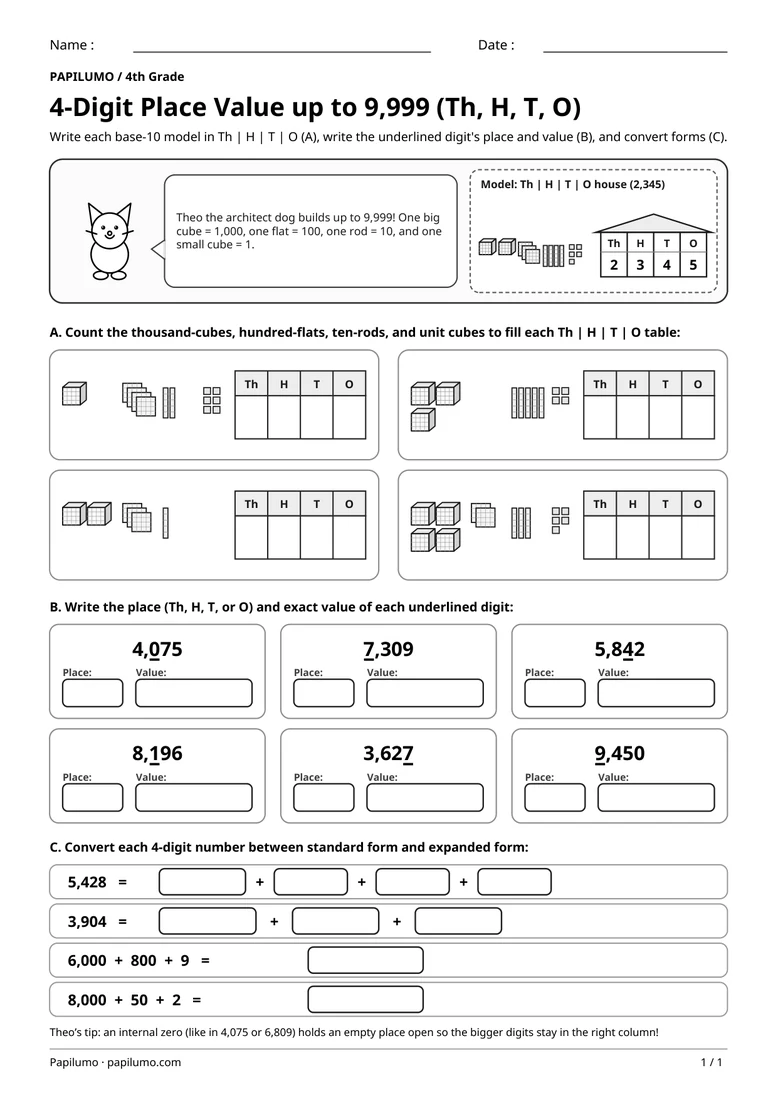
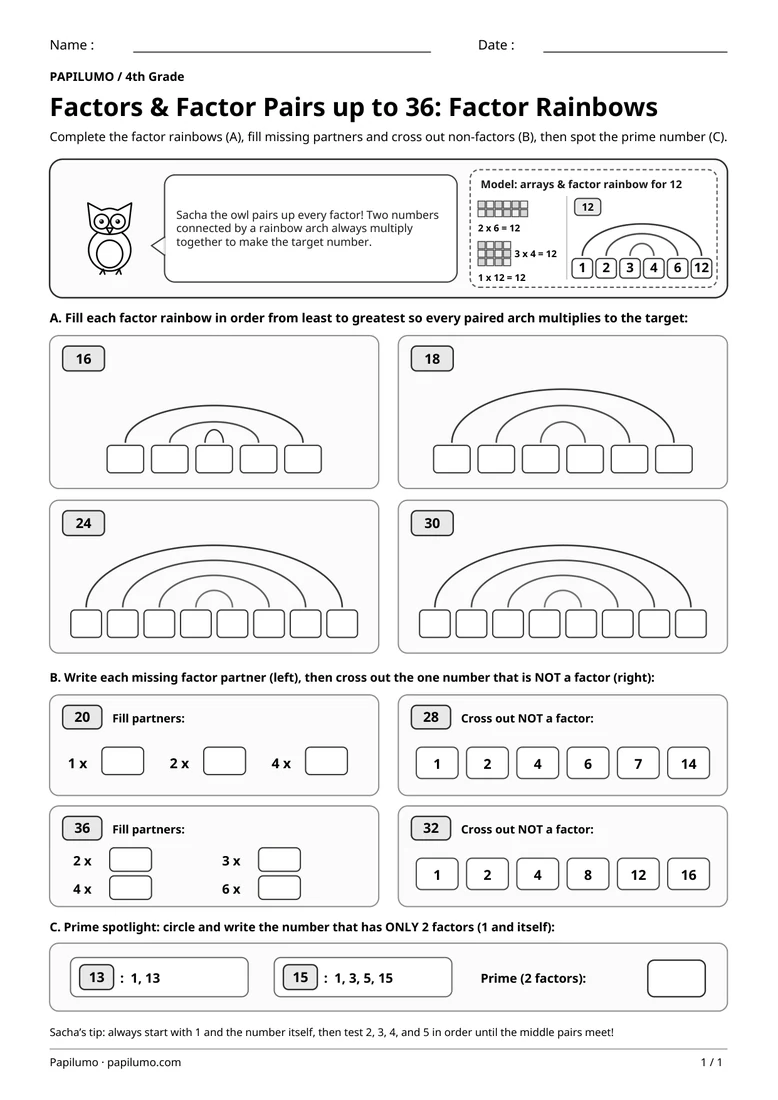
Building 4-digit place-value fluency up to 9,999 in 4th Grade extends base-ten reasoning cleanly beyond the 999 ceiling and prepares students for multi-digit operations, rounding, and numbers into the millions. By reading 3D thousand-cubes alongside flats, rods, and ones, learners grasp concretely that ten hundreds bundle into one thousand. Equally vital, practicing internal zero placeholders—such as in 3,054, 4,075, and 6,809—prevents students from collapsing four-digit numbers into three-digit ones when writing expanded or standard forms. For a related skill, use Factors and Factor Pairs up to 36: Factor Rainbows with Sacha (4th Grade): Complete the factor rainbows (A), fill missing partners and cross out non-factors (B), then spot the prime number (C).
Preparing a short session
Print the student worksheet at 100% actual size on crisp white A4 paper without shrinking margins, and provide a sharpened pencil along with a clean eraser. Keep the separate one-page answer key PDF neatly out of sight until all three parts are completely finished. Before starting, verify together aloud what each drawn base-10 piece represents: a big 3D cube equals 1,000, a square grid flat equals 100, a slim ten-rod equals 10, and a small single unit cube equals 1 one, noting that zero means skipping that piece.
A concrete example to get started
Inside the top banner beside Theo the architect dog, the worked example connects visual base-10 blocks for 2,345 directly to a four-column Th | H | T | O place-value house under a pitched roof. Two 3D thousand-cubes, three hundred-flats, four ten-rods, and five unit cubes line up cleanly right beside the digits 2, 3, 4, and 5 under Th, H, T, and O. This clear visual model demonstrates immediately how physical block counts translate smoothly into standard four-digit place-value notation.
Supporting the activity
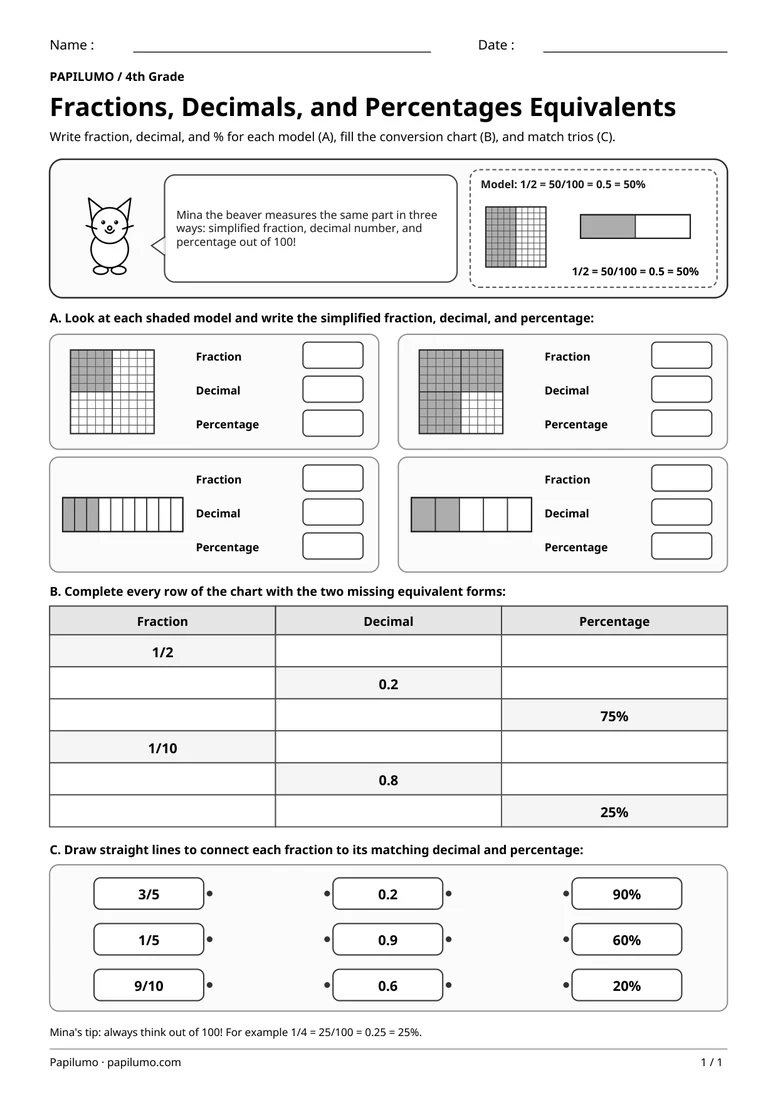
Part A features four visual base-10 block collections to record cleanly inside Th | H | T | O place-value tables: 1,426, 3,054 (with zero hundred-flats), 2,310 (with zero unit cubes), and 4,235. Part B tests six underlined digits across varied positions: 4,075 (underlined 0 is H, value 0), 7,309 (7 is Th, value 7,000), 5,842 (4 is T, value 40), 8,196 (1 is H, value 100), 3,627 (7 is O, value 7), and 9,450 (9 is Th, value 9,000). Part C converts 5,428, 3,904, 6,000 + 800 + 9, and 8,000 + 50 + 2. To vary the practice, try Fractions, Decimals, and Percentages Equivalents with Mina the Beaver: Write fraction, decimal, and % for each model (A), fill the conversion chart (B), and match trios (C).
What to notice and how to check
When the sheet is completely done, place the separate one-page answer key next to your child’s worksheet to check every table, underlined digit value, and form conversion calmly together. In Part A, confirm carefully that 3,054 and 2,310 include a clear 0 in the empty column rather than shifting digits left. In Part B, verify that the underlined 0 in 4,075 lists H and 0 while 7 in 7,309 lists Th and 7,000. In Part C, check 5,428, 3,904, 6,809, and 8,052 cleanly without skipping zeros.
Making the task easier
Write the partial value next to each block group first (like 3,000 and 50 and 4) before filling the Th | H | T | O table.
Keep the learning aim, but reduce how much the child has to handle at once. Cover part of the page with another sheet and reveal one task at a time. Demonstrate a separate example, then leave a real opportunity to work something out. An answer reached with support is still a useful attempt; it does not yet show that the same task can be completed independently.
Taking the idea beyond the worksheet
Create two original 4-digit numbers with a zero in a different internal place, then write both in expanded form.
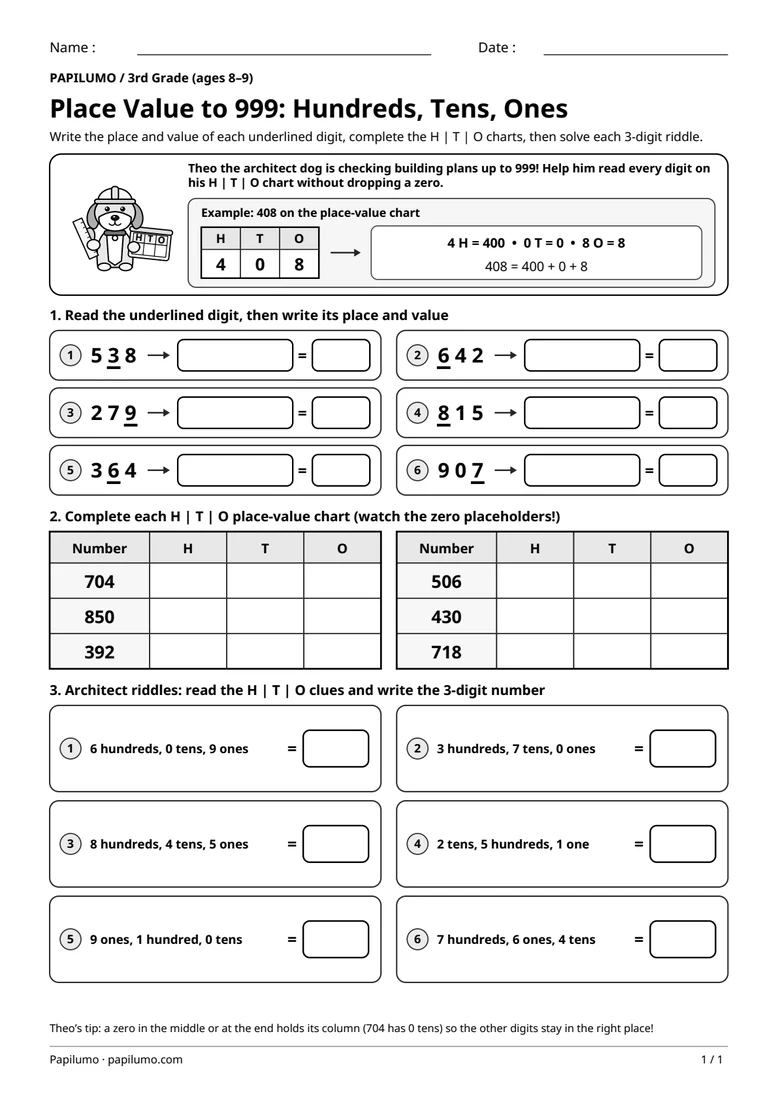
Use the follow-up to meet the same idea in a different setting. Offer it once the first task makes sense, without insisting that the whole page must be perfect. The child might explain a strategy, make an example or set a challenge for an adult. Return to the worksheet only when it helps connect the two situations. A short conversation or a practical activity can be enough to finish the session. To continue exploring, use Hundreds, Tens, and Ones up to 999 with Theo the Architect Dog: Write the place and value of each underlined digit, complete the H | T | O charts, then solve each 3-digit riddle.
Downloading and printing the PDF
This free PDF contains one worksheet designed for A4 paper. Download the file using the button on this page and open it in your PDF reader. Choose actual size or a 100% scale, check the orientation in the print preview and turn off any browser headers or footers. The illustrations use vector lines, so their outlines stay sharp when printed. Check the margins on one copy before preparing several sheets for a group. The level shown on the page is a guide, rather than a requirement to complete the activity at a particular age.