

What this worksheet helps children practise
Test candidate factors in order (1, 2, 3, 4, 5...) and check that every connected arch pair multiplies back to the target!
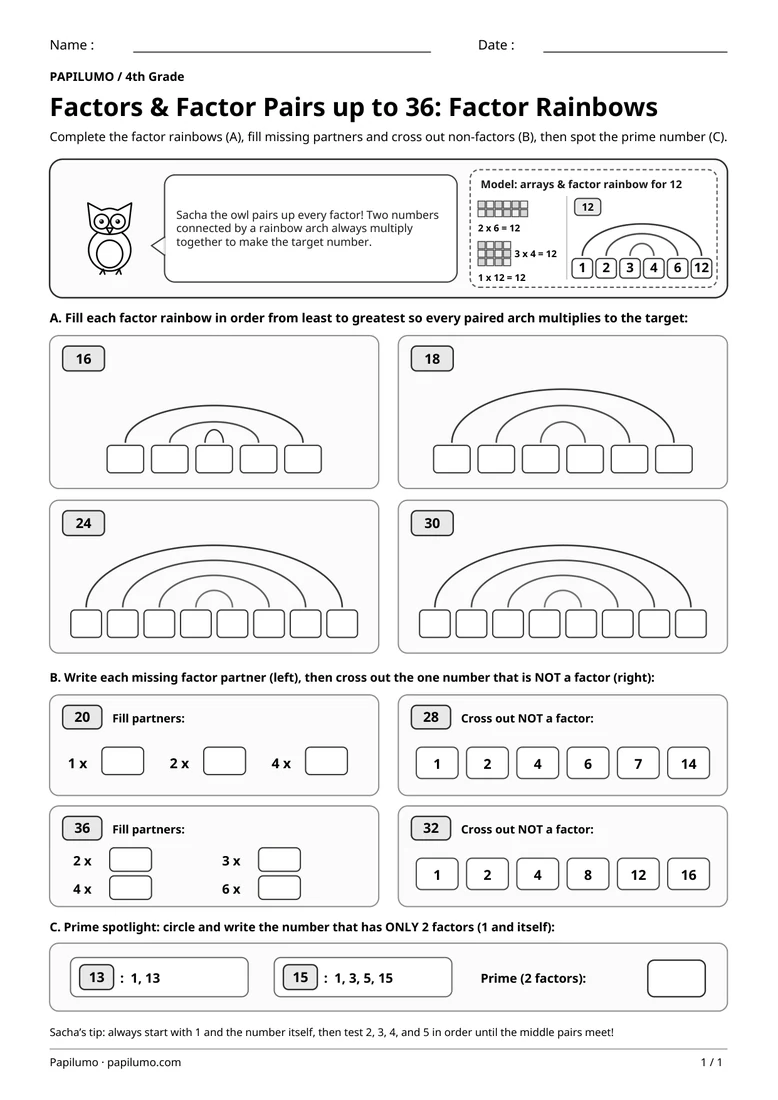
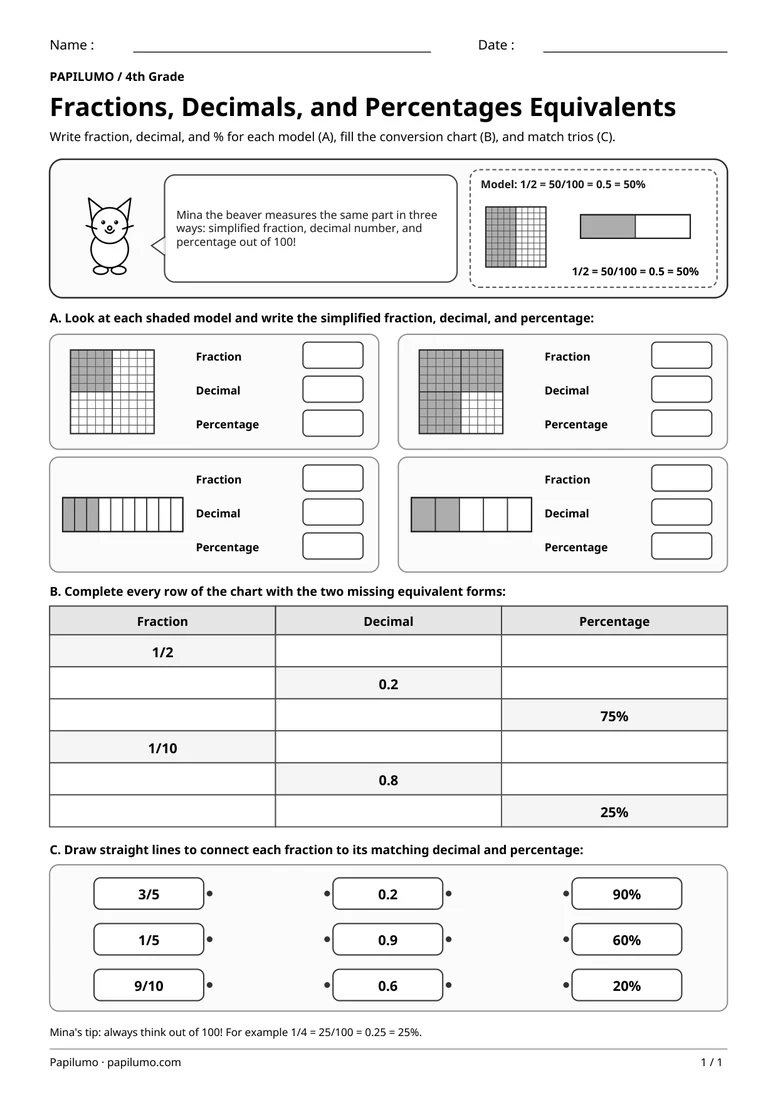
Finding every factor of a whole number in 4th Grade connects multiplication facts directly to exact division, rectangular area models, and future fraction simplification. Rather than guessing factors out of order, the factor-rainbow method teaches learners to test candidate divisors systematically from 1 upward while recording each matching partner on the far right. When both ends meet cleanly in the middle—such as 4 x 4 for the square number 16—students know with mathematical certainty that no factor was missed along the way. For a related skill, use Fractions, Decimals, and Percentages Equivalents with Mina the Beaver: Write fraction, decimal, and % for each model (A), fill the conversion chart (B), and match trios (C).
Preparing a short session
Print the student worksheet at 100% actual size on crisp white A4 paper without shrinking margins, and prepare a sharpened pencil along with a clean eraser. Keep the separate one-page answer key PDF tucked out of sight until all three parts are completely finished. Before beginning, review aloud how to check divisibility systematically: start with 1 times the number itself, then test calmly whether 2, 3, 4, 5, or 6 divides the target evenly with zero remainder.
A concrete example to get started
Inside the top banner beside Sacha the owl, two grid arrays for 2 x 6 and 3 x 4 show concretely why 2, 3, 4, and 6 divide 12 evenly into equal rows. Directly beside the arrays, the factor rainbow for 12 displays all six factors in ascending order (1, 2, 3, 4, 6, 12) linked by three concentric arches: 1 with 12, 2 with 6, and 3 with 4. This worked guide builds immediate confidence before Part A begins.
Supporting the activity
Part A features four factor rainbows to complete cleanly in ascending order: 16 (1, 2, 4, 8, 16), 18 (1, 2, 3, 6, 9, 18), 24 (1, 2, 3, 4, 6, 8, 12, 24), and 30 (1, 2, 3, 5, 6, 10, 15, 30). Part B asks learners to complete missing partners for 20 (20, 10, and 5) and 36 (18, 12, 9, and 6), then cross out the single non-factor in 28 (cross out 6) and 32 (cross out 12). Finally, Part C compares factor lists for 13 and 15. To vary the practice, try Equal Quantities & One-to-One Pairing (1 to 4) with Leo the Bunny: Draw 1-to-1 lines from animals to treats and circle a badge, then match each basket to its equal dot card.
What to notice and how to check
When the entire worksheet is finished, lay the separate one-page answer key beside your child’s page to review every rainbow arch, factor pair, and crossed-out number calmly together. In Part A, confirm all factor lists run strictly from least to greatest without duplicates or gaps, noting that square number 16 places single factor 4 right in the center. In Part B, verify 20, 10, 5 and 18, 12, 9, 6 alongside crossed-out non-factors 6 and 12. In Part C, confirm prime 13 and discuss why composite 15 has four factors—an ideal bridge toward upcoming division fluency, prime factorization, and simplifying fractions in upper elementary math.
Making the task easier
Write 1 in the leftmost box and the target number in the rightmost box of each rainbow first before testing 2 and 3.
Keep the learning aim, but reduce how much the child has to handle at once. Cover part of the page with another sheet and reveal one task at a time. Demonstrate a separate example, then leave a real opportunity to work something out. An answer reached with support is still a useful attempt; it does not yet show that the same task can be completed independently.
Taking the idea beyond the worksheet
Draw your own complete factor rainbow for 36 on scrap paper and explain why it has an odd number of factors.
Use the follow-up to meet the same idea in a different setting. Offer it once the first task makes sense, without insisting that the whole page must be perfect. The child might explain a strategy, make an example or set a challenge for an adult. Return to the worksheet only when it helps connect the two situations. A short conversation or a practical activity can be enough to finish the session. To continue exploring, use Square numbers with grids: count Sami’s mosaic tiles: Count the rows and the tiles in one row. Complete each multiplication.
Downloading and printing the PDF
This free PDF contains one worksheet designed for A4 paper. Download the file using the button on this page and open it in your PDF reader. Choose actual size or a 100% scale, check the orientation in the print preview and turn off any browser headers or footers. The illustrations use vector lines, so their outlines stay sharp when printed. Check the margins on one copy before preparing several sheets for a group. The level shown on the page is a guide, rather than a requirement to complete the activity at a particular age.