
What this worksheet helps children practise
Say the word out loud and listen to what your mouth does on the very last sound before choosing your letter!
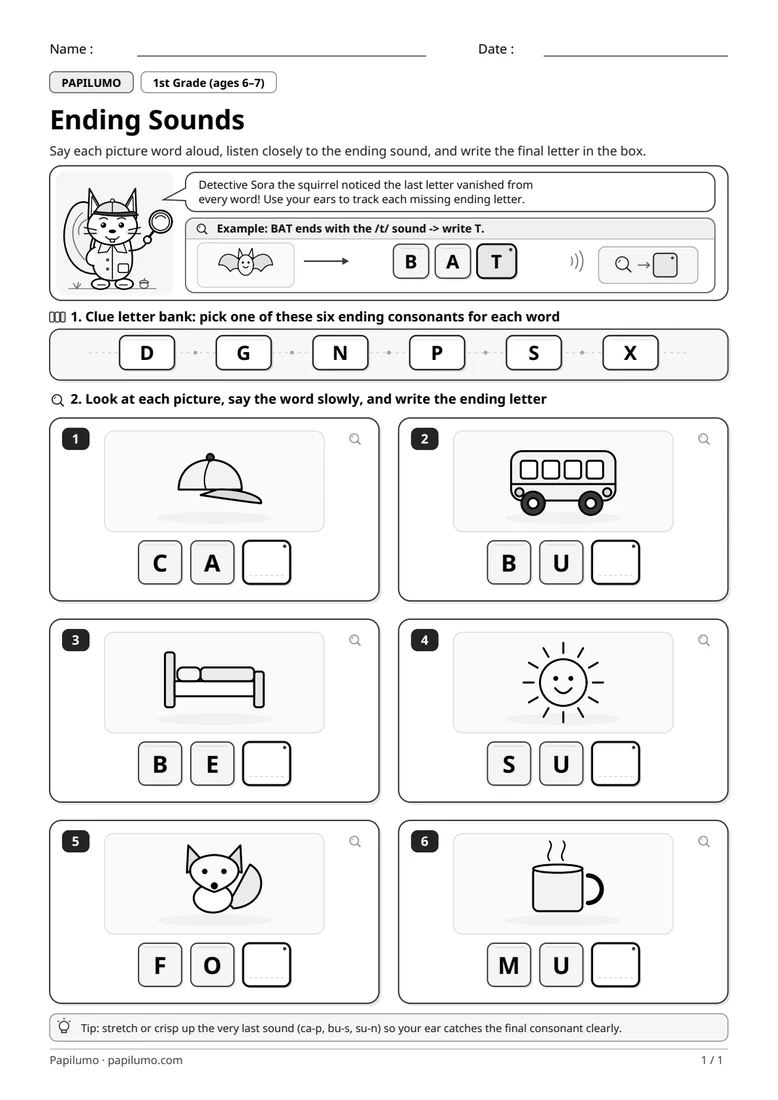
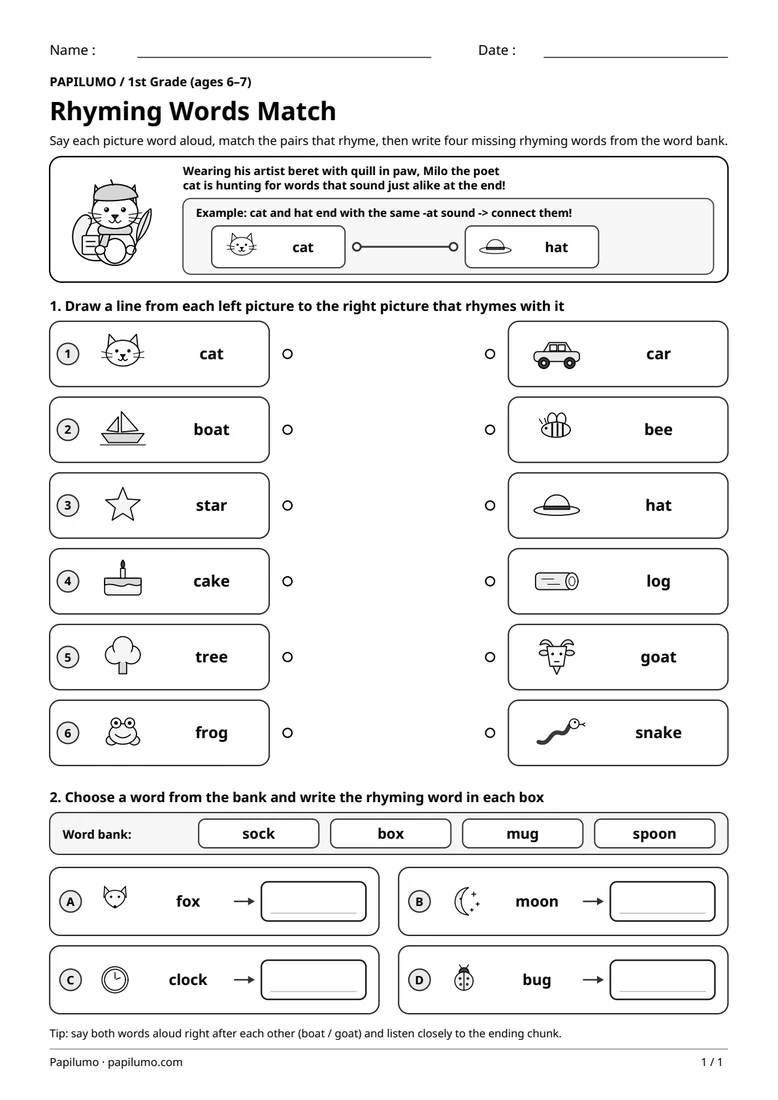
Isolating the final phoneme in spoken CVC words is a cornerstone of early phonics mastery and independent spelling in first grade. While many young learners spot beginning sounds effortlessly on their first try, the ending consonant is often dropped, skipped, or guessed in early writing unless children learn to listen all the way through the syllable. Pairing clean vector illustrations with partial word frames focuses attention squarely on the coda sound—covering crisp stops (/p/, /d/, /g/), steady continuants (/s/, /n/), and the /ks/ ending spelled X—without overwhelming emerging writers. For a related skill, use Rhyming Words Picture Match with Milo the Poet Cat: Say each picture word aloud, match the pairs that rhyme, then write four missing rhyming words from the word bank.
Preparing a short session
Print the student worksheet at actual size (100%) on plain white letter or A4 paper without shrinking margins, and provide a sharpened pencil alongside a soft eraser. Keep the separate answer key completely out of sight while your child works independently. Before writing a single letter, point to each illustration together to confirm the exact target word (cap, bus, bed, sun, fox, mug) so vocabulary uncertainty never blocks phonemic listening, then read through the six uppercase bank letters in Part 1 together at an easy pace.
A concrete example to get started
In the top example panel beside Detective Sora the squirrel, children see a small flying bat next to the tiles B, A, and the framed answer T. Saying “ba-t” aloud highlights the crisp /t/ tap right at the end of the word, showing immediately how the matching clue letter fits into the empty right-hand square. Because the first two letters are already printed cleanly on the card, learners can devote their full concentration to listening for the ending phoneme and connecting that spoken sound to its printed uppercase letter.
Supporting the activity
Using the six-letter clue bank in Part 1, students work steadily through the six numbered picture cards in Part 2 and write one uppercase ending consonant in each blank box: 1. CA[P] (a peaked baseball cap), 2. BU[S] (a classic school bus), 3. BE[D] (a cozy bed with pillow and blanket), 4. SU[N] (a smiling sun), 5. FO[X] (a bushy-tailed fox), and 6. MU[G] (a warm steaming mug). Each letter in the top strip appears exactly once across the six cards, giving helpful self-checking cues as cards fill up. To vary the practice, try Picture Words and Missing Letters with Sora the Writer Owl: Look at each picture, pick its two missing letters from the tile bank, then spell the last two words.
What to notice and how to check
When reviewing with the separate PDF answer key showing all six complete words, ask your child to touch each letter tile from left to right and blend the full word aloud smoothly. If a stop consonant like P, D, or G caused brief hesitation—especially confusing D with B or G with K—say the target word slowly together and notice how the lips or tongue finish the sound before erasing neatly and writing the matching letter.
Making the task easier
Lightly cross off each letter in the top clue strip as soon as you use it so fewer choices remain for the last cards.
Keep the learning aim, but reduce how much the child has to handle at once. Cover part of the page with another sheet and reveal one task at a time. Demonstrate a separate example, then leave a real opportunity to work something out. An answer reached with support is still a useful attempt; it does not yet show that the same task can be completed independently.
Taking the idea beyond the worksheet
Think of three more three-letter words that end with N, P, or T (like pan, map, hat) and draw tiny doodles for them on the back.
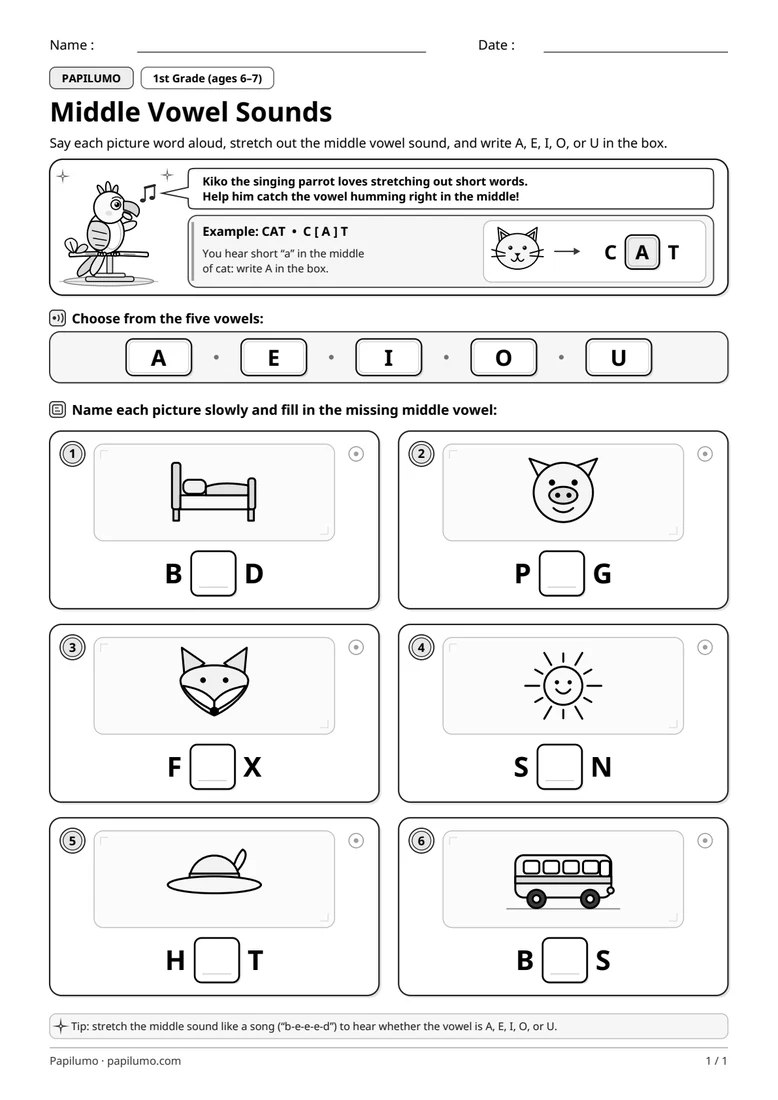
Use the follow-up to meet the same idea in a different setting. Offer it once the first task makes sense, without insisting that the whole page must be perfect. The child might explain a strategy, make an example or set a challenge for an adult. Return to the worksheet only when it helps connect the two situations. A short conversation or a practical activity can be enough to finish the session. To continue exploring, use Middle Vowel Sounds in CVC Words with Kiko the Parrot: Say each picture word aloud, stretch out the middle vowel sound, and write A, E, I, O, or U in the box.
Downloading and printing the PDF
This free PDF contains one worksheet designed for A4 paper. Download the file using the button on this page and open it in your PDF reader. Choose actual size or a 100% scale, check the orientation in the print preview and turn off any browser headers or footers. The illustrations use vector lines, so their outlines stay sharp when printed. Check the margins on one copy before preparing several sheets for a group. The level shown on the page is a guide, rather than a requirement to complete the activity at a particular age.