


What this worksheet helps children practise
Tap one finger under each box as you say the word slowly, then cross off that letter in the bank.
Filling missing letters in familiar illustrated words connects phonemic segmentation, letter-sound mapping, and early spelling accuracy throughout 1st grade. By combining clear picture cues with the letters already printed in each word, children carefully test beginning consonants, vowel teams, double letters, and ending sounds instead of guessing blindly. Moving cleanly from eight two-blank guided words in Part 1 to two open spelling boxes in Part 2 bridges supported word completion and independent encoding on one calm, well-spaced printable sheet without visual clutter. For a related skill, use Unscramble Illustrated Words with Sora the Owl: Look at each picture, cross off each scrambled letter tile as you use it, and write the word in the boxes.
Preparing a short session
Print the student worksheet at actual size (100%) on plain white paper without shrinking margins, and provide a sharpened pencil with a clean eraser while keeping the separate answer key out of reach during independent work. Before writing a single letter, point to and name all eight Part 1 pictures, the two Part 2 drawings, and the BOAT example aloud together so every object is recognized right away. Encourage your learner to scan all sixteen tiles in the letter bank and cross off each letter lightly as it is used.
A concrete example to get started
In the top example panel right beside Sora the writer owl, students see exactly how BOAT works step by step. The crisp sailboat drawing gives the target word immediately, while the shaded outer tiles show B and T already locked in place and leave two middle slots for O and A to form B [O] [A] T. Seeing both the picture clue and the exact letter-box count helps first graders anchor sounds smoothly from left to right instead of squeezing extra letters into a word.
Supporting the activity
In Part 1, learners complete eight familiar four- to six-letter everyday words using every tile in the sixteen-letter bank exactly once: MOON (O, N), APPLE (A, L), TRAIN (R, I), BOOK (O, K), FLOWER (F, W), TREE (R, E), HOUSE (O, S), and FISH (F, S). In Part 2, two open picture-clue cards invite students to spell STAR next to the five-pointed star and CAKE beside the frosted birthday cake, placing one neat uppercase letter inside each box. To vary the practice, try Alphabetical Order: Letters & Words with Lilo the Postman Parrot: Use the A–Z strip to write the letter before and after, then sort each group of four picture words from A to Z.
What to notice and how to check
When checking with the separate PDF answer key, confirm first that all sixteen tiles in the letter bank have been crossed off once, including repeated letters such as O, F, R, and S across different words. Pay close attention to silent or vowel-team spellings like the double P and silent E in APPLE and HOUSE, AI in TRAIN, OW in FLOWER, EE in TREE, and OA in BOAT, which young writers often simplify phonetically. If any blank stalls your child, stretch the word slowly while tapping each box in order.
Making the task easier
Cover the right column with a sheet of paper and solve the first four picture words before tackling the rest.
Keep the learning aim, but reduce how much the child has to handle at once. Cover part of the page with another sheet and reveal one task at a time. Demonstrate a separate example, then leave a real opportunity to work something out. An answer reached with support is still a useful attempt; it does not yet show that the same task can be completed independently.
Taking the idea beyond the worksheet
Draw two more everyday objects on scrap paper, draw their letter boxes, and leave two blanks for a partner to solve.
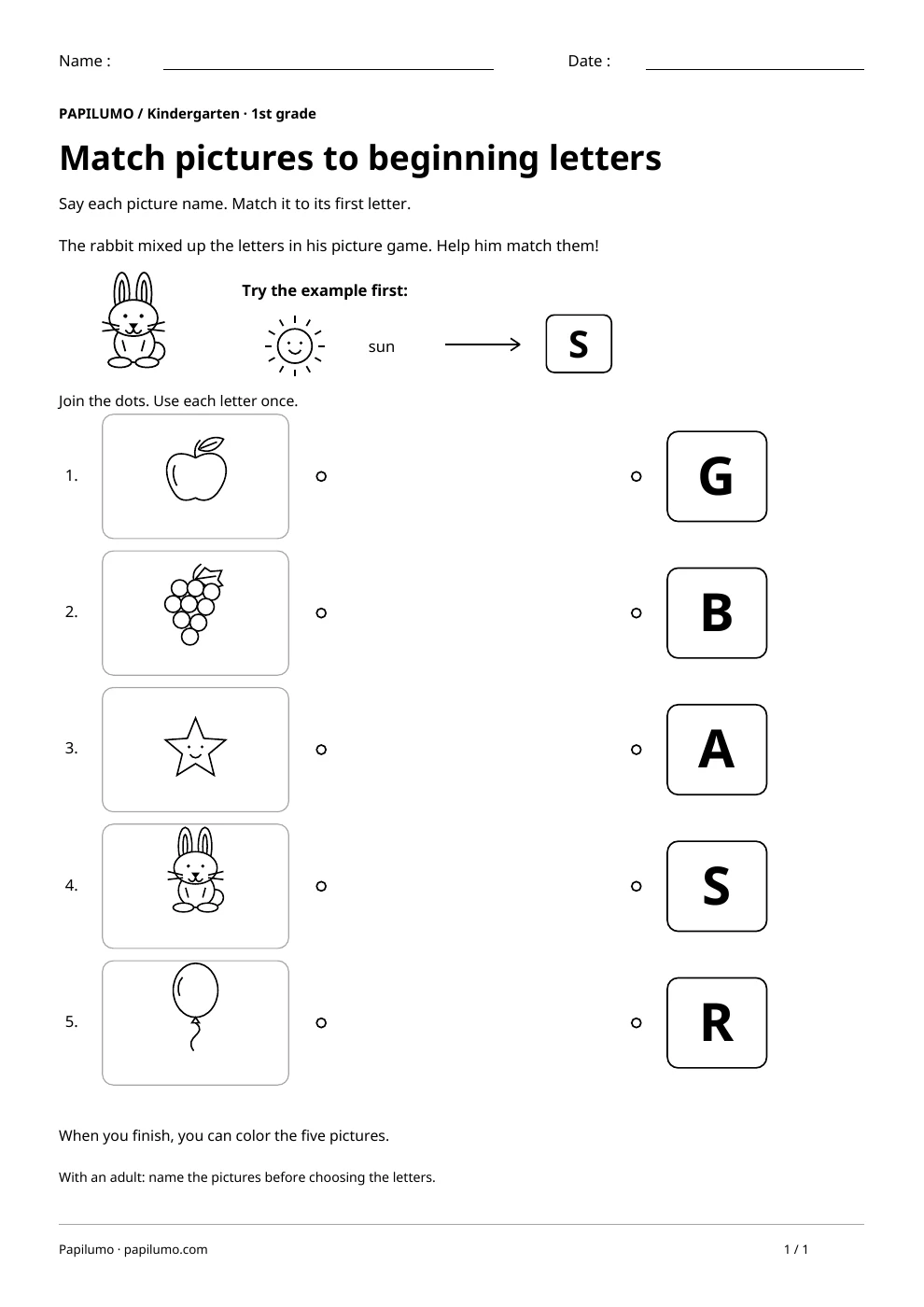
Use the follow-up to meet the same idea in a different setting. Offer it once the first task makes sense, without insisting that the whole page must be perfect. The child might explain a strategy, make an example or set a challenge for an adult. Return to the worksheet only when it helps connect the two situations. A short conversation or a practical activity can be enough to finish the session. To continue exploring, use Beginning sounds: match pictures to first letters: Say each picture name. Match it to its first letter.
Downloading and printing the PDF
This free PDF contains one worksheet designed for A4 paper. Download the file using the button on this page and open it in your PDF reader. Choose actual size or a 100% scale, check the orientation in the print preview and turn off any browser headers or footers. The illustrations use vector lines, so their outlines stay sharp when printed. Check the margins on one copy before preparing several sheets for a group. The level shown on the page is a guide, rather than a requirement to complete the activity at a particular age.