

What this worksheet helps children practise
A common mistake is adding one to both addends, which increases the total by two. Point back to the wings: only one spot is extra. If your child counts every spot, accept that as a check, then ask which fact from the top line could make the bottom line easier. The purpose is to notice a relationship rather than race through the page.
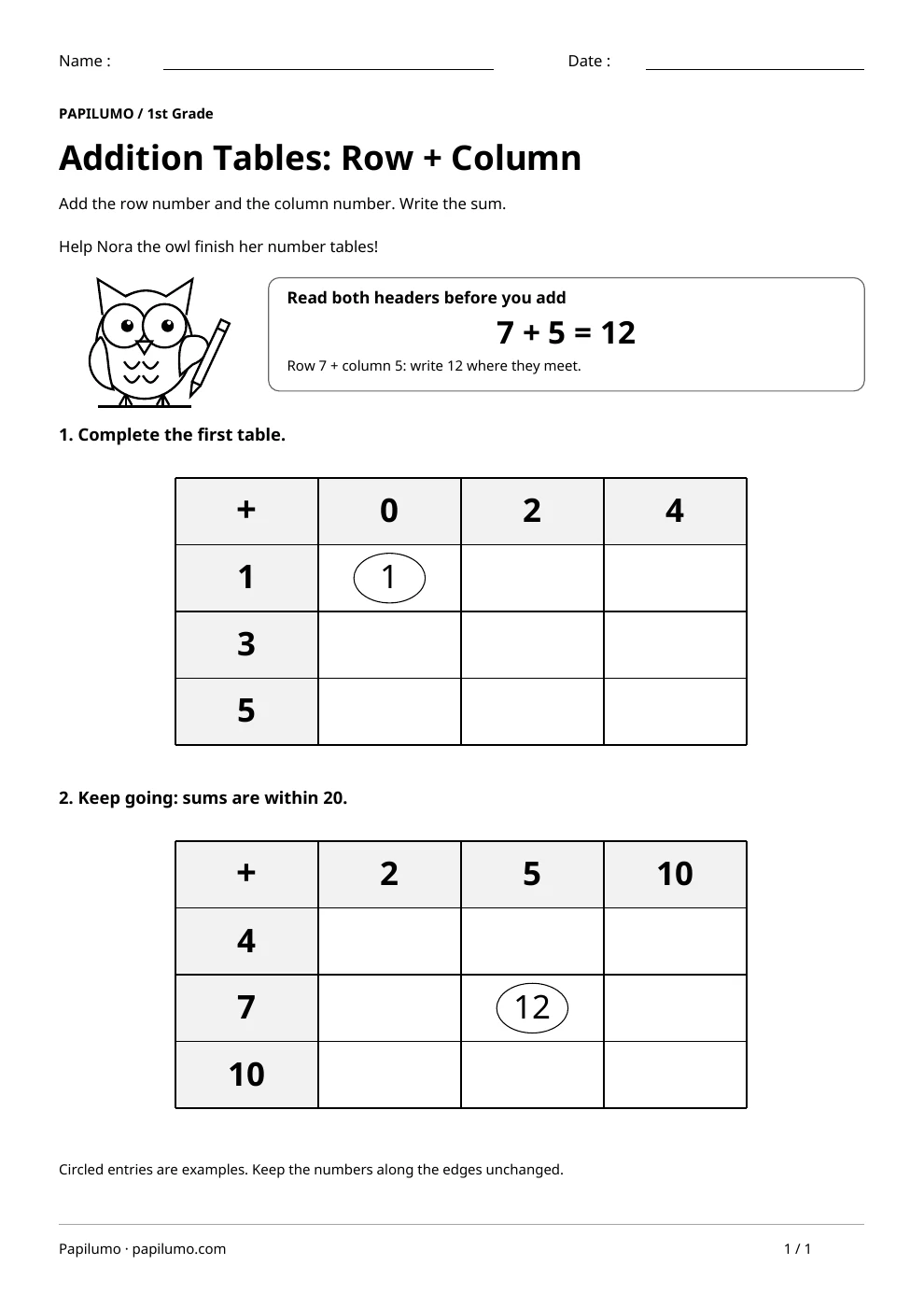
The strategy starts with the double of the smaller addend. To solve 6 + 7, children use 6 + 6 and add one to that total. The two original addends are neighbors, not equal numbers. Matching spots on the wings show the shared double, while a ring around the extra spot identifies the single change. This is also called a near-doubles strategy. For a related skill, use Addition Tables to Complete Within 20: Add the row number and the column number. Write the sum.
Preparing a short session
Print the student page in black and white at actual size. Have a pencil and an eraser ready. Read the directions aloud and point to both equations in one card. Explain that the ring is only a marker: it is not another spot. The marked spot still belongs in the total. Children should be able to count the spots and find doubles with support if needed.
A concrete example to get started
The example shows one spot on the left wing and two on the right. Cover the circled spot to see one on each side: 1 + 1 = 2. Reveal that spot to make 1 + 2 = 3. The second total is one greater than the first. Ask your child to explain what changed before starting the independent questions.
Supporting the activity
On each card, solve the top doubles equation first. Then use its answer to complete the bottom equation with two neighboring addends. Adding one to the first total gives the second total. The ladybug provides a way to check both groups. A child can cover and uncover the extra spot with a finger without crossing out or drawing any new spots. To vary the practice, try Addition doubles from 1 to 5 with dice: Count the dots on the two matching dice, then write the total.
What to notice and how to check
The doubles and near-doubles answers are 4 and 5, 6 and 7, 8 and 9, 10 and 11, 12 and 13, and 16 and 17. The separate key fills all twelve boxes. Card 5 uses 6 + 6 = 12 to solve 6 + 7 = 13. The final card starts with the double of eight to solve 8 + 9.
Making the task easier
For extra support, begin with the first three cards, whose sums stay below ten. Build two equal groups of counters and then add a single counter to the right-hand group. Let your child give an oral answer before writing. Save the cards involving twelve, thirteen, sixteen and seventeen for another session if those quantities make the strategy harder to follow.
Keep the learning aim, but reduce how much the child has to handle at once. Cover part of the page with another sheet and reveal one task at a time. Demonstrate a separate example, then leave a real opportunity to work something out. An answer reached with support is still a useful attempt; it does not yet show that the same task can be completed independently.
Taking the idea beyond the worksheet
For a further challenge, ask about 7 + 8, which is not one of the six cards. Your child can explain that 7 + 7 is fourteen, so the next total is fifteen. Ask whether swapping the groups to make 8 + 7 changes the sum. Children can draw their own almost-matching ladybug wings for a partner, keeping the total below twenty and checking the reasoning together.
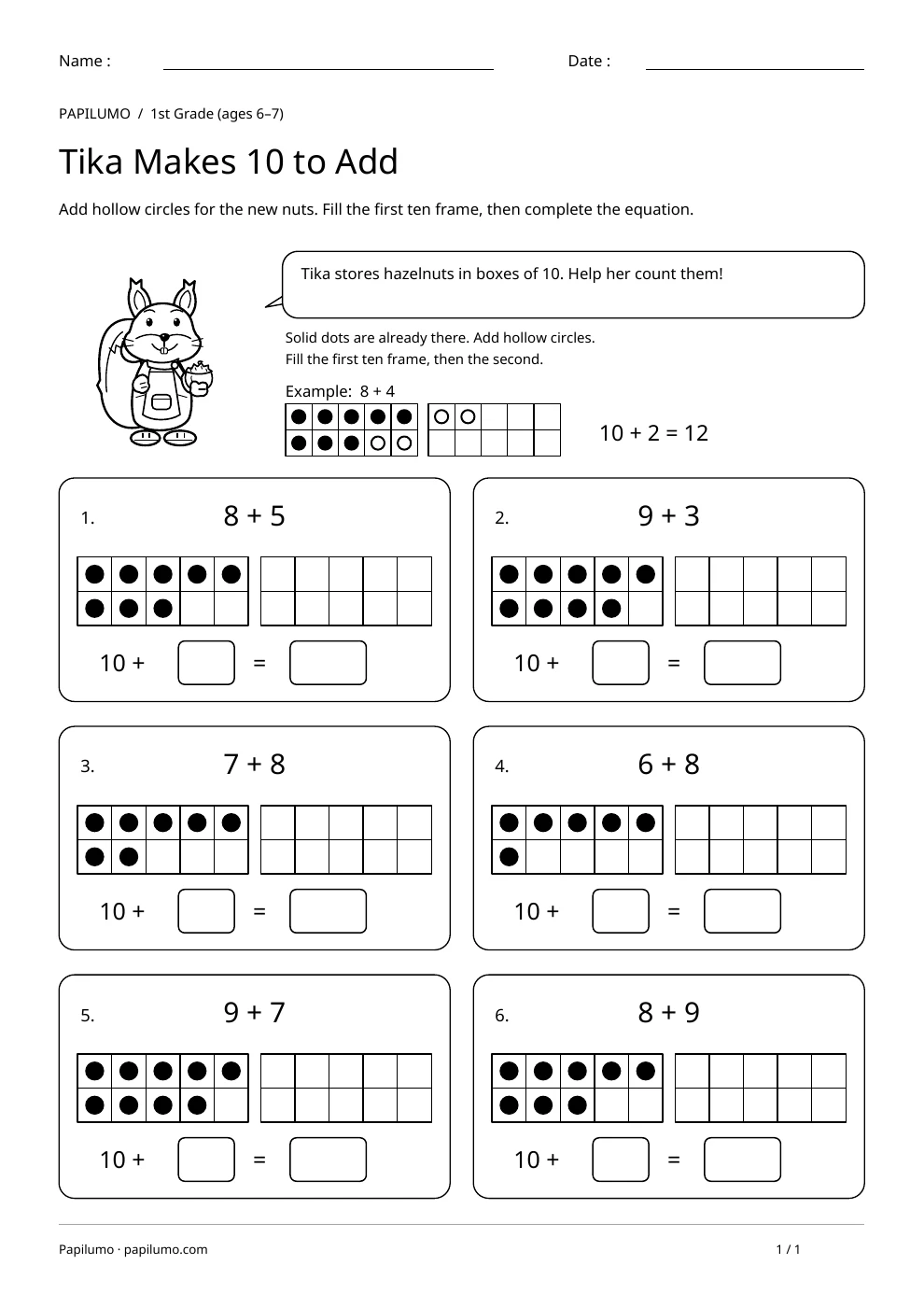
Use the follow-up to meet the same idea in a different setting. Offer it once the first task makes sense, without insisting that the whole page must be perfect. The child might explain a strategy, make an example or set a challenge for an adult. Return to the worksheet only when it helps connect the two situations. A short conversation or a practical activity can be enough to finish the session. To continue exploring, use Addition Within 20: Make 10 with Tika: Add hollow circles for the new nuts. Fill the first ten frame, then complete the equation.
Downloading and printing the PDF
This free PDF contains one worksheet designed for A4 paper. Download the file using the button on this page and open it in your PDF reader. Choose actual size or a 100% scale, check the orientation in the print preview and turn off any browser headers or footers. The illustrations use vector lines, so their outlines stay sharp when printed. Check the margins on one copy before preparing several sheets for a group. The level shown on the page is a guide, rather than a requirement to complete the activity at a particular age.