

What this worksheet helps children practise
If a child starts with the smallest number, return to the first choice without erasing the whole card. Ask which number is greatest. A number strip can support comparisons between one-digit and two-digit numbers within this range. Gradually remove that help as the child gains confidence. The steps support the direction of the order; their equal spacing does not show the numerical distance between the values.
Ordering numbers in descending order means comparing several values and keeping the same direction throughout the list. Children choose the greatest remaining number rather than the smallest, as they would in ascending order. The given numbers do not form a regular sequence. This is therefore different from counting backward by ones. The task practices sorting a specified set and reading the greater-than sign between neighboring values, while keeping every original number in the answer. For a related skill, use Descending Order to 100: Greatest to Least with Polo: Write each set of five numbers in descending order from greatest to least down the steps.
Preparing a short session
Provide a pencil, an eraser and an optional number strip from one to twenty. Read the instruction and ask which kind of number belongs in the first box. Follow the steps from left to right with a finger. Each box sits a little lower, but the reading direction stays the same. Look at one card together before starting. Keep the answer key aside so the child can make and explain a first attempt.
A concrete example to get started
The example starts with 3, 9, 6 and 12. The greatest number is 12, so it goes in the first box. Of the remaining numbers, 9 is greatest, followed by 6 and then 3. The completed chain is 12 > 9 > 6 > 3. Ask the child to read it aloud. All four original numbers are used exactly once, even though some numbers between them are missing.
Supporting the activity
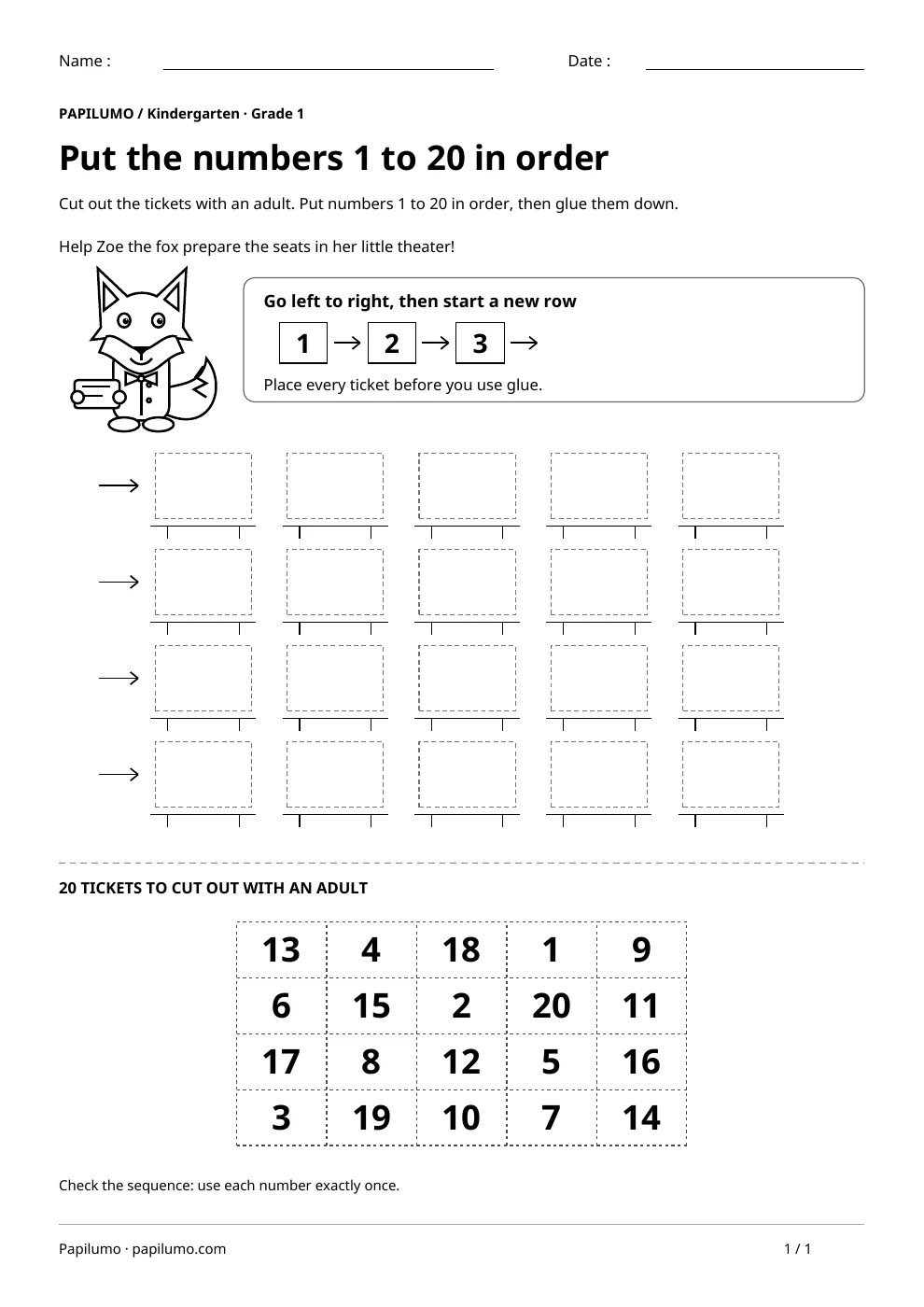
Complete one card at a time, working left to right and then down the page. A child may lightly cross out each given number after copying it to avoid using it twice. First compare all four numbers, place the greatest and repeat with those left over. Ask for an explanation of one comparison instead of a fast answer to the whole page. Three cards can be enough for a first session; the rest provide later practice. To vary the practice, try Ordering Numbers 1–20: Cut and Paste: Cut out the tickets with an adult. Put numbers 1 to 20 in order, then glue them down.
What to notice and how to check
The expected orders are 16, 12, 7, 4; 18, 14, 9, 2; 20, 15, 11, 6; 19, 13, 8, 5; 17, 14, 10, 3; and 18, 12, 7, 1. Check that every given number appears once and that each left neighbor is greater than its right neighbor. A descending list with an invented number still needs correction because it does not sort the original set.
Making the task easier
Cover three numbers and reveal them gradually, comparing two values at a time before choosing the greatest.
Keep the learning aim, but reduce how much the child has to handle at once. Cover part of the page with another sheet and reveal one task at a time. Demonstrate a separate example, then leave a real opportunity to work something out. An answer reached with support is still a useful attempt; it does not yet show that the same task can be completed independently.
Taking the idea beyond the worksheet
Give a partner four different numbers to twenty. Ask for both ascending and descending order and an explanation of the change.
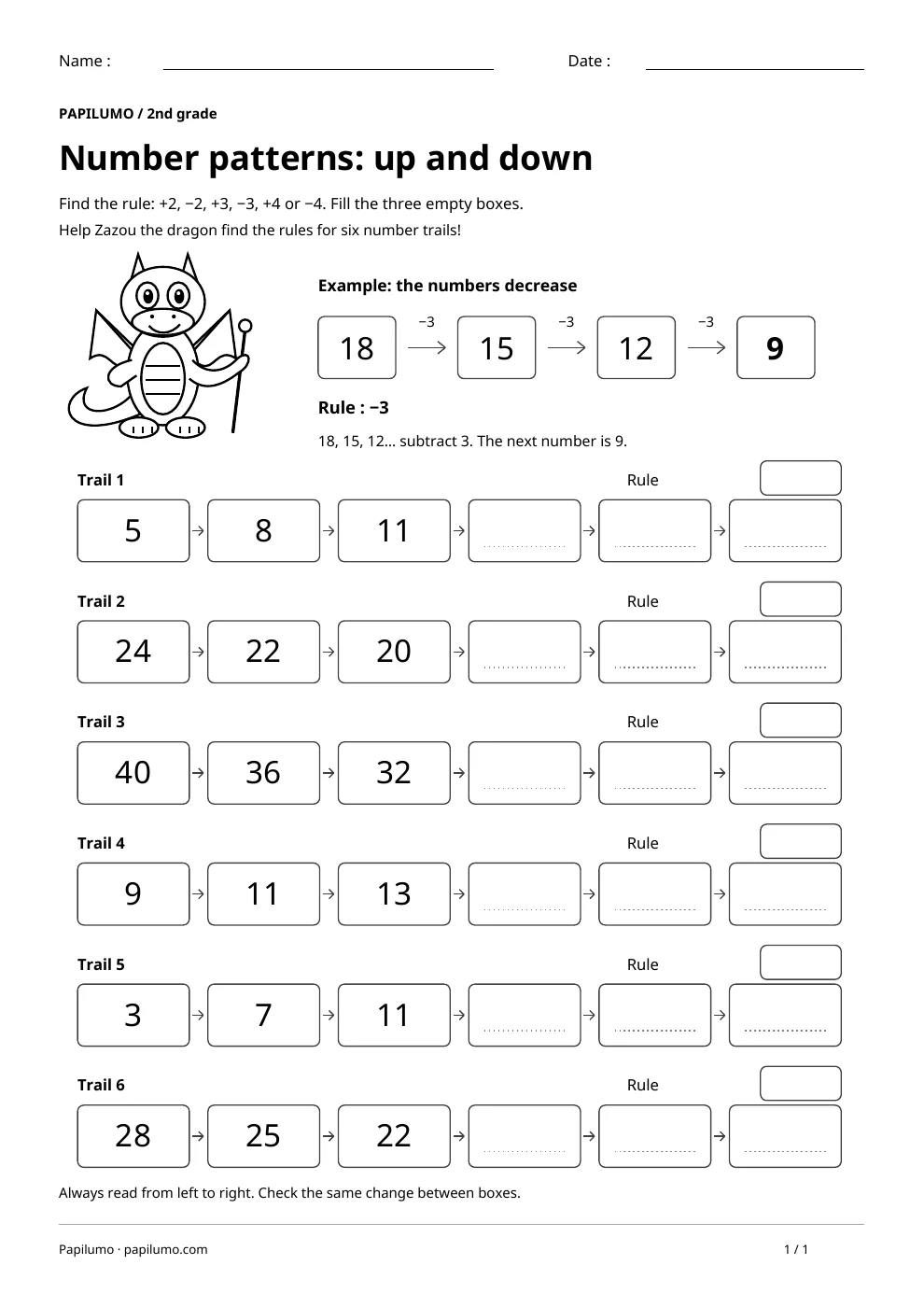
Use the follow-up to meet the same idea in a different setting. Offer it once the first task makes sense, without insisting that the whole page must be perfect. The child might explain a strategy, make an example or set a challenge for an adult. Return to the worksheet only when it helps connect the two situations. A short conversation or a practical activity can be enough to finish the session. To continue exploring, use Increasing and decreasing number patterns to 40: Find the rule: +2, −2, +3, −3, +4 or −4. Fill the three empty boxes.
Downloading and printing the PDF
This free PDF contains one worksheet designed for A4 paper. Download the file using the button on this page and open it in your PDF reader. Choose actual size or a 100% scale, check the orientation in the print preview and turn off any browser headers or footers. The illustrations use vector lines, so their outlines stay sharp when printed. Check the margins on one copy before preparing several sheets for a group. The level shown on the page is a guide, rather than a requirement to complete the activity at a particular age.