
What this worksheet helps children practise
Trace the outer egg outline from the top black dot first, then keep every inner pattern band neatly inside the shell.
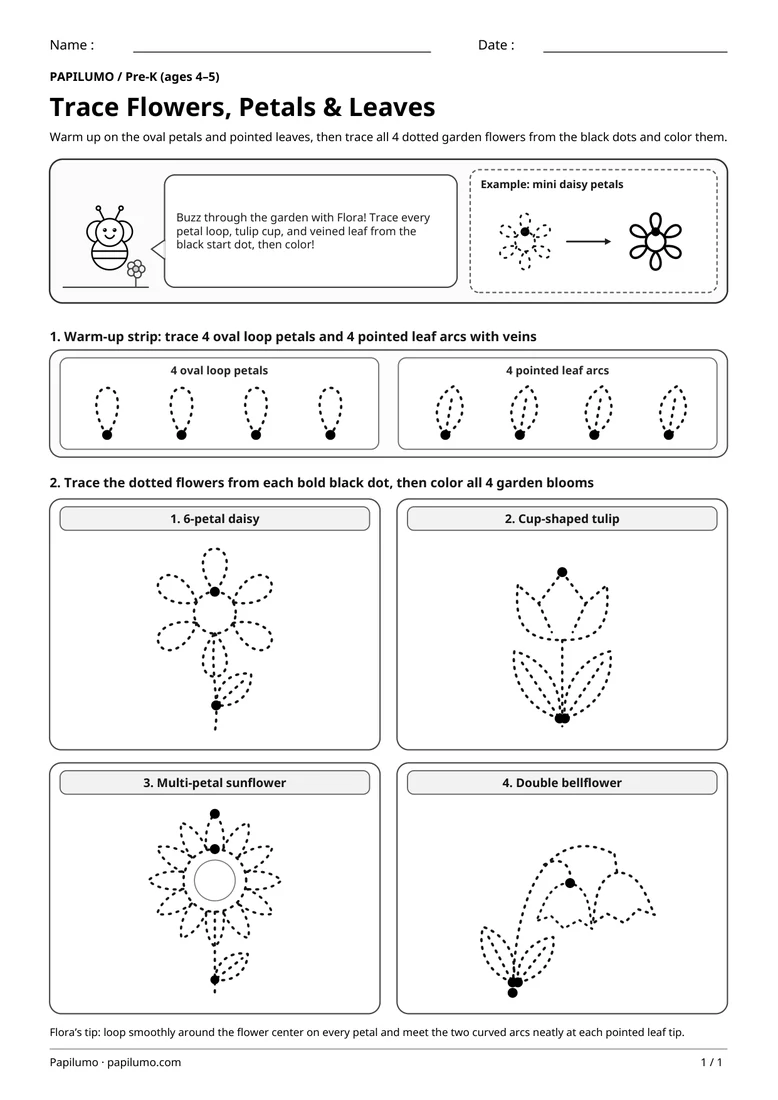
Tracing decorative patterns inside a bounded oval teaches four- and five-year-olds how to regulate stroke size and stop cleanly at curved borders. Before moving across each band, children judge the narrowing width near the top and bottom of the egg while practicing six foundational pre-writing motions: sharp zigzags, continuous waves, scalloped arches, cursive-style loops, coiled spirals, and neat vertical dashes. Staying inside clear boundaries develops visuomotor planning, steady wrist rotation, even spacing, and confident pencil control. Moving smoothly between pointed zigzags, rounded waves, and tight coils builds lasting confidence for upcoming letters and numbers. For a related skill, use Trace Flowers, Petals, and Leaves with Flora the Bee (Pre-K): Warm up on the oval petals and pointed leaves, then trace all 4 dotted garden flowers from the black dots and color them.
Preparing a short session
Print the student worksheet at actual size (100%) on smooth white A4 paper and prepare a bright, uncluttered table with a sharpened triangular pencil, fine washable markers, or smooth colored pencils. Keep the separate solid-line answer key tucked neatly aside until all four decorated eggs are completely traced. Before writing, invite your child to place one fingertip on the bold black start dot at the top of each egg and name every motif across the warm-up strip and all four shells aloud.
A concrete example to get started
Inside the rounded top banner on the left, Mimi the artist hen holds a fine paintbrush beside a tiny decorated egg. Next to her speech bubble sits a clear worked mini model: on the left, a small dotted egg displays two internal decorative bands with a bold black top start dot, connected by a neat arrow to the finished solid-line patterned egg on the right so young learners instantly see both the outer shell and inner bands completed cleanly.
Supporting the activity
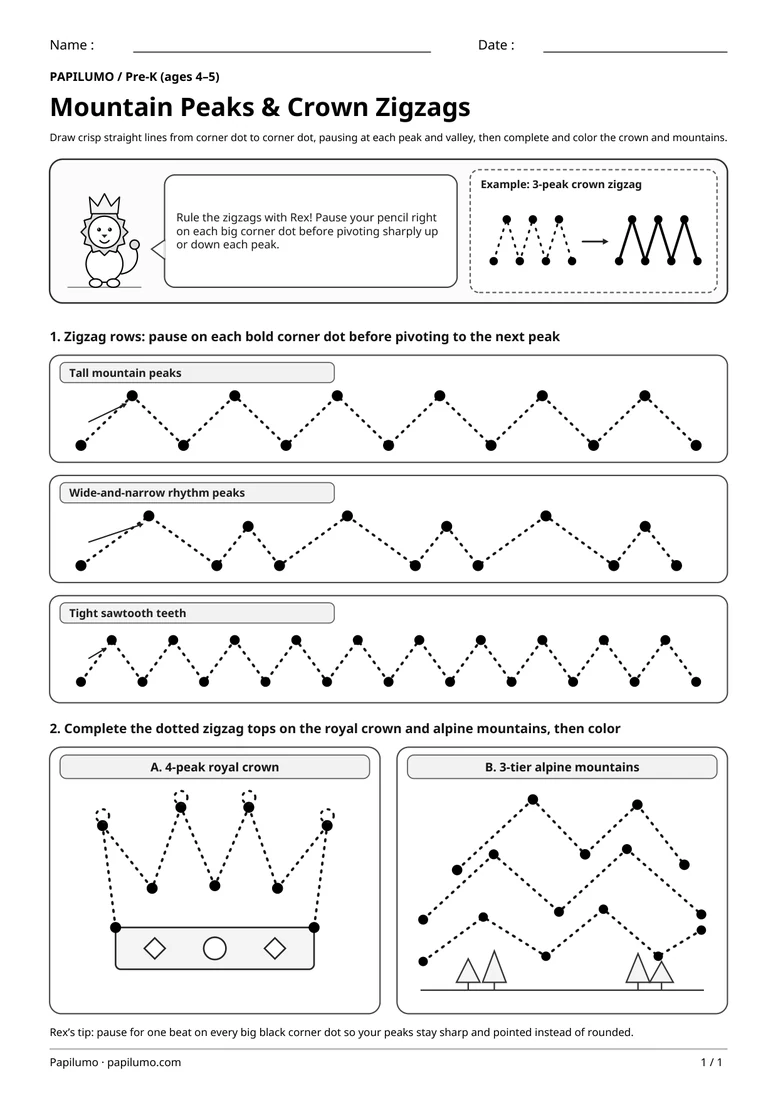
Right below the banner, the warm-up strip offers three small motif boxes for quick practice: sharp zigzags on the left, scalloped arches in the center, and coiled spirals on the right. Below, four large numbered cards present one spacious egg each. Egg 1 guides straight horizontal divider bands and crisp zigzags. Egg 2 trains smooth flowing waves alongside round beaded dots. Egg 3 combines rounded scalloped arches with a row of loops. Egg 4 pairs three coiled mini spirals with tidy vertical dashes ready for coloring. To vary the practice, try Mountain Peaks and Crown Zigzag Tracing with Rex (Pre-K): Draw crisp straight lines from corner dot to corner dot, pausing at each peak and valley, then complete and color the crown and mountains.
What to notice and how to check
When all three warm-up swatches and four decorated eggs have been traced, place the separate continuous-line answer key next to your child’s page to inspect every band calmly together. Check that each oval shell closes smoothly at the top dot, the zigzags and scallops stay neatly inside the egg walls, the waves, loops, and spirals flow smoothly without rushed corners, and no small dot or vertical dash was skipped. Praise neat focus and let your child color each patterned band brightly. Each finished decorated egg becomes a neat mini gallery piece children feel proud to display.
Making the task easier
Trace the zigzag, scallop, and spiral warm-up boxes twice with your finger before tracing the four decorated eggs with a pencil.
Keep the learning aim, but reduce how much the child has to handle at once. Cover part of the page with another sheet and reveal one task at a time. Demonstrate a separate example, then leave a real opportunity to work something out. An answer reached with support is still a useful attempt; it does not yet show that the same task can be completed independently.
Taking the idea beyond the worksheet
Color each band on every egg in alternating bright shades to create repeating color patterns across the four shells.
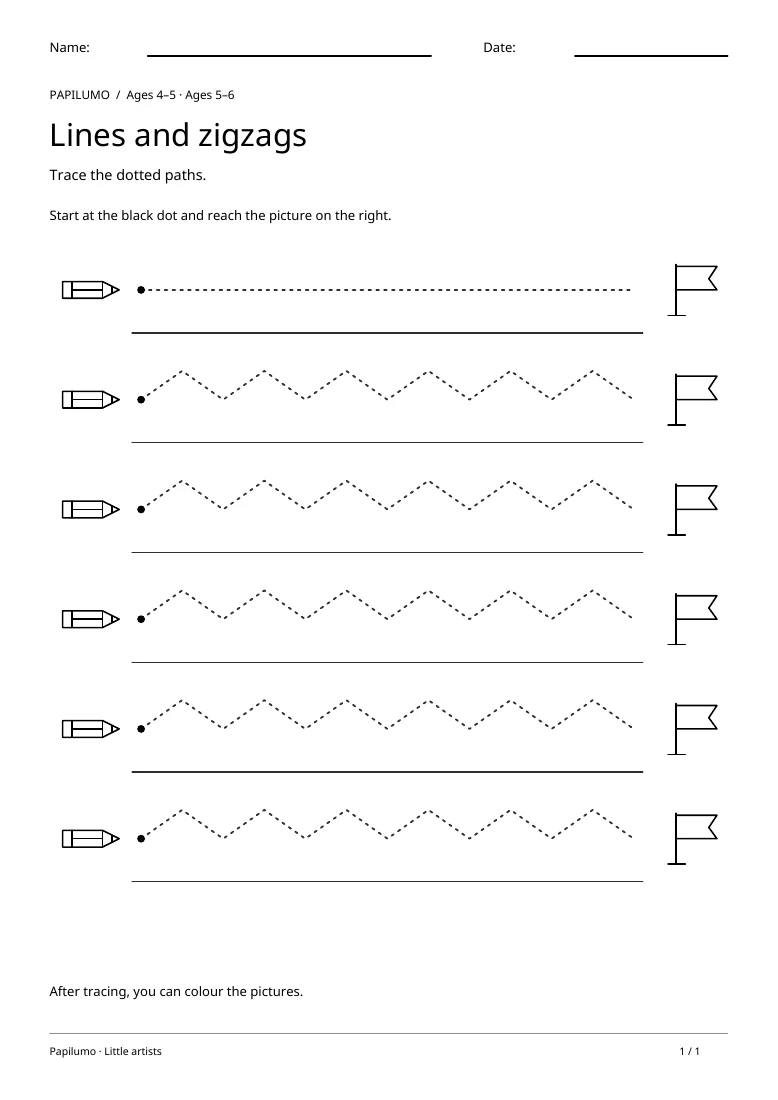
Use the follow-up to meet the same idea in a different setting. Offer it once the first task makes sense, without insisting that the whole page must be perfect. The child might explain a strategy, make an example or set a challenge for an adult. Return to the worksheet only when it helps connect the two situations. A short conversation or a practical activity can be enough to finish the session. To continue exploring, use Straight Line and Zigzag Tracing Worksheet: Trace the dotted paths.
Downloading and printing the PDF
This free PDF contains one worksheet designed for A4 paper. Download the file using the button on this page and open it in your PDF reader. Choose actual size or a 100% scale, check the orientation in the print preview and turn off any browser headers or footers. The illustrations use vector lines, so their outlines stay sharp when printed. Check the margins on one copy before preparing several sheets for a group. The level shown on the page is a guide, rather than a requirement to complete the activity at a particular age.