What this worksheet helps children practise
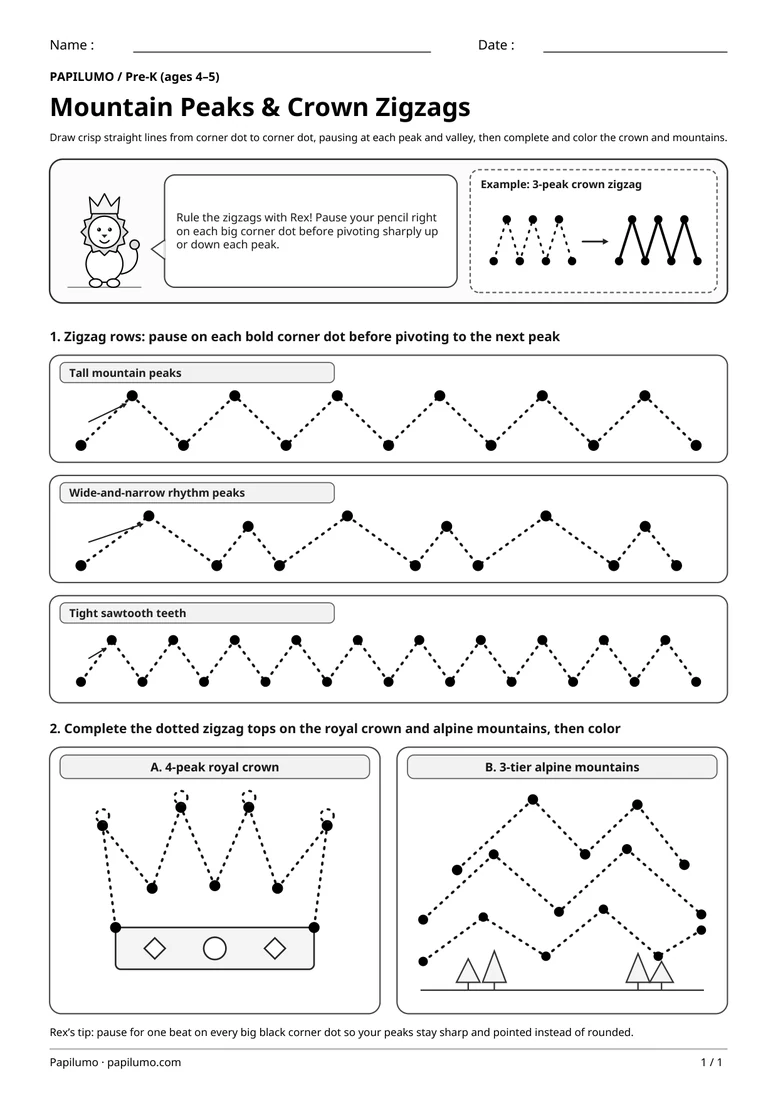
Stop right on every bold black corner dot, pivot your pencil sharply, and draw straight down or up to the next vertex.
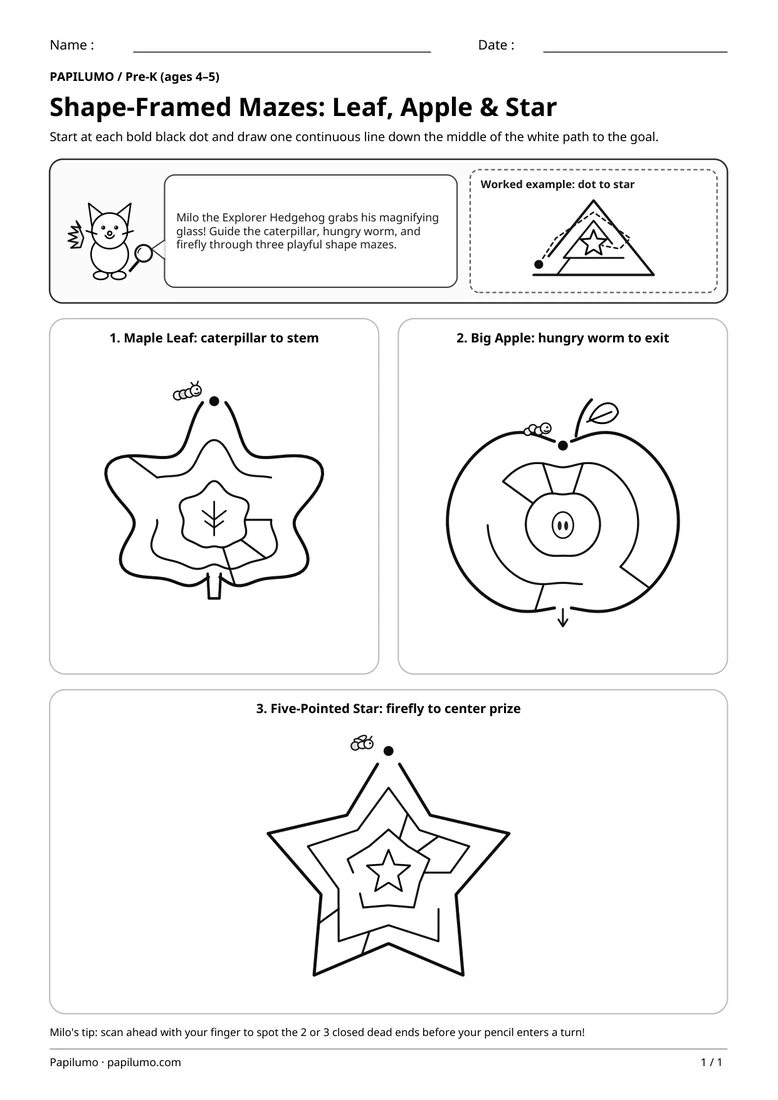
Drawing sharp, clean zigzags requires young learners to slow down at each vertex rather than rushing across the page in rounded bumps. By pausing briefly on every bold black corner dot before pivoting direction, four- and five-year-olds build deliberate finger control, visual tracking across varying peak widths, and rhythmic hand coordination. Mastering crisp stop-and-pivot angles directly prepares Pre-K students to form straight-angled uppercase letters such as A, M, N, V, W, and Z accurately. Alternating upward and downward strokes across varying peak heights also strengthens visual estimation, steady pencil pressure, and patient spacing. For a related skill, use Shape-Framed Mazes (Leaf, Apple, Star) with Milo (Pre-K): Start at each bold black dot and draw one continuous line down the middle of the white path to the goal.
Preparing a short session
Print the student worksheet at actual size (100%) on crisp white A4 paper and sit together at a bright, uncluttered table with a sharpened triangular pencil or fine washable marker so every corner dot stays easy to aim for. Keep the separate solid-line answer key tucked neatly aside until all three rows and both large pictures are complete. Before drawing, ask your child to tap each black corner dot with one finger, saying stop at every peak and valley on the rows, crown, and mountains.
A concrete example to get started
Inside the rounded top banner on the left, Rex the crowned lion cub beams beside his speech bubble with a paper crown perched on his fluffy mane. To the right sits a clear worked mini model: on the left, a dotted 3-peak crown zigzag highlights bold stop-and-pivot black dots at every top peak and bottom valley, followed by an arrow pointing to the crisp solid continuous 3-peak zigzag on the right so children see how sharp corners look immediately.
Supporting the activity
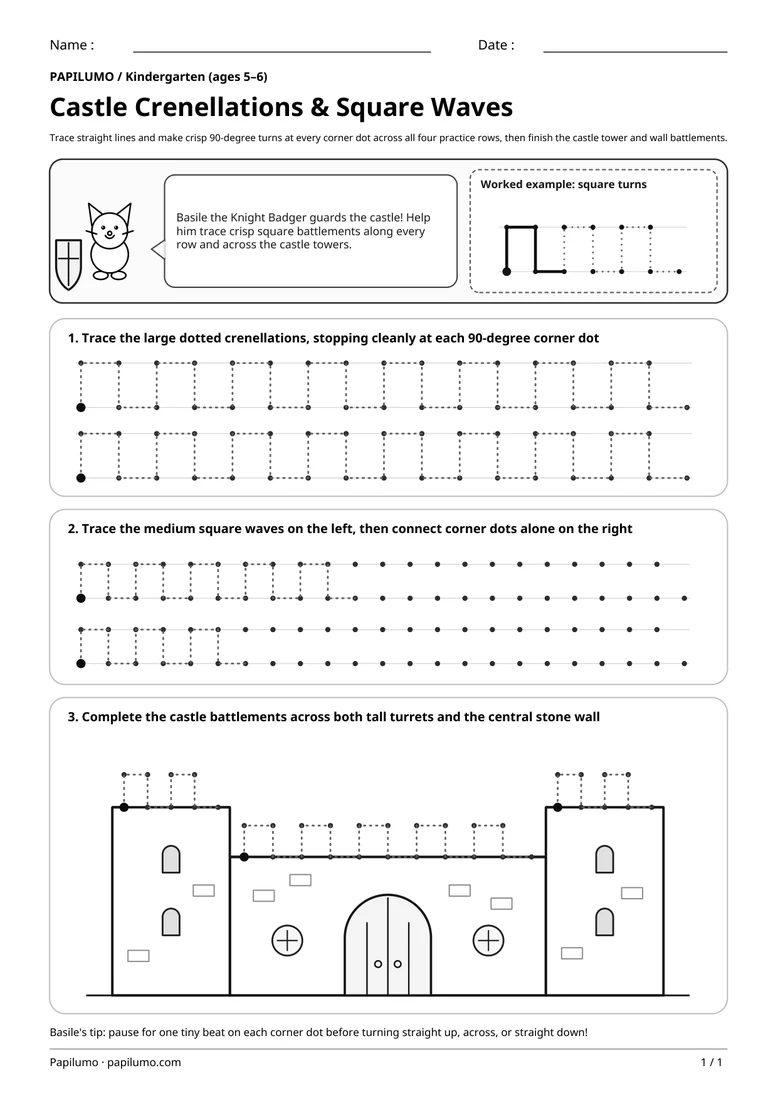
Section 1 fills the upper half with three wide horizontal zigzag rows marked with bold corner dots at every turn: Row 1 trains tall steady mountain peaks, Row 2 alternates wide and narrow rhythm peaks, and Row 3 tightens into brisk sawtooth shark teeth. Section 2 presents two large illustrated cards below: on the left, a 4-peak royal crown with jeweled band and dotted top points to finish; on the right, a 3-tier alpine mountain range with forest foreground and dotted jagged ridges. Both illustrated cards apply the exact stop-and-pivot corner skill inside fun royal and mountain scenes. To vary the practice, try Castle Crenellations and Square-Wave Tracing with Basile (Kindergarten): Trace straight lines and make crisp 90-degree turns at every corner dot across all four practice rows, then finish the castle tower and wall battlements.
What to notice and how to check
When all three zigzag rows, the royal crown, and the alpine mountains are traced, set the separate solid-line answer key beside your child’s worksheet to check every vertex calmly together. Look closely to see that lines meet right on the bold corner dots without rounding over the peaks, that the wide-and-narrow rhythm in Row 2 stays clear, and that all four crown points and three mountain tiers connect cleanly before coloring the royal jewels and mountain trees. Every crisp peak leaves children proud of their sharp, steady zigzag control.
Making the task easier
Tap each corner dot with your finger and whisper stop before connecting the dotted mountain peaks slowly with a pencil.
Keep the learning aim, but reduce how much the child has to handle at once. Cover part of the page with another sheet and reveal one task at a time. Demonstrate a separate example, then leave a real opportunity to work something out. An answer reached with support is still a useful attempt; it does not yet show that the same task can be completed independently.
Taking the idea beyond the worksheet
Color the royal crown jewels in bright hues, shade the pine foothills, and leave crisp white snowcaps on the tallest alpine peaks.
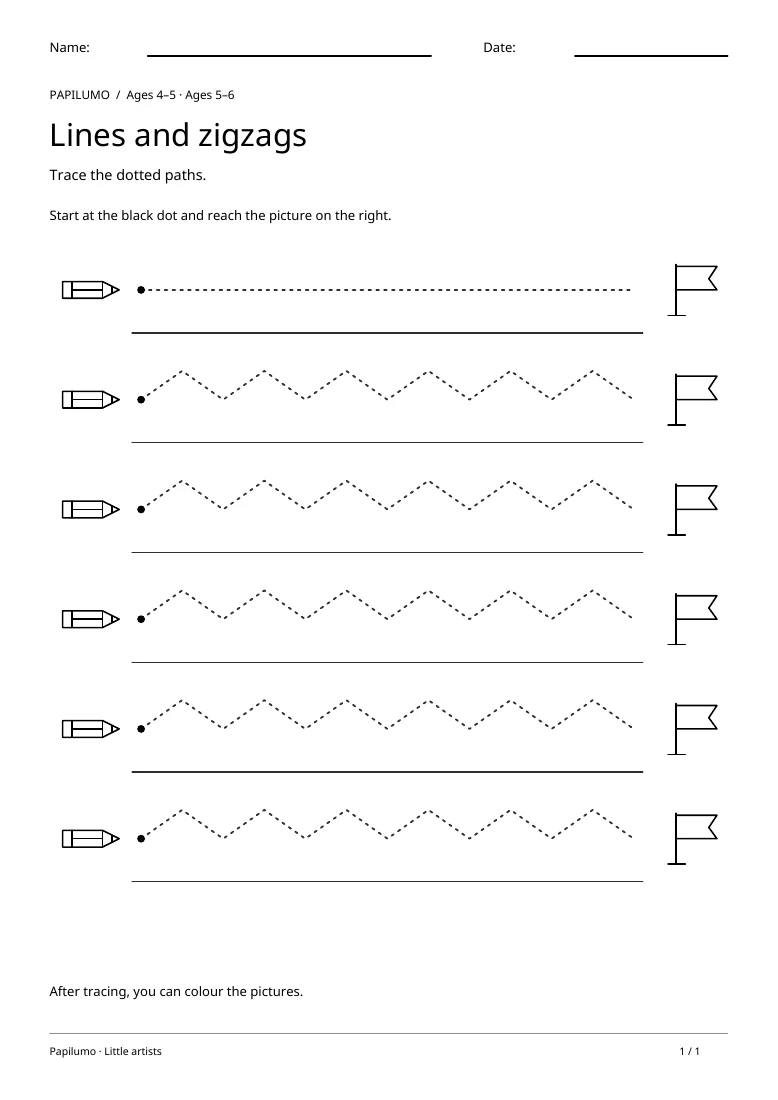
Use the follow-up to meet the same idea in a different setting. Offer it once the first task makes sense, without insisting that the whole page must be perfect. The child might explain a strategy, make an example or set a challenge for an adult. Return to the worksheet only when it helps connect the two situations. A short conversation or a practical activity can be enough to finish the session. To continue exploring, use Straight Line and Zigzag Tracing Worksheet: Trace the dotted paths.
Downloading and printing the PDF
This free PDF contains one worksheet designed for A4 paper. Download the file using the button on this page and open it in your PDF reader. Choose actual size or a 100% scale, check the orientation in the print preview and turn off any browser headers or footers. The illustrations use vector lines, so their outlines stay sharp when printed. Check the margins on one copy before preparing several sheets for a group. The level shown on the page is a guide, rather than a requirement to complete the activity at a particular age.