
What this worksheet helps children practise
Say each shape name like a bouncy song as your finger hops along the row—your ears will hear what comes next!
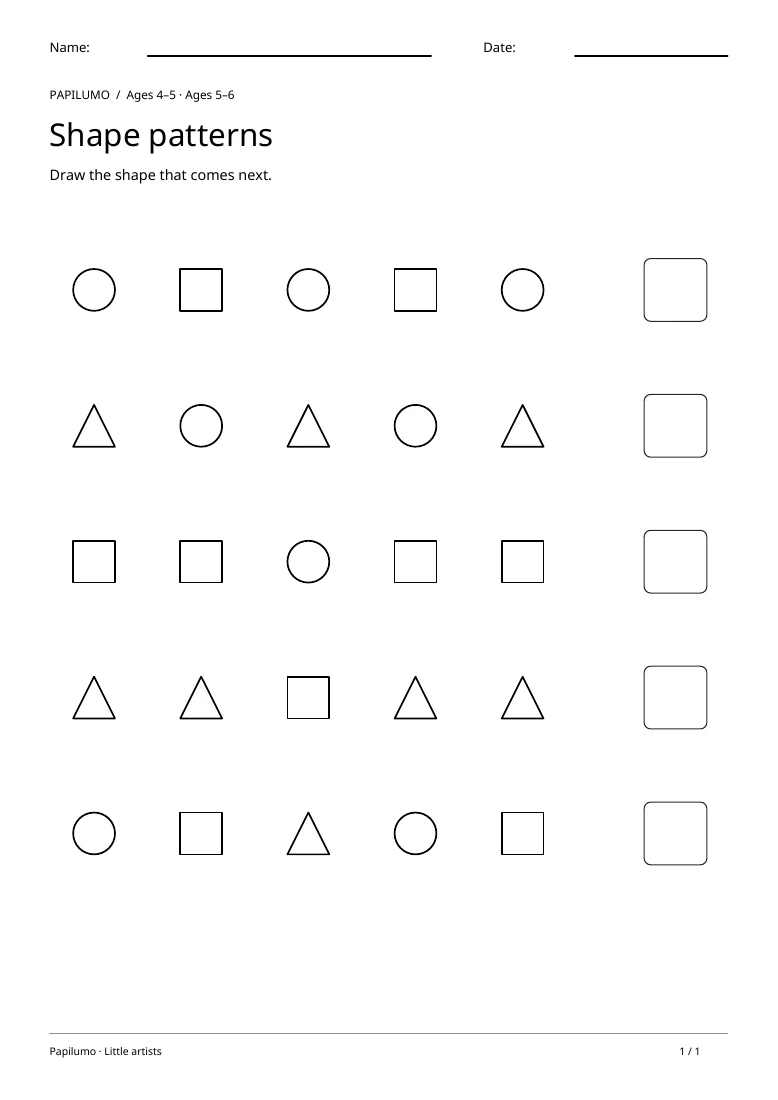
Continuing repeating patterns in Pre-K nurtures early algebraic reasoning, visual discrimination, and sequential memory long before formal number sequences begin. By examining six given pictures from left to right, four- and five-year-olds learn to isolate the core repeating unit rather than matching only the final icon. Moving smoothly from a simple alternation (AB) to doubled and three-part patterns (AAB, ABB, ABC, and AABB) strengthens vocabulary for flat shapes, encourages confident verbal prediction, and builds steady fine-motor pencil control as children sketch two clean shapes in each row. For a related skill, use Kindergarten Pattern Worksheet: What Shape Comes Next?: Draw the shape that comes next.
Preparing a short session
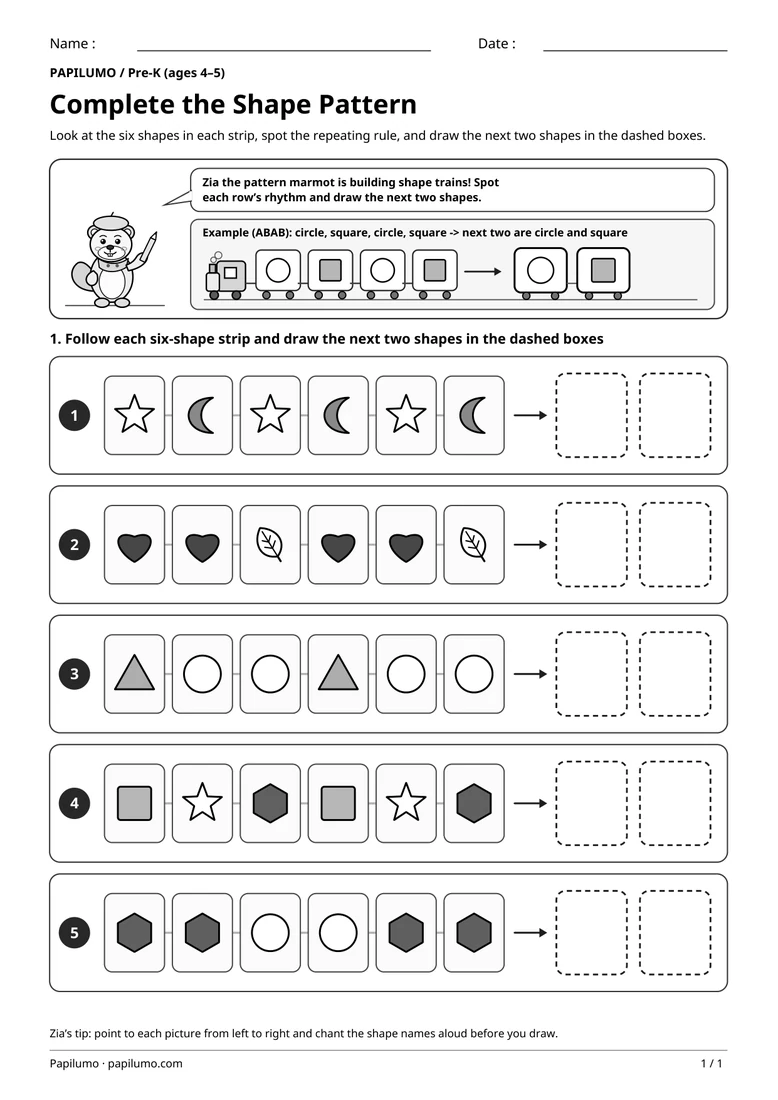
Print the student page at actual size (100%) on plain white A4 or letter paper without cropping margins, and keep the separate answer key PDF tucked out of sight while children work. Provide a sharpened pencil and a soft eraser; crayons may wait until the end for optional coloring after checking. Before drawing in any dashed box, scan the page together and name all eight shapes aloud—star, moon, heart, leaf, triangle, circle, square, and hexagon—then read Zia’s worked train example slowly from left to right.
A concrete example to get started
Inside the framed banner right beside Zia the pattern marmot, a playful four-car ABAB train displays white circle, grey square, white circle, and grey square along a neat rail track. A directional arrow points straight to two solid-framed boxes where a white circle and a grey square are already drawn as the next two cars. Walking through this visual anchor shows Pre-K learners exactly how to chant the repeating pair aloud from left to right and draw two matching shapes at the end of the line.
Supporting the activity
Five progressive strips fill the worksheet, each giving six shapes followed by two blank dashed boxes. Row 1 (AB) repeats star, moon, star, moon, star, moon, so the next two shapes are star and moon. Row 2 (AAB) shows heart, heart, leaf twice, ending with heart and heart. Row 3 (ABB) pairs triangle, circle, circle twice, calling for triangle and circle. Row 4 (ABC) cycles through square, star, hexagon twice, continuing with square and star. Row 5 (AABB) presents hexagon, hexagon, circle, circle, hexagon, hexagon, finishing cleanly with circle and circle. To vary the practice, try Missing shapes in repeating patterns: Look at each pattern. Draw the missing shapes in the empty boxes.
What to notice and how to check
When reviewing with the separate one-page answer key, read all eight positions in every finished strip aloud together while pointing with a finger to confirm the rhythm stays steady from start to finish. Accept recognizable hand-drawn circles, hearts, stars, or moons from four- and five-year-old pencils without demanding ruler precision, focusing instead on the exact pair order in every row: star and moon, heart and heart, triangle and circle, square and star, and finally circle and circle.
Making the task easier
Cover the lower strips with a sheet of blank paper so only one pattern row shows at a time.
Keep the learning aim, but reduce how much the child has to handle at once. Cover part of the page with another sheet and reveal one task at a time. Demonstrate a separate example, then leave a real opportunity to work something out. An answer reached with support is still a useful attempt; it does not yet show that the same task can be completed independently.
Taking the idea beyond the worksheet
Flip the page over and invent your own six-shape pattern train for a partner to finish with two more shapes.
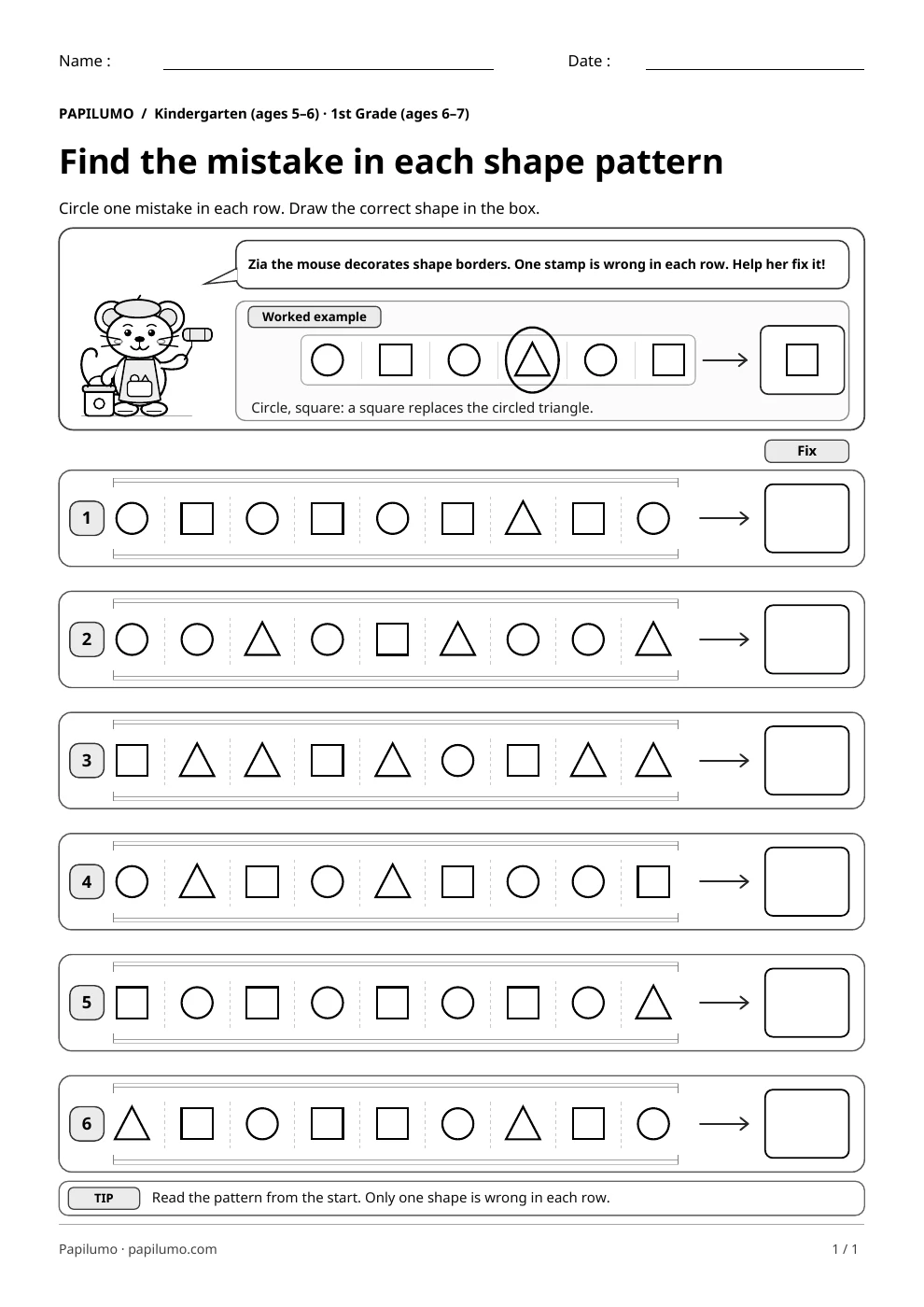
Use the follow-up to meet the same idea in a different setting. Offer it once the first task makes sense, without insisting that the whole page must be perfect. The child might explain a strategy, make an example or set a challenge for an adult. Return to the worksheet only when it helps connect the two situations. A short conversation or a practical activity can be enough to finish the session. To continue exploring, use Find the mistake in each shape pattern with Zia: Circle one mistake in each row. Draw the correct shape in the box.
Downloading and printing the PDF
This free PDF contains one worksheet designed for A4 paper. Download the file using the button on this page and open it in your PDF reader. Choose actual size or a 100% scale, check the orientation in the print preview and turn off any browser headers or footers. The illustrations use vector lines, so their outlines stay sharp when printed. Check the margins on one copy before preparing several sheets for a group. The level shown on the page is a guide, rather than a requirement to complete the activity at a particular age.