What this worksheet helps children practise
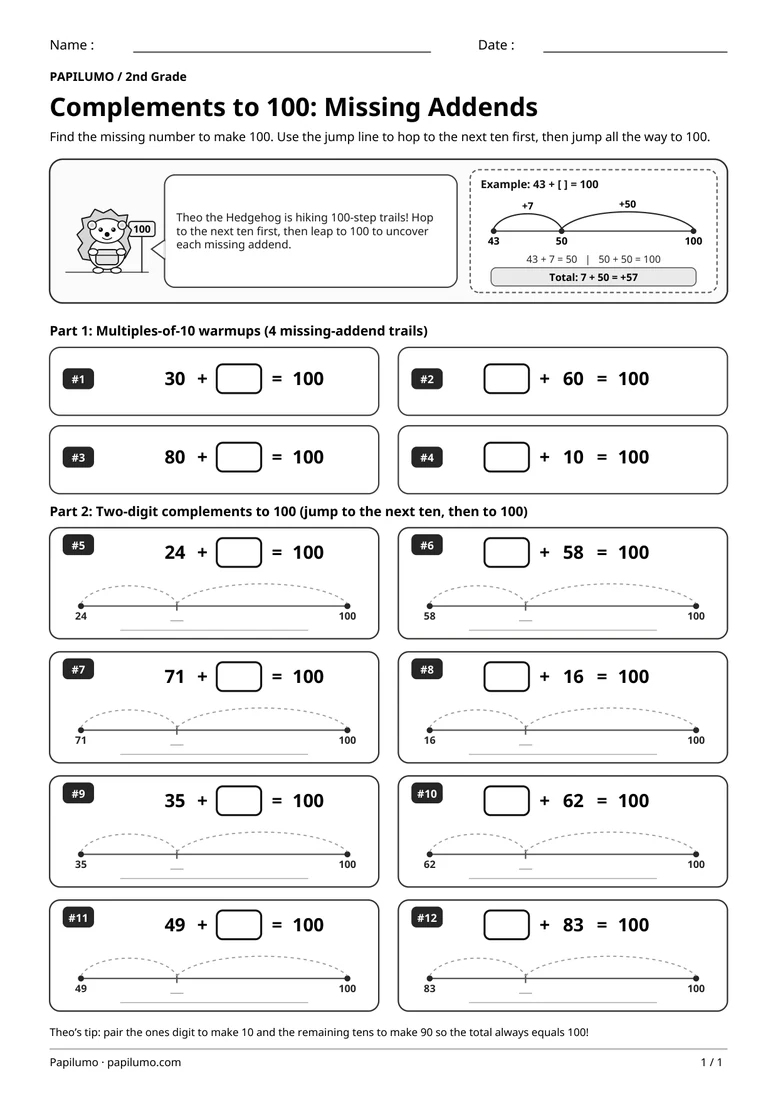
Hop to the next multiple of ten first, leap the rest of the way to 100, then add your two hops together!
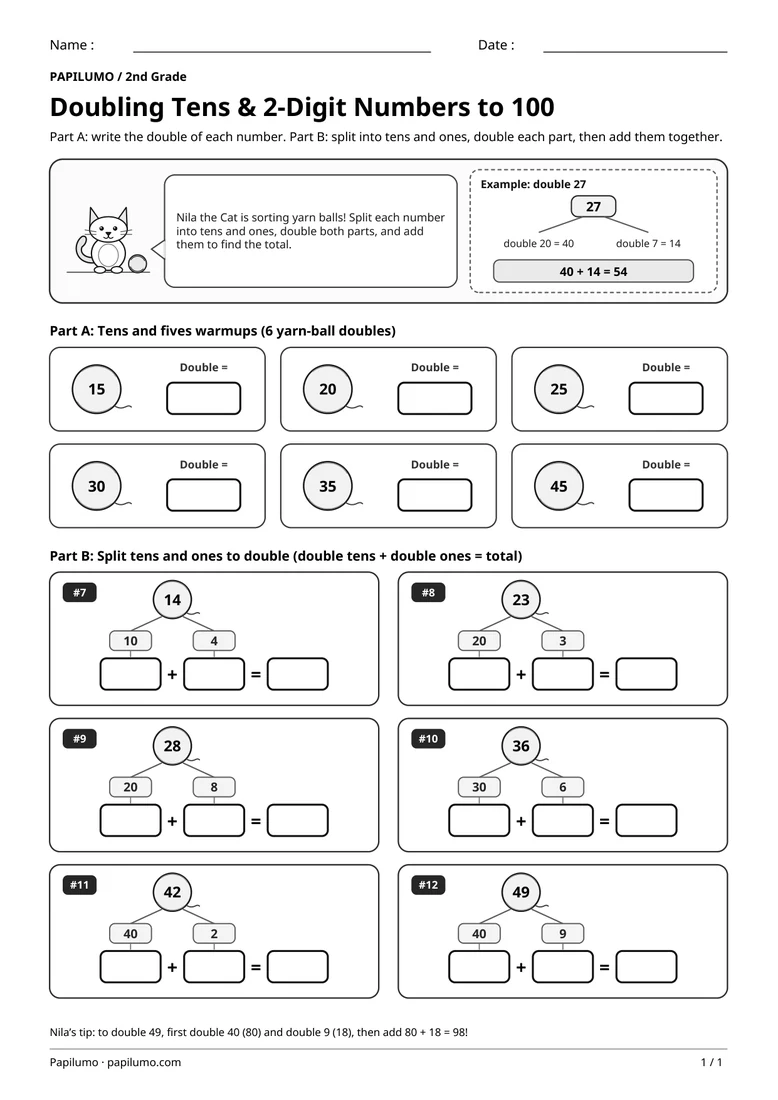
Finding two-digit complements to 100 in 2nd Grade strengthens place-value intuition far beyond slow counting by ones. Instead of guessing or falling into the classic extra-ten trap (writing 86 instead of 76 to pair with 24), students anchor themselves on a clear two-hop mental strategy: first make 10 in the ones place to land on the next multiple of 10, then add the remaining tens up to 100. Varying the blank position between right and left addends reinforces addition commutativity and number-bond flexibility. For a related skill, use Doubling Tens and Two-Digit Numbers to 100 with Nila (2nd Grade): Part A: write the double of each number. Part B: split into tens and ones, double each part, then add them together.
Preparing a short session
Print the student worksheet at actual size (100%) on plain white A4 or letter paper so every bold answer box and open-jump scratch line remains crisp and easy to mark. Seat your learner at a calm desk with a sharpened pencil and eraser, keeping the separate one-page answer key PDF tucked out of sight until all twelve trails are finished. Before tackling Part 2, trace Theo’s worked example together with one finger, naming the stopover ten first.
A concrete example to get started
Inside the framed banner beside Theo the Hedgehog, the worked box “43 + [ ] = 100” breaks down the two-hop trail visually and step by step. First, hop +7 from 43 up to the next ten milestone at 50 (43 + 7 = 50). Next, leap +50 from 50 straight to 100 (50 + 50 = 100). Combining both hops gives 7 + 50 = +57, showing immediately why 43 + 57 = 100 without finger counting.
Supporting the activity
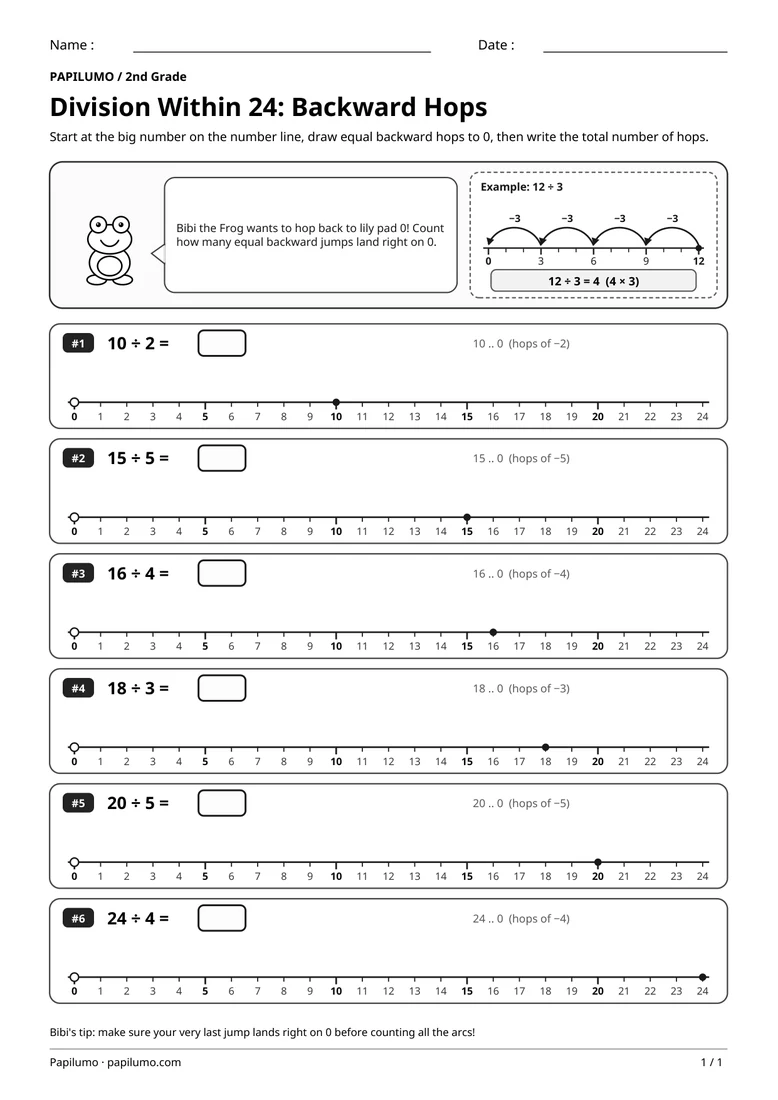
Part 1 opens with four friendly tens warmups: 30 + [ ] = 100 (70), [ ] + 60 = 100 (40), 80 + [ ] = 100 (20), and [ ] + 10 = 100 (90). Part 2 presents eight structured two-digit cards with open-jump scratch lines: 24 + [ ] = 100 (76), [ ] + 58 = 100 (42), 71 + [ ] = 100 (29), [ ] + 16 = 100 (84), 35 + [ ] = 100 (65), [ ] + 62 = 100 (38), 49 + [ ] = 100 (51), and [ ] + 83 = 100 (17). Students mark the next-ten stopover and combine both hops. To vary the practice, try Division as Repeated Subtraction on a Number Line (Within 24) with Bibi: Start at the big number on the number line, draw equal backward hops to 0, then write the total number of hops.
What to notice and how to check
Once all twelve trails reach 100, place the separate one-page answer key PDF beside your child’s worksheet to verify both the final answers and the mental hops. Check every bold complement inside the answer box along with the two-hop mental decomposition printed neatly beneath each equation (to the next ten plus remaining tens). If an answer is ten too high—such as 86 for 24—redraw the two hops together so the learner sees that the first hop already creates the next ten.
Making the task easier
Write the next ten milestone right above the middle tick mark (such as 30 after 24) before finding the two jump sizes.
Keep the learning aim, but reduce how much the child has to handle at once. Cover part of the page with another sheet and reveal one task at a time. Demonstrate a separate example, then leave a real opportunity to work something out. An answer reached with support is still a useful attempt; it does not yet show that the same task can be completed independently.
Taking the idea beyond the worksheet
Double-check each solved card by adding the ones digits to 10 and the tens digits to 90—they must total 100!
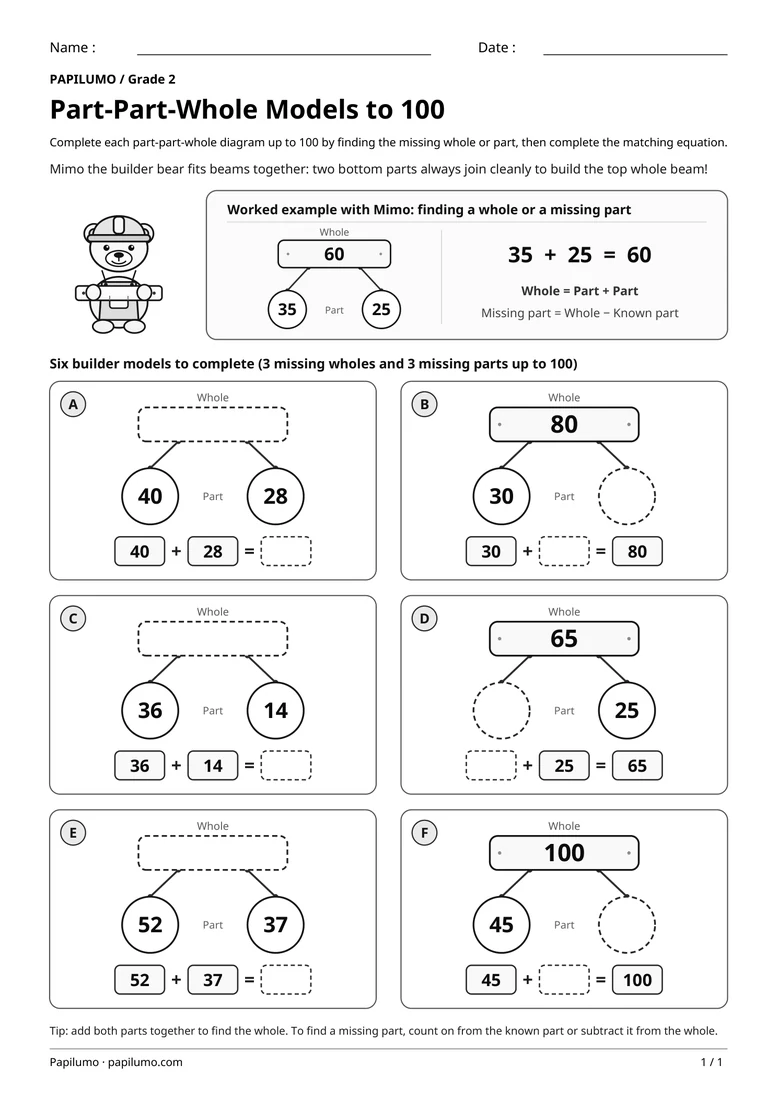
Use the follow-up to meet the same idea in a different setting. Offer it once the first task makes sense, without insisting that the whole page must be perfect. The child might explain a strategy, make an example or set a challenge for an adult. Return to the worksheet only when it helps connect the two situations. A short conversation or a practical activity can be enough to finish the session. To continue exploring, use Part-Part-Whole Models to 100 with Mimo the Builder Bear: Complete each part-part-whole diagram up to 100 by finding the missing whole or part, then complete the matching equation.
Downloading and printing the PDF
This free PDF contains one worksheet designed for A4 paper. Download the file using the button on this page and open it in your PDF reader. Choose actual size or a 100% scale, check the orientation in the print preview and turn off any browser headers or footers. The illustrations use vector lines, so their outlines stay sharp when printed. Check the margins on one copy before preparing several sheets for a group. The level shown on the page is a guide, rather than a requirement to complete the activity at a particular age.