

What this worksheet helps children practise
Solve both small boxes at the bottom first, then compare those two totals in the big circle!
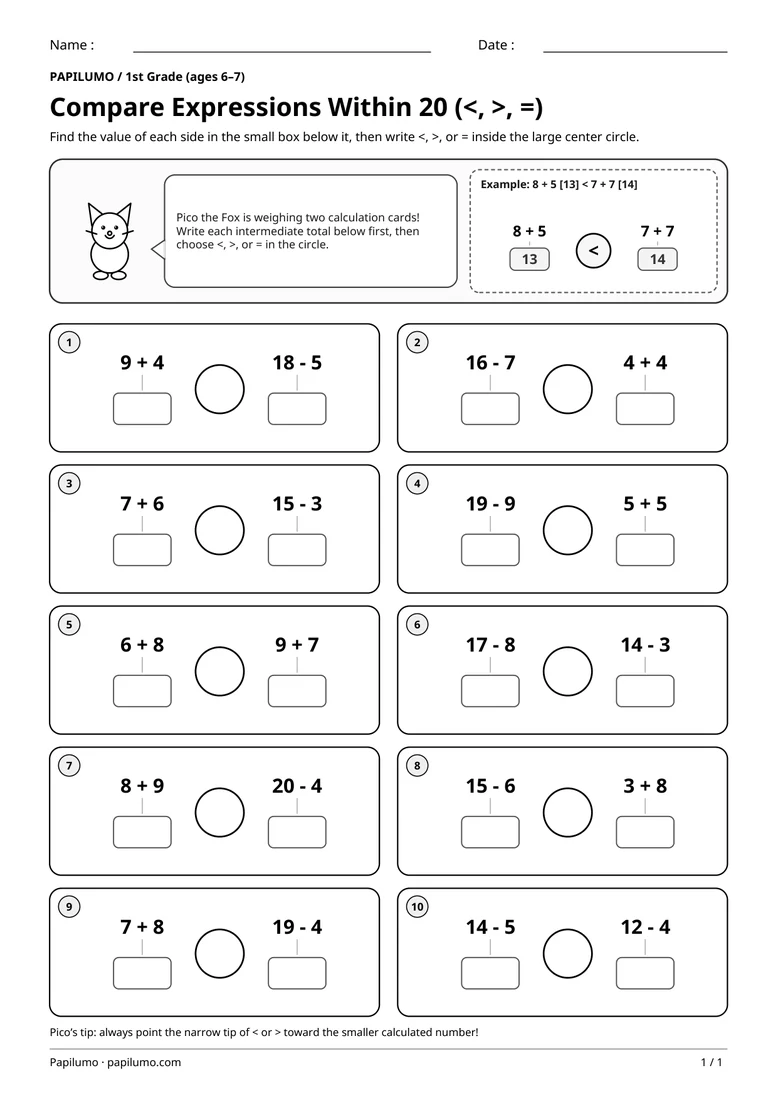
Comparing two complete expressions such as 9 + 4 and 18 - 5 challenges 1st grade learners to compute accurately on both sides and interpret relational symbols (<, >, =) with real mathematical meaning. Jotting each intermediate value inside the small scratch box underneath frees working memory and makes student thinking immediately visible for quick adult coaching. Pairing addition and subtraction on the very same card deepens mental math fluency within 20 and reinforces that the = sign means both sides hold the exact same value, building lasting number flexibility. For a related skill, use Add 2-Digit and 1-Digit Numbers With Regrouping to 99 with Noa: Split the 1-digit number into two parts: first build a bridge to the next ten, then add what is left up to 99.
Preparing a short session
Print the student worksheet at actual size (100%) on crisp white A4 paper and keep the separate one-page answer key tucked safely out of sight while your child works independently. Settle together at a quiet, bright, uncluttered desk with a sharpened pencil and a soft eraser. Before solving the first card, remind your learner to fill in both small sub-boxes beneath each expression first, check both calculated totals briefly, and then compare those two numbers cleanly inside the large center circle without rushing.
A concrete example to get started
Inside the rounded top banner beside smiling Pico the Fox, a friendly speech bubble explains the comparison rule right beside a dashed worked-example box. Inside the model, 8 + 5 sits neatly above a small scratch box holding 13, a bold < fills the center circle, and 7 + 7 sits neatly above a small box holding 14. Young solvers immediately see how computing both sides first makes choosing <, >, or = completely effortless before starting the ten independent cards below.
Supporting the activity
Below the banner, ten airy rounded cards fill five neat rows of two columns mixing addition and subtraction within 20: 9+4 vs 18-5, 16-7 vs 4+4, 7+6 vs 15-3, 19-9 vs 5+5, 6+8 vs 9+7, 17-8 vs 14-3, 8+9 vs 20-4, 15-6 vs 3+8, 7+8 vs 19-4, and 14-5 vs 12-4. Generous scratch sub-boxes beneath both sides and wide center circles give children plenty of neat writing room and clear visual structure across the full page. To vary the practice, try Subtract 1-Digit From 2-Digit Numbers With Regrouping to 99 with Toto: Split the 1-digit number into two parts: first hop back to the previous round ten, then subtract what remains.
What to notice and how to check
When all ten comparison circles are filled in completely, place the separate one-page black-and-white answer key beside your child’s finished worksheet to verify every card calmly in the matching 2×5 grid. The answer key clearly displays both bold intermediate values beneath each expression and the exact symbol (<, >, or =) inside every center circle. Read the equal-value = cards aloud together to highlight equivalent facts, praise careful mental calculation and neat writing, and invite your child to color smiling Pico and the card borders.
Making the task easier
Say the two small box numbers aloud as a sentence like '13 is less than 14' before writing the symbol.
Keep the learning aim, but reduce how much the child has to handle at once. Cover part of the page with another sheet and reveal one task at a time. Demonstrate a separate example, then leave a real opportunity to work something out. An answer reached with support is still a useful attempt; it does not yet show that the same task can be completed independently.
Taking the idea beyond the worksheet
On two cards with < or >, figure out how much you would add to the smaller side to make both sides equal.
Use the follow-up to meet the same idea in a different setting. Offer it once the first task makes sense, without insisting that the whole page must be perfect. The child might explain a strategy, make an example or set a challenge for an adult. Return to the worksheet only when it helps connect the two situations. A short conversation or a practical activity can be enough to finish the session. To continue exploring, use Comparing Numbers to 20: Compare each pair of numbers. Write <, > or = in the box.
Downloading and printing the PDF
This free PDF contains one worksheet designed for A4 paper. Download the file using the button on this page and open it in your PDF reader. Choose actual size or a 100% scale, check the orientation in the print preview and turn off any browser headers or footers. The illustrations use vector lines, so their outlines stay sharp when printed. Check the margins on one copy before preparing several sheets for a group. The level shown on the page is a guide, rather than a requirement to complete the activity at a particular age.