

What this worksheet helps children practise
Ask your child which complement to 10 lands on the next round ten before breaking off the leftover ones.
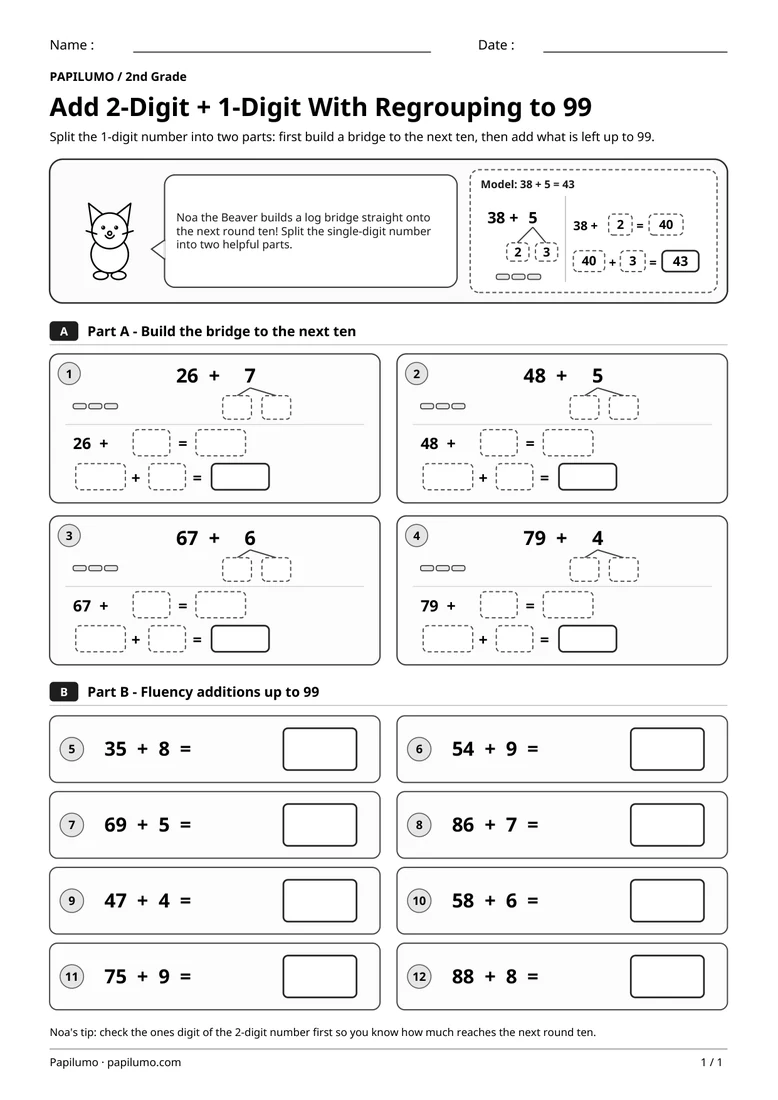
Across twelve carefully graded problems, children connect three essential mental arithmetic skills: reading the ones digit of any 2-digit number to find its exact complement to the next ten, splitting a single-digit addend flexibly into two logical parts, and tracking the resulting tens jump accurately from the 30s all the way to the 90s. Recording both split parts and step equations in the first section makes an invisible mental shortcut concrete before learners shift smoothly to direct fluency sums below. For a related skill, use Subtract 1-Digit From 2-Digit Numbers With Regrouping to 99 with Toto: Split the 1-digit number into two parts: first hop back to the previous round ten, then subtract what remains.
Preparing a short session
Print the student worksheet on one plain white A4 page in sharp black and white and provide a sharpened pencil and eraser. No cutting, gluing, or extra cards are needed. Four spacious guided bridge cards and eight generous fluency frames offer plenty of open writing room for tidy child-sized digits. Plan a relaxed 12-to-15-minute session at home, in a classroom mental-math routine, or at an independent math center while keeping the separate answer key aside.
A concrete example to get started
In the top banner frame beside Noa the Beaver, the worked model walks step by step through 38 + 5. Two clean branches drop below 5 into twin bubbles showing 2 on the left (because 38 + 2 reaches the round ten 40) and 3 on the right. Step 1 writes the bridge equation 38 + 2 = 40 inside a dashed log pill, and Step 2 finishes the crossing with 40 + 3 = 43. Every learner can inspect the exact pattern before touching the first card.
Supporting the activity
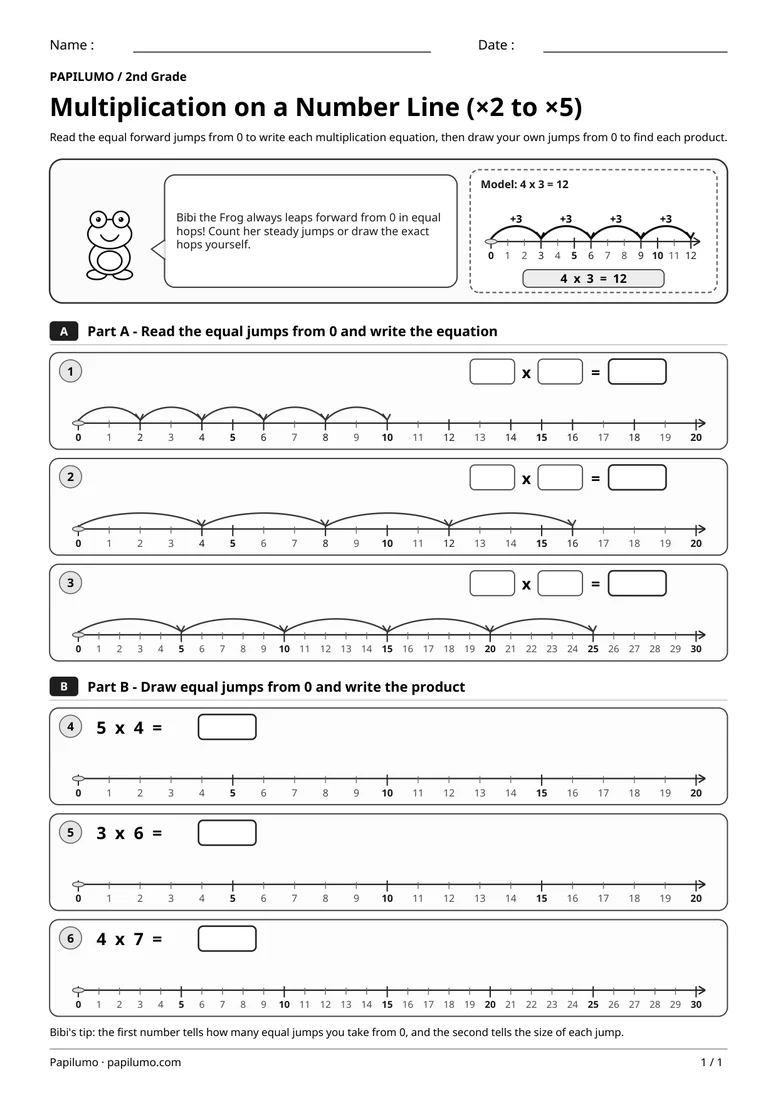
Part A presents four guided bridge cards (26 + 7, 48 + 5, 67 + 6, and 79 + 4) complete with twin split bubbles and two step lines that pause cleanly on 30, 50, 70, and 80. Part B then shifts to eight direct fluency sums up to 99: 35 + 8, 54 + 9, 69 + 5, 86 + 7, 47 + 4, 58 + 6, 75 + 9, and 88 + 8. Students apply the same mental bridge strategy inside wide answer boxes without extra scaffolding. To vary the practice, try Multiplication on a Number Line (Equal Jumps, ×2 to ×5) with Bibi: Read the equal forward jumps from 0 to write each multiplication equation, then draw your own jumps from 0 to find each product.
What to notice and how to check
Once all twelve cards are completed, set the separate one-page answer key PDF right beside your child's completed sheet for calm joint checking. Every guided bridge card shows the exact twin split parts, intermediate round tens, and bold totals (33, 53, 73, and 83), while all eight fluency equations display bold completed sums: 43, 63, 74, 93, 51, 64, 84, and 96. If any sum is off by one, verify first that the two split parts really recombine into the original 1-digit addend.
Making the task easier
For 26 + 7, lay out 2 ten-sticks and 6 loose cubes: slide in 4 cubes to complete 30, then add the remaining 3.
Keep the learning aim, but reduce how much the child has to handle at once. Cover part of the page with another sheet and reveal one task at a time. Demonstrate a separate example, then leave a real opportunity to work something out. An answer reached with support is still a useful attempt; it does not yet show that the same task can be completed independently.
Taking the idea beyond the worksheet
Invite your child to write two extra tens-crossing sums between 50 and 99 on the back, such as 67 + 8 or 85 + 7.
Use the follow-up to meet the same idea in a different setting. Offer it once the first task makes sense, without insisting that the whole page must be perfect. The child might explain a strategy, make an example or set a challenge for an adult. Return to the worksheet only when it helps connect the two situations. A short conversation or a practical activity can be enough to finish the session. To continue exploring, use Two-Digit Addition with Regrouping: Add. Write the carried ten in the small box, then write the sum.
Downloading and printing the PDF
This free PDF contains one worksheet designed for A4 paper. Download the file using the button on this page and open it in your PDF reader. Choose actual size or a 100% scale, check the orientation in the print preview and turn off any browser headers or footers. The illustrations use vector lines, so their outlines stay sharp when printed. Check the margins on one copy before preparing several sheets for a group. The level shown on the page is a guide, rather than a requirement to complete the activity at a particular age.