
What this worksheet helps children practise
Invite your child to trace one wheel and the roof curve with a finger before picking up a pencil.
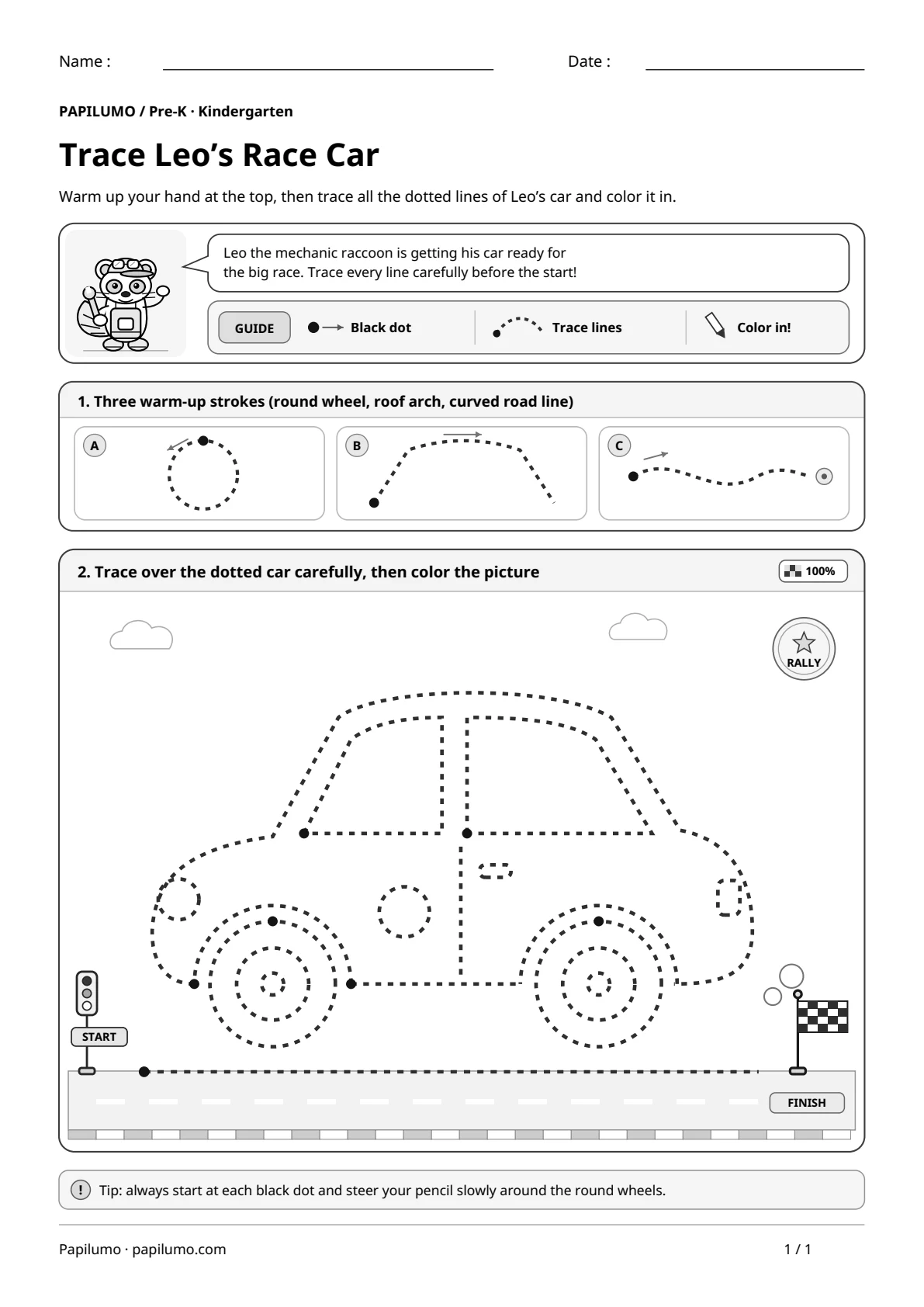
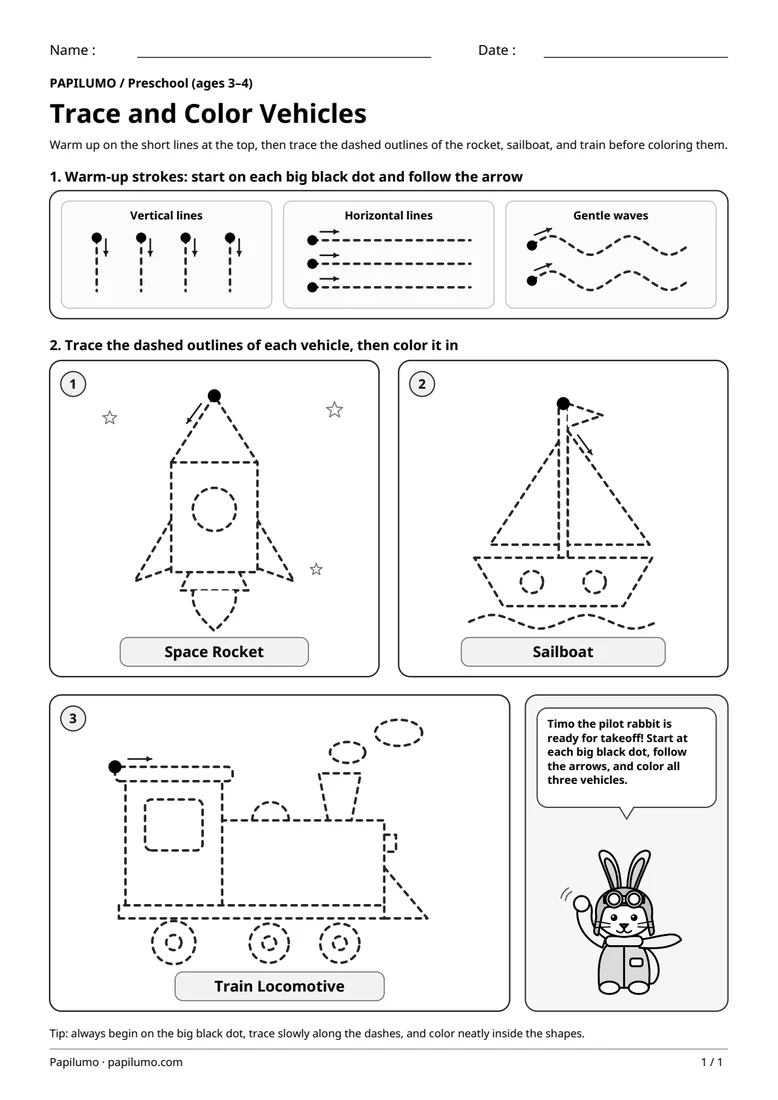
Tracing a complete car outline blends steady pencil control, bilateral hand-eye coordination, and smooth transitions between curved and straight pre-writing movements. Unlike repetitive rows of disconnected shapes, a familiar vehicle motivates children to stay carefully on track: slanted front and rear windshields, curved bumpers, arched wheel wells, concentric circular tires and hubcaps, bright headlights, door seams, and rounded side windows all connect into one meaningful picture. Stopping at each black starting dot teaches intentional directionality, while wrapping up the activity by coloring the car body, wheels, and checkered finish flag reinforces finger endurance, wrist stability, and creative pride. For a related skill, use Trace and Color Vehicles (Rocket, Sailboat, Train) with Timo the Rabbit: Warm up on the short lines at the top, then trace the dashed outlines of the rocket, sailboat, and train before coloring them.
Preparing a short session
Print the student worksheet at actual size (100%) on crisp white A4 or letter paper without shrinking page margins. Offer a sharpened thick pencil or medium-tip washable marker for clear dotted tracing, along with crayons or colored pencils for the final coloring step. Keep a soft eraser within easy reach if older preschoolers want to smooth a corner, though tracing freely matters far more than perfection. Help children sit comfortably with both feet supported and one forearm resting lightly on the table, turning the sheet slightly toward their writing hand so circular wheel strokes flow naturally without twisting the wrist.
A concrete example to get started
1. Three warm-up strokes (round wheel, roof arch, curved road line)
Supporting the activity
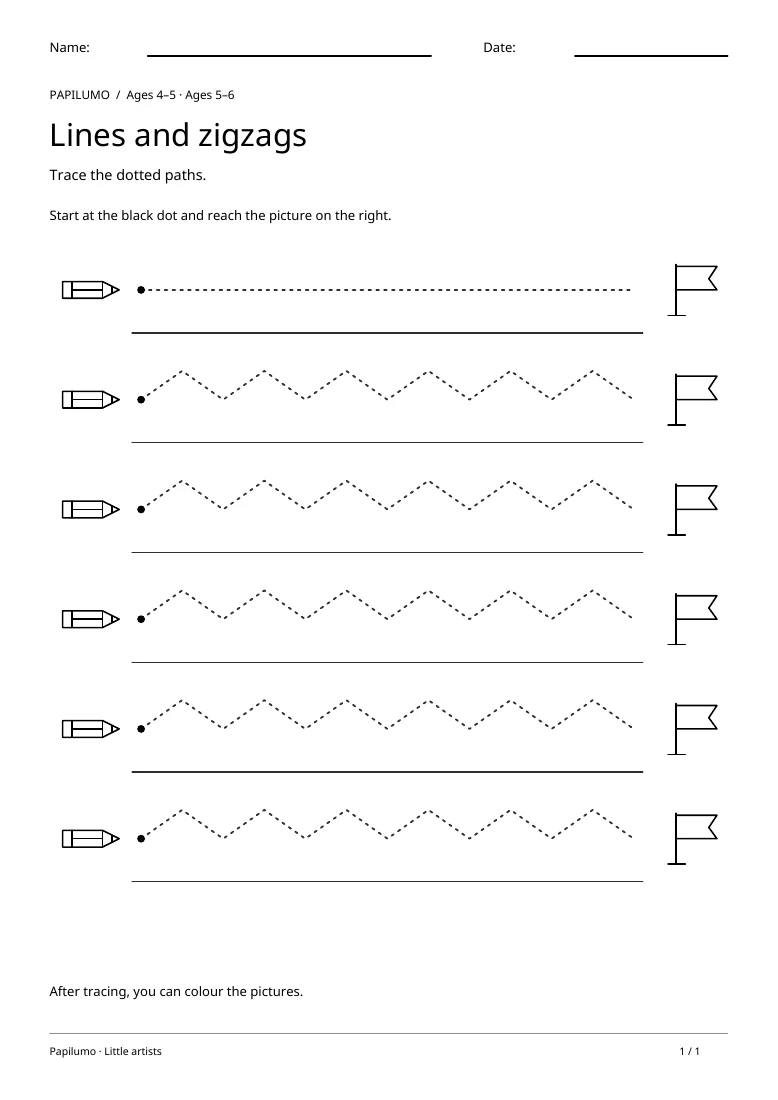
Next, move down to the large dotted race car across the middle of the page. Guide learners to work piece by piece rather than rushing in a single breath: start with the outer car body silhouette and curved wheel arches, then complete the two rounded cabin windows, the front and rear concentric wheels with rims and center caps, the headlight, taillight, racing circle badge, door handle, and finally the dotted road leading toward the checkered flag. Stopping briefly at each black dot keeps lines neat and accurate. To vary the practice, try Straight Line and Zigzag Tracing Worksheet: Trace the dotted paths.
What to notice and how to check
When the tracing is finished, place the completed worksheet beside the solid adult reference sheet. Check together that each wheel ring closes smoothly without pointed corners, that window frames sit centered inside the cabin roof, and that bumper curves join the chassis cleanly. Praise strong, steady control on tricky curves first, gently retrace any wobbly stretch together if desired, and invite children to write a favorite racing number inside the door circle before coloring Leo’s car.
Making the task easier
Trace just the outer car silhouette and two big wheels first, then add windows and headlights later.
Keep the learning aim, but reduce how much the child has to handle at once. Cover part of the page with another sheet and reveal one task at a time. Demonstrate a separate example, then leave a real opportunity to work something out. An answer reached with support is still a useful attempt; it does not yet show that the same task can be completed independently.
Taking the idea beyond the worksheet
Write a favorite racing number inside the door circle and draw rolling hills behind the track.
Use the follow-up to meet the same idea in a different setting. Offer it once the first task makes sense, without insisting that the whole page must be perfect. The child might explain a strategy, make an example or set a challenge for an adult. Return to the worksheet only when it helps connect the two situations. A short conversation or a practical activity can be enough to finish the session. To continue exploring, use Trace and Color Forest Animals with Eli the Squirrel: Start at each solid black dot to trace smoothly along the dotted lines, then color all four woodland drawings.
Downloading and printing the PDF
This free PDF contains one worksheet designed for A4 paper. Download the file using the button on this page and open it in your PDF reader. Choose actual size or a 100% scale, check the orientation in the print preview and turn off any browser headers or footers. The illustrations use vector lines, so their outlines stay sharp when printed. Check the margins on one copy before preparing several sheets for a group. The level shown on the page is a guide, rather than a requirement to complete the activity at a particular age.