


What this worksheet helps children practise
Rest your pencil on the black dot, breathe slowly, and let your fingers glide without pressing too hard.
Tracing large, playful picture contours builds essential fine-motor control, wrist flexibility, and steady hand-eye coordination in preschool. As learners follow big round eyes, repeating scalloped feathers, a smooth spiral shell, flowing wing loops, and a curved arch door, they practice slowing down around bends, adjusting grip pressure, and closing shapes neatly. Combining structured pre-writing strokes with open coloring inside clear borders also strengthens visual focus, bilateral paper steadying, and finger stamina ahead of early letter formation. For a related skill, use Trace and Color Farm Animals with Mimi the Farmer Bear: Warm up on the fence posts, roof peaks, and meadow bumps, then trace each dotted animal from the big black dot and color it in.
Preparing a short session
Print the student worksheet at actual size (100%) on sturdy white paper so crayons or colored pencils glide smoothly without tearing or bleeding through the page. Seat your child comfortably at table height with both forearms supported and offer a thick pencil, soft eraser, or triangular crayons for an easy three-finger grip. Before starting, look together at the small demonstration banner beside Eli the little artist squirrel at the top of the page, while keeping the separate completed answer key tucked neatly out of sight.
A concrete example to get started
Inside the top demo box next to Eli the little artist squirrel, children see the full tracing move in a single glance: set the pencil tip right on the solid black starter anchor dot, glide steadily over the evenly spaced dashes without rushing, and end with a clean solid line just like the finished model shown right beside it. Having a visible starter anchor dot at the beginning of each dotted path removes guesswork for four- and five-year-olds and builds calm confidence from the very first stroke.
Supporting the activity
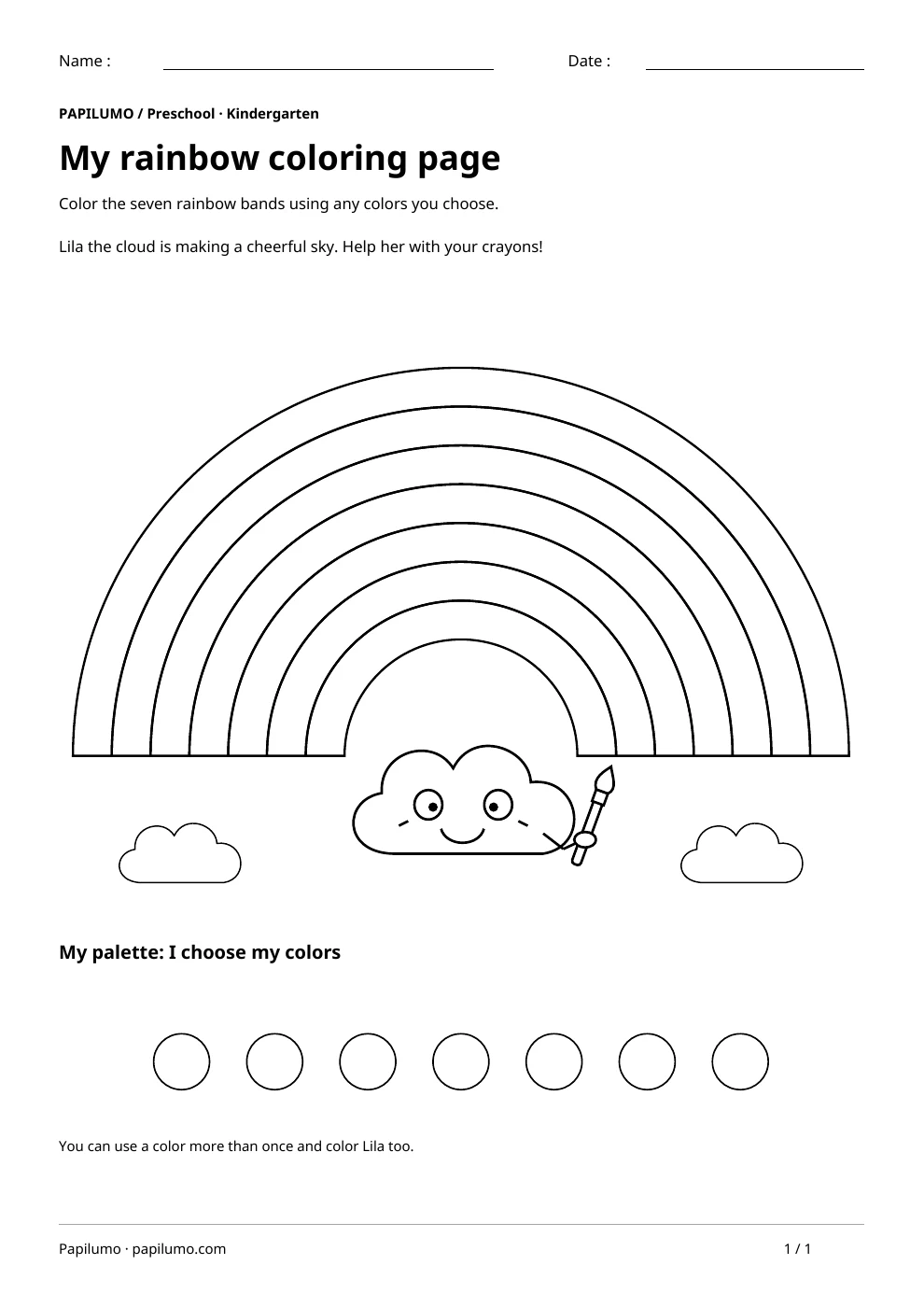
The page features a balanced two-by-two grid with four generous frames sized specifically for preschool hands and early crayon strokes. In frame 1, the friendly perched owl lets learners trace big round eyes, folded side wings, and two neat rows of scalloped belly feathers. In frame 2, the gliding snail guides pencils along a gentle body curve, two antennae, and a continuous spiral shell. Frame 3 introduces flowing loop patterns inside the butterfly’s four wings, while frame 4 invites children to trace the smiling mushroom house’s dome roof, round spots, and arched doorway before coloring. To vary the practice, try Rainbow Coloring Page with Lila the Cloud: Color the seven rainbow bands using any colors you choose.
What to notice and how to check
When your child finishes tracing and coloring, place the separate answer key beside the student sheet so they can compare every finished solid black contour against their own pencil lines. Check gently together that strokes start near the anchor dots, stay close to the dotted tracks around curves, scallops, and spirals, and close cleanly without sharp corners. If any curve felt tricky, invite your child to trace that path slowly with one finger first or go over it lightly with a thicker washable marker.
Making the task easier
Trace each dotted path with one finger first—starting with the owl’s big round eyes and the snail’s spiral.
Keep the learning aim, but reduce how much the child has to handle at once. Cover part of the page with another sheet and reveal one task at a time. Demonstrate a separate example, then leave a real opportunity to work something out. An answer reached with support is still a useful attempt; it does not yet show that the same task can be completed independently.
Taking the idea beyond the worksheet
Draw extra woodland details around each frame such as falling leaves, tiny flowers, or sunny clouds, then tell a short story.
Use the follow-up to meet the same idea in a different setting. Offer it once the first task makes sense, without insisting that the whole page must be perfect. The child might explain a strategy, make an example or set a challenge for an adult. Return to the worksheet only when it helps connect the two situations. A short conversation or a practical activity can be enough to finish the session. To continue exploring, use Trace and Color Ocean Animals with Lila the Sea Otter: Warm up on the waves and bubbles, then trace each dotted outline from the big black dot and color all four sea creatures.
Downloading and printing the PDF
This free PDF contains one worksheet designed for A4 paper. Download the file using the button on this page and open it in your PDF reader. Choose actual size or a 100% scale, check the orientation in the print preview and turn off any browser headers or footers. The illustrations use vector lines, so their outlines stay sharp when printed. Check the margins on one copy before preparing several sheets for a group. The level shown on the page is a guide, rather than a requirement to complete the activity at a particular age.