What this worksheet helps children practise
Let children choose and reuse colors. Suggest short movements and offer a break before coloring becomes tiring.
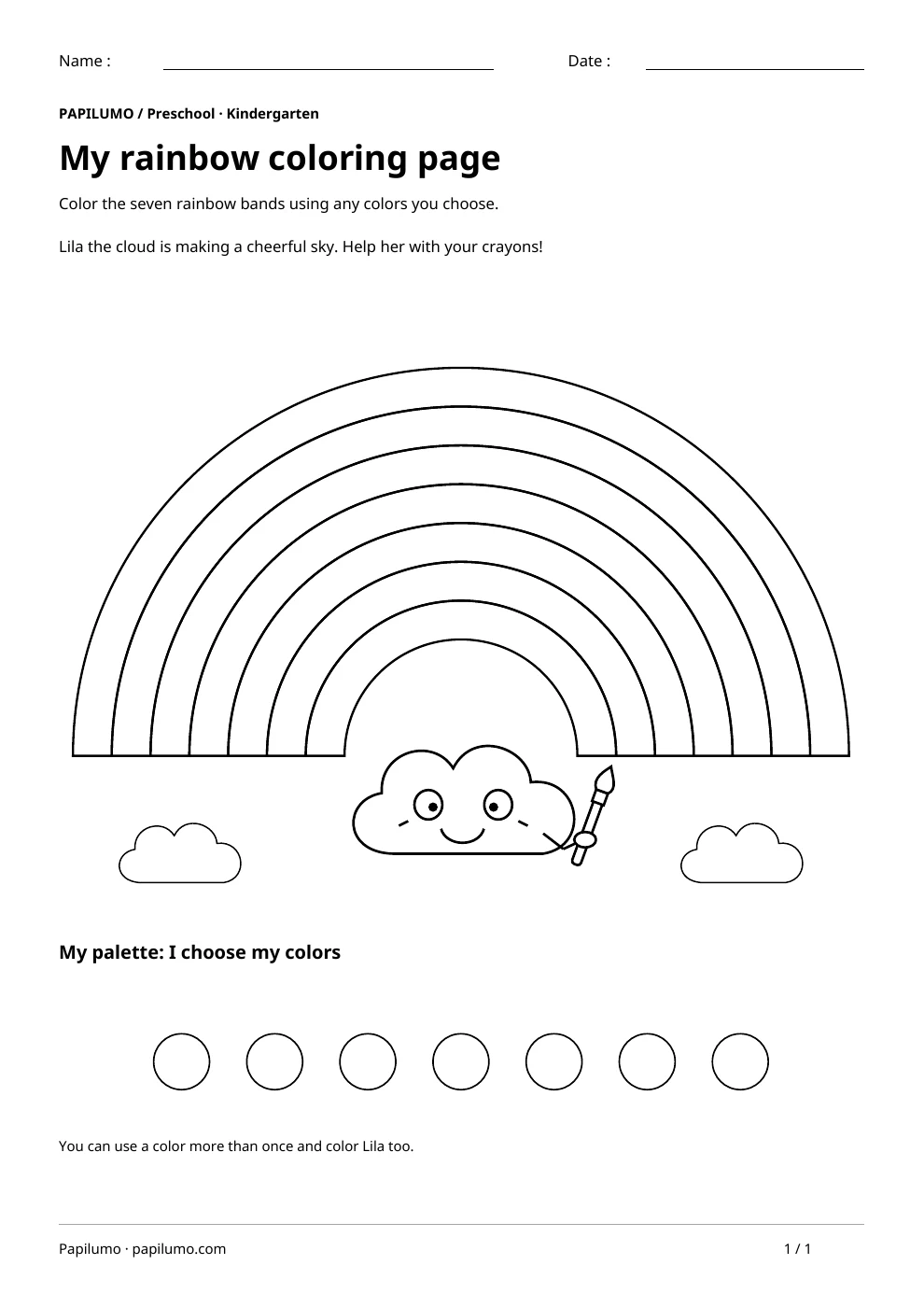
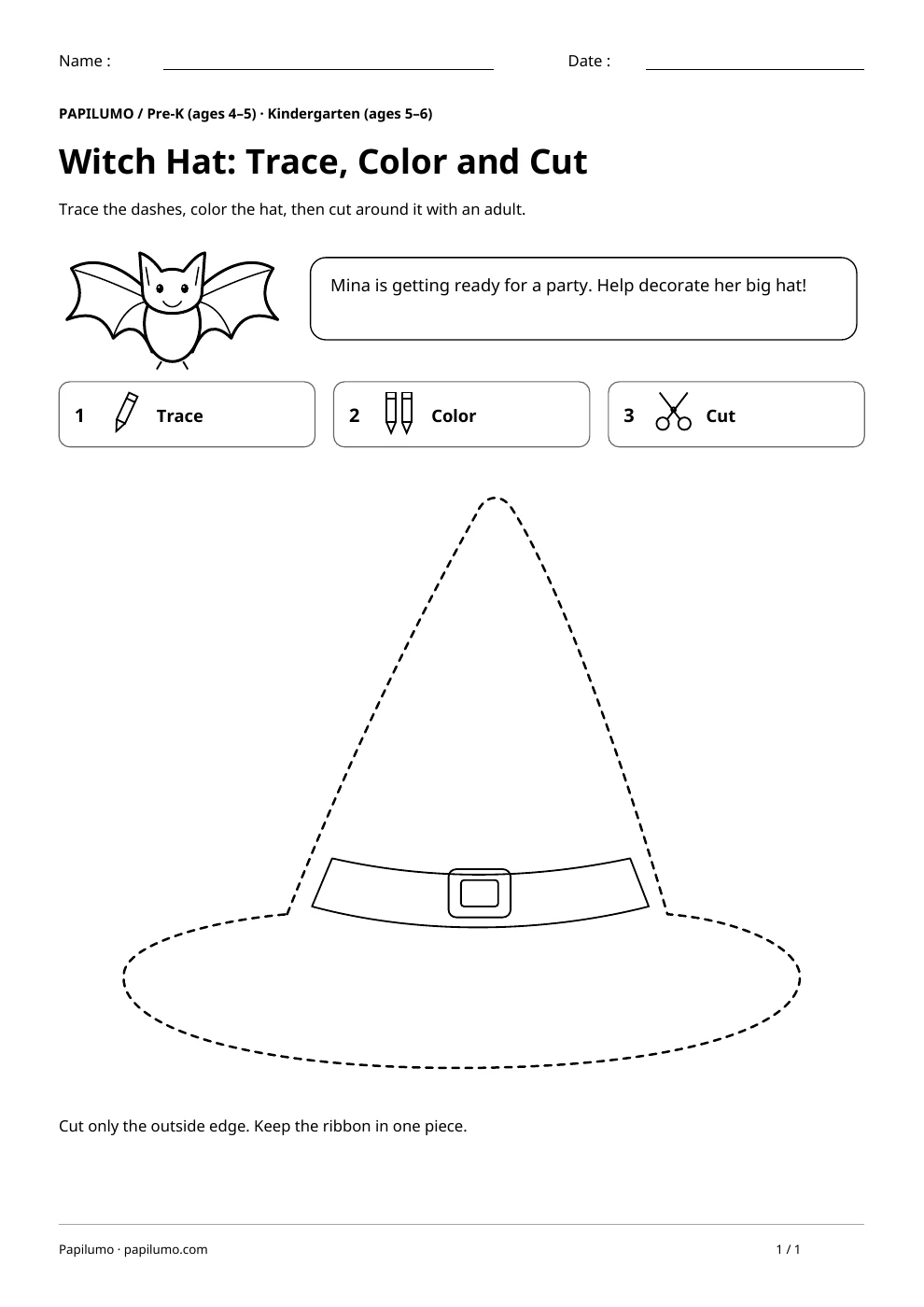
The activity supports color choices and control of a drawing tool within curved spaces. It does not require reading numerals, solving calculations or following a color code. The seven bands are a drawing format, not a scientific lesson about the colors of light. Preschool and kindergarten are suggested starting points. Adjust the length of the activity, the drawing tool and the amount of coloring to the child’s comfort. Recognizing a boundary can be practiced without demanding perfectly neat results. For a related skill, use Witch Hat: Trace, Color and Cut: Trace the dashes, color the hat, then cut around it with an adult.
Preparing a short session
Print the child’s page at actual size on A4 paper. Put out a small selection of pencils or crayons, reducing the choices if that makes starting easier. Introduce Lila and ask which color she might use first. Allow children to turn the sheet to find a comfortable hand position. Keep the guidance page with the adult. Its numbers simply identify the seven bands and should not be turned into a compulsory color-by-number task.
A concrete example to get started
A child might choose a blue pencil, try it in one palette circle and then color one band of the large rainbow. That is only one possible approach. Starting directly on the rainbow, choosing another color or using blue again elsewhere are also welcome. Demonstrate a short, slow movement on spare paper rather than completing the first band for the child. Leave room for personal choices and small experiments with pressure and direction.
Supporting the activity
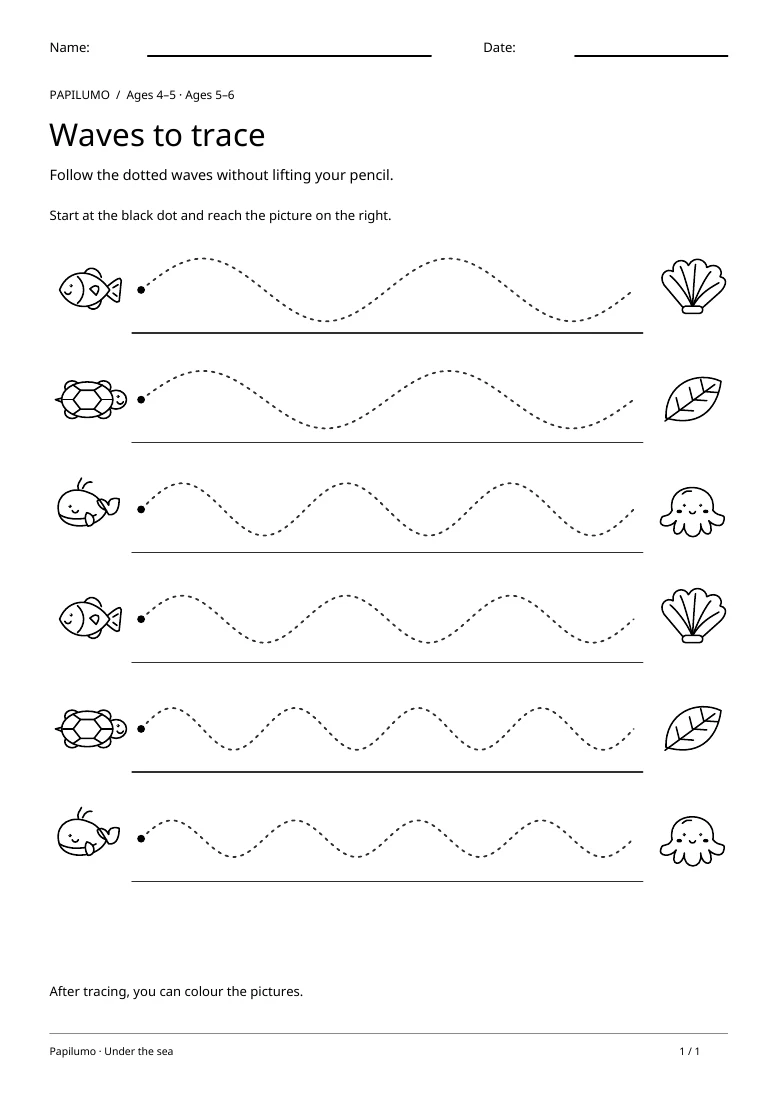
Invite the child to choose one band and fill part of it with small, comfortable movements. Working from the outside toward the center is possible but not required. Point out the edges if the chosen space becomes hard to follow. Pause after one or two bands when needed. The seven circles are an optional palette, not another task that must be finished. Lila can be colored after the broad bands if the child wants. There is no need to fill every part of the page in one sitting. To vary the practice, try Wavy Line Tracing Worksheet: Ocean Waves: Follow the dotted waves without lifting your pencil.
What to notice and how to check
There is no single correct set of colors. The adult page numbers the bands 1 through 7, from largest to smallest, to support a conversation or help locate a space. Those numbers do not appear on the child’s picture. Notice whether children can find their chosen area, adjust a movement near an edge and describe a preference if they wish. A small mark outside a line does not make the picture wrong. Avoid redrawing their work to make every band look uniform.
Making the task easier
Offer two crayons and just one broad band. Return to the other areas in another short session.
Keep the learning aim, but reduce how much the child has to handle at once. Cover part of the page with another sheet and reveal one task at a time. Demonstrate a separate example, then leave a real opportunity to work something out. An answer reached with support is still a useful attempt; it does not yet show that the same task can be completed independently.
Taking the idea beyond the worksheet
Name some of the colors used or compare two bands. Make up a short story about Lila’s sky without requiring another completed picture.
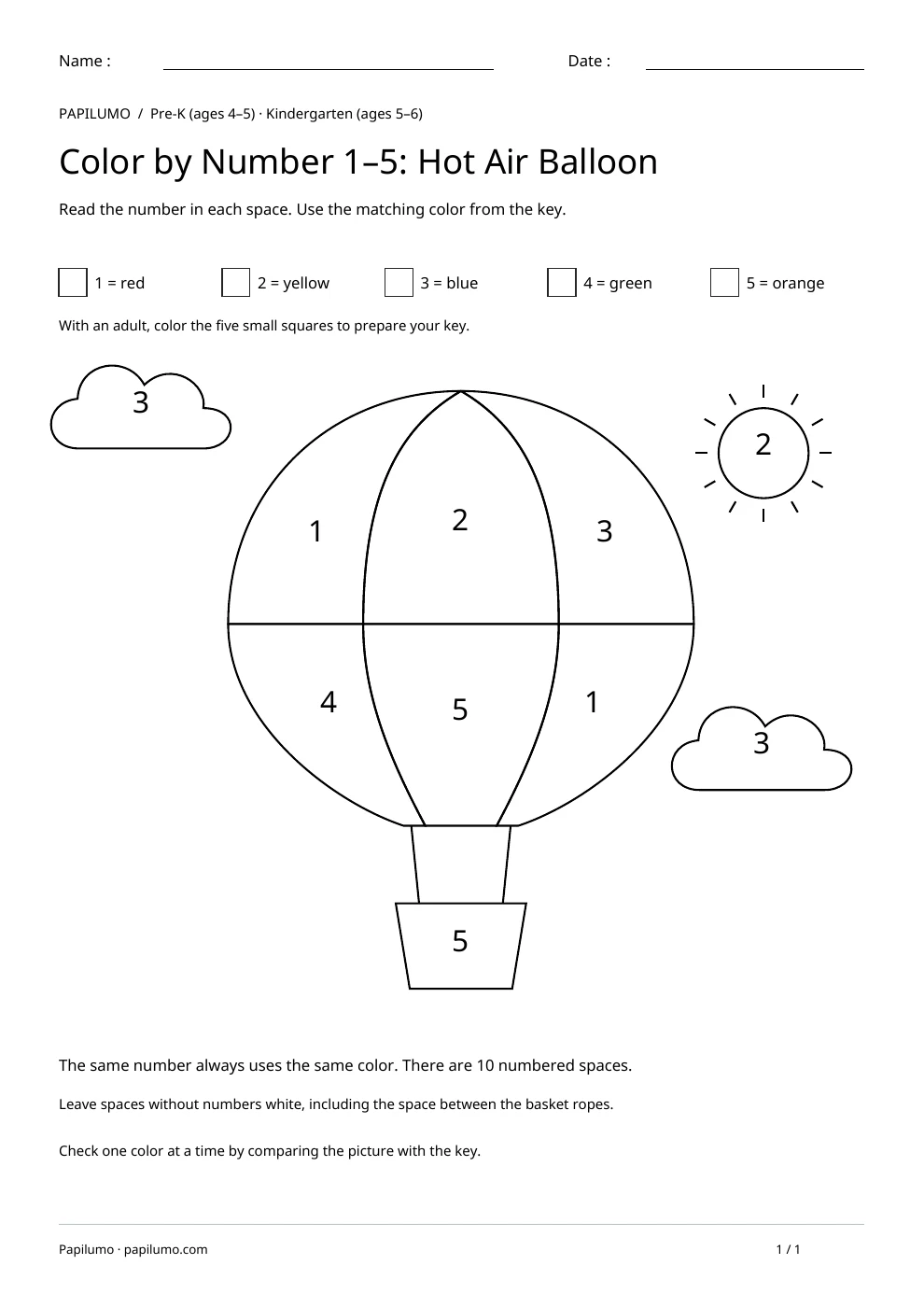
Use the follow-up to meet the same idea in a different setting. Offer it once the first task makes sense, without insisting that the whole page must be perfect. The child might explain a strategy, make an example or set a challenge for an adult. Return to the worksheet only when it helps connect the two situations. A short conversation or a practical activity can be enough to finish the session. To continue exploring, use Color by Number 1–5: Hot Air Balloon: Read the number in each space. Use the matching color from the key.
Downloading and printing the PDF
This free PDF contains one worksheet designed for A4 paper. Download the file using the button on this page and open it in your PDF reader. Choose actual size or a 100% scale, check the orientation in the print preview and turn off any browser headers or footers. The illustrations use vector lines, so their outlines stay sharp when printed. Check the margins on one copy before preparing several sheets for a group. The level shown on the page is a guide, rather than a requirement to complete the activity at a particular age.