What this worksheet helps children practise
Ask children to name the place before writing its digit. Distinguish three tens from three ones so the written product keeps its meaning.
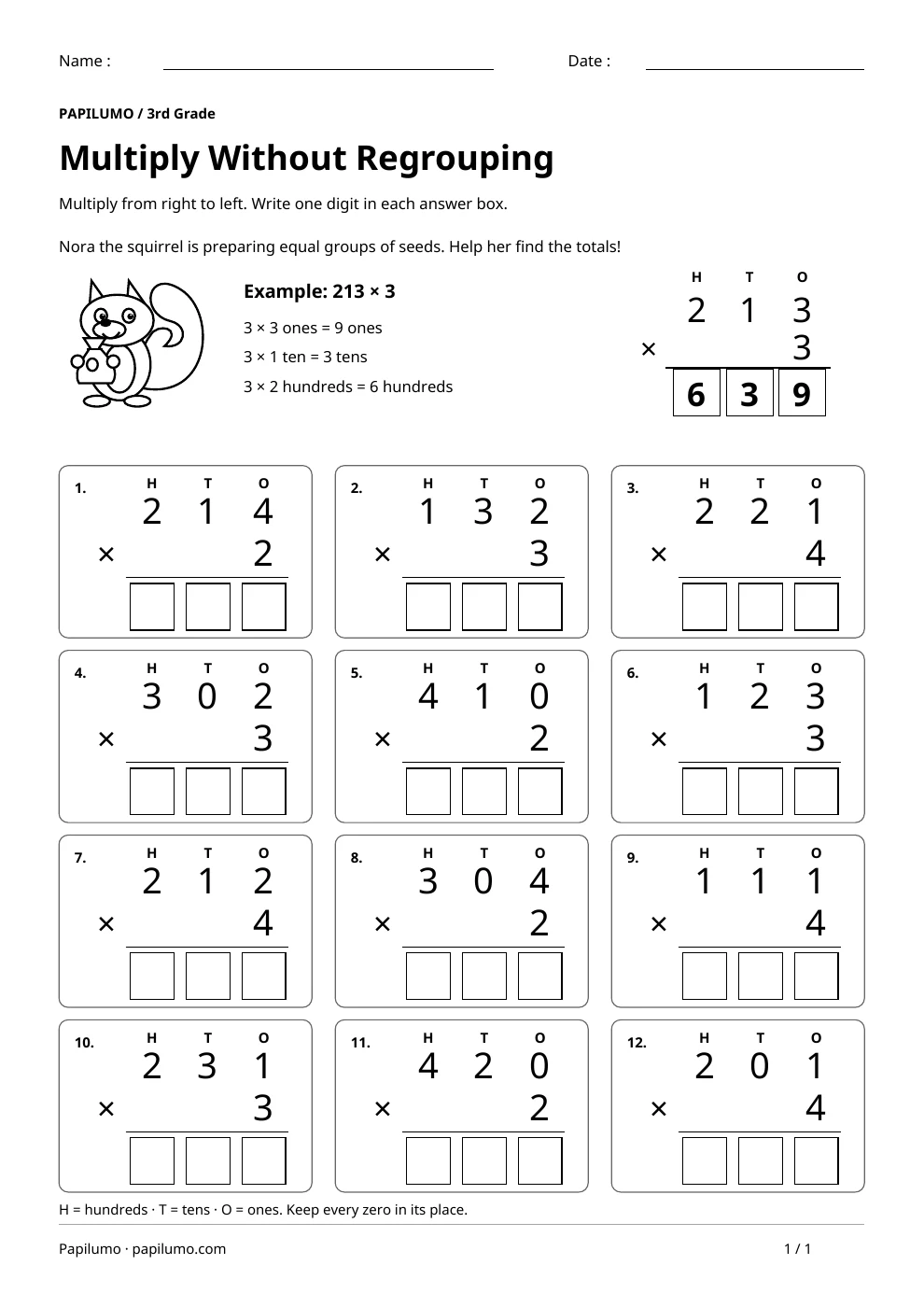
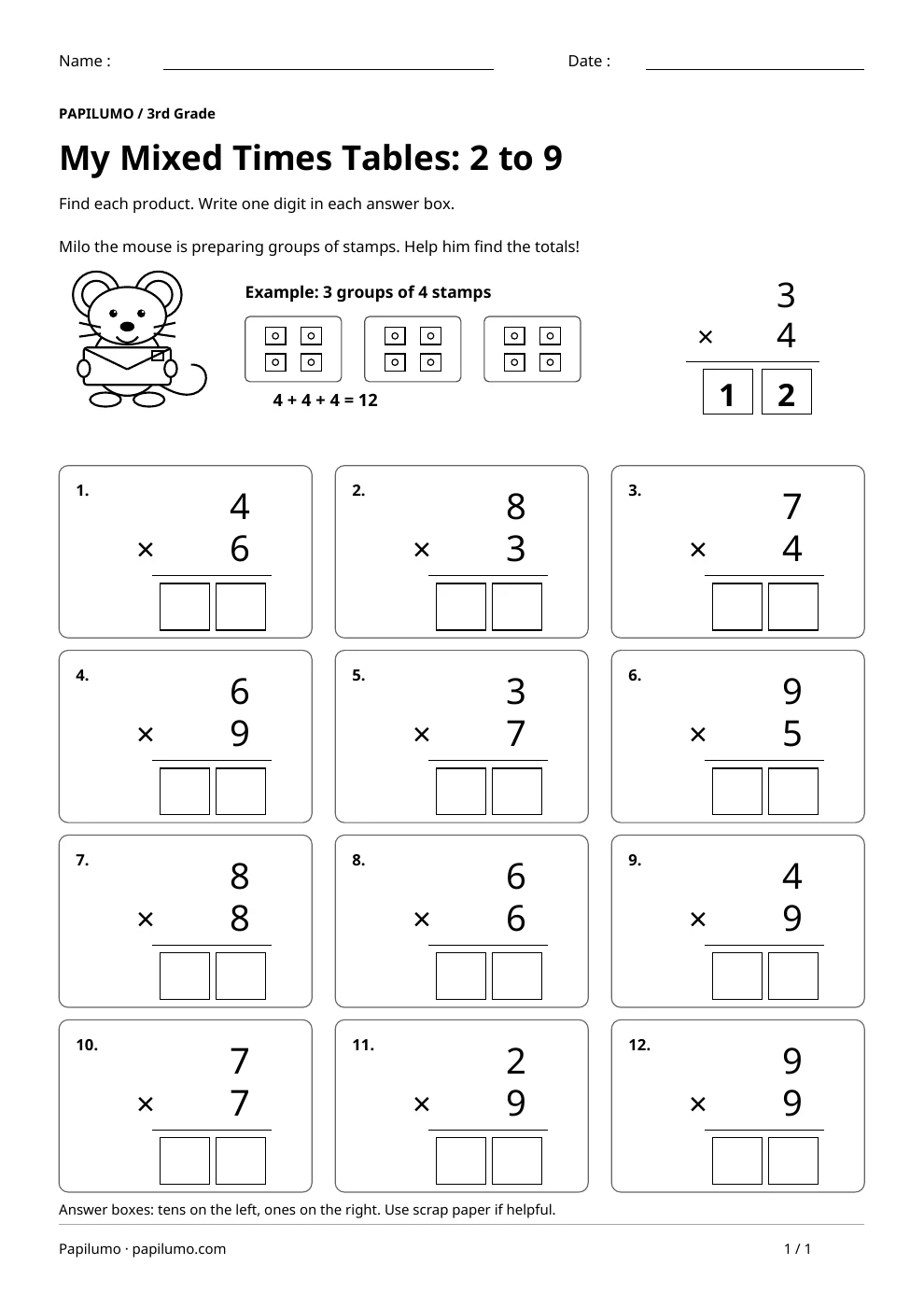
This activity can support third-grade multiplication practice when children know the relevant facts and understand place value. Readiness matters more than the grade label. Instead of recalling one isolated fact, children multiply the ones, tens and hundreds of the same number. Every column product is less than ten, so they can focus on alignment and the meaning of the written method before regrouping is introduced. All final answers have three digits. Several problems include a zero, either in the original number or in the product, and its position matters. For a related skill, use Mixed Multiplication Facts: Times Tables 2–9: Find each product. Write one digit in each answer box.
Preparing a short session
Print at actual size and provide a pencil and scrap paper. Keep the key aside. Read the column labels together: H means hundreds, T means tens and O means ones. The one-digit multiplier sits under the ones. Show the order of the numbered frames, left to right and then top to bottom. Base-ten blocks or simple place-value sketches can help children understand the example before they use only written digits.
A concrete example to get started
For 213 × 3, start with 3 × 3 ones = 9 ones. Next, 3 × 1 ten = 3 tens, and 3 × 2 hundreds = 6 hundreds. The answer is 639, also written as 600 + 30 + 9. The middle 3 represents thirty, not three ones. Apply the same steps to the first task, 214 × 2: 8 ones, 2 tens and 4 hundreds make 428. Read the whole answer after recording its separate digits.
Supporting the activity
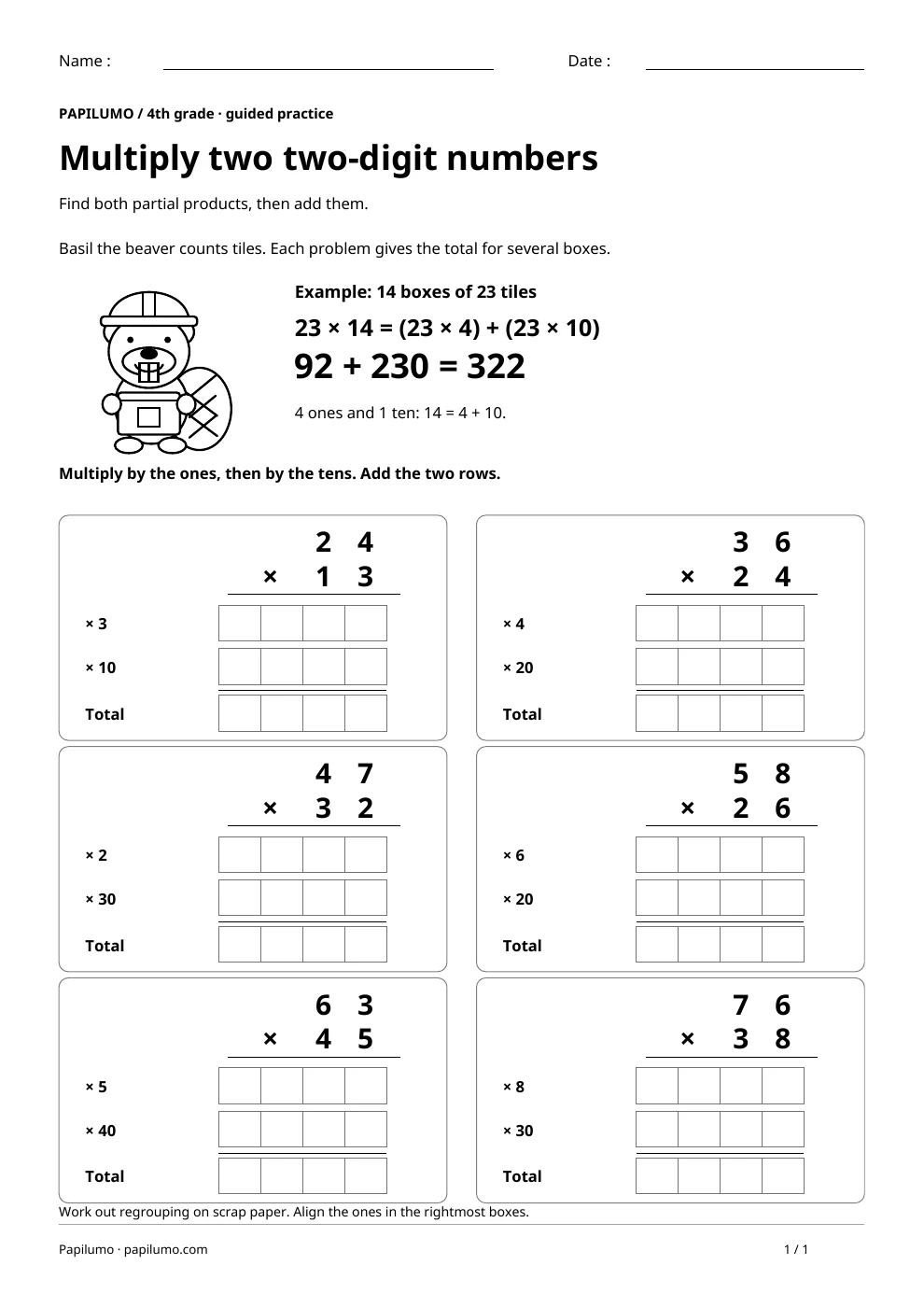
Offer a row of three problems at a time. Children identify the number of equal groups, work from right to left and write each digit in the matching column. They may say each small multiplication aloud before recording it. For 302 × 3, the zero in the tens column is essential: the answer is 906. Writing 96 changes the place values. If a fact is difficult, allow a multiplication chart so the main focus can remain on the written method. There is no need for a timer or a single uninterrupted sitting. To vary the practice, try Two-digit by two-digit multiplication with partial products: Find both partial products, then add them.
What to notice and how to check
The answers in order are 428, 396, 884, 906, 820, 369, 848, 608, 444, 693, 840 and 804. The key fills all three boxes in each frame. Check fact knowledge, alignment and zeros separately. Decomposing the starting number offers another check: 302 × 3 = 900 + 0 + 6. If a child adds 214 and 2 instead, return to the meaning of two equal groups of 214. Correct the specific step rather than asking for the entire sheet again.
Making the task easier
Begin with three problems multiplying by 2. Cover the remaining frames and allow a sketch of hundreds, tens and ones on scrap paper.
Keep the learning aim, but reduce how much the child has to handle at once. Cover part of the page with another sheet and reveal one task at a time. Demonstrate a separate example, then leave a real opportunity to work something out. An answer reached with support is still a useful attempt; it does not yet show that the same task can be completed independently.
Taking the idea beyond the worksheet
Invent a short story for 201 × 4. Then choose another three-digit number that can be multiplied by 3 without regrouping and explain why it works.
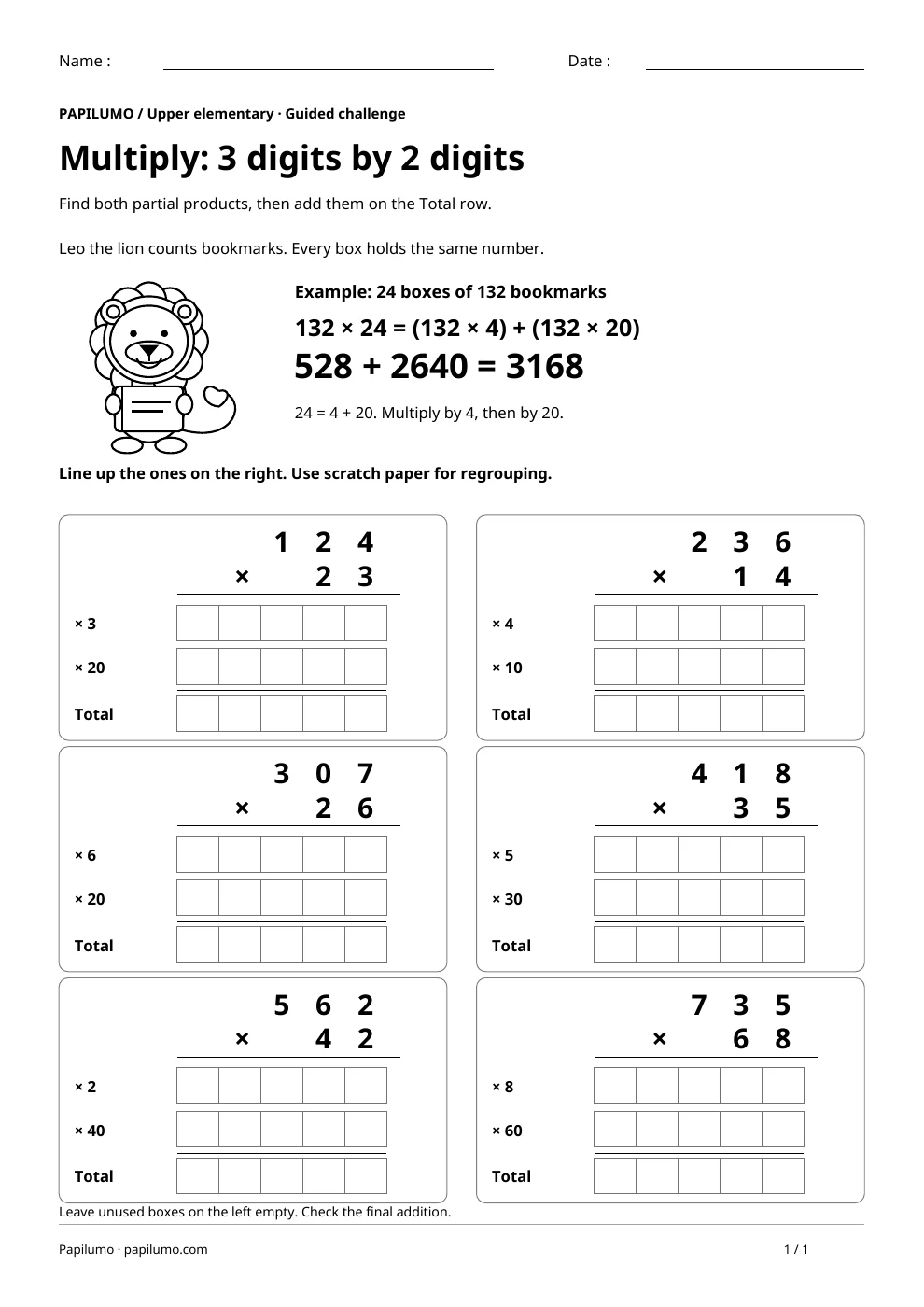
Use the follow-up to meet the same idea in a different setting. Offer it once the first task makes sense, without insisting that the whole page must be perfect. The child might explain a strategy, make an example or set a challenge for an adult. Return to the worksheet only when it helps connect the two situations. A short conversation or a practical activity can be enough to finish the session. To continue exploring, use 3-Digit by 2-Digit Multiplication with Partial Products: Find both partial products, then add them on the Total row.
Downloading and printing the PDF
This free PDF contains one worksheet designed for A4 paper. Download the file using the button on this page and open it in your PDF reader. Choose actual size or a 100% scale, check the orientation in the print preview and turn off any browser headers or footers. The illustrations use vector lines, so their outlines stay sharp when printed. Check the margins on one copy before preparing several sheets for a group. The level shown on the page is a guide, rather than a requirement to complete the activity at a particular age.