

What this worksheet helps children practise
Count the straight sides and corners with your finger, check the word bank, and write neatly on the guided line!
Connecting visual 2D shapes to their accurate written names and defining geometric attributes is a cornerstone of 1st grade geometry. Rather than guessing from overall appearance alone, children learn to inspect defining features—counting straight sides, spotting corners, and comparing side lengths—to distinguish a square from a rectangle, a circle from an oval, or a diamond from a triangle. Copying words from an illustrated word bank onto guided writing lines reinforces precise math vocabulary, independent reading of short clues, neat letter sizing, and steady pencil control. For a related skill, use Tangram Puzzles: Identify and Fit the 7 Pieces with Kiko: Study the 7-piece Tangram square, fill in the shape counts, draw straight split lines inside each silhouette, and match the pairs.
Preparing a short session
Print the student worksheet at actual size (100%) on plain white A4 or letter paper, and set your child up at a clear table with a sharpened pencil and clean eraser. Keep the separate one-page answer key neatly out of sight while your child solves both sections independently. Before writing the first word, examine the six illustrated reference badges in the top word bank together, reading each label aloud while tracing the straight sides, corners, or smooth curved outlines carefully with one finger.
A concrete example to get started
Inside the top banner right next to Zelie the detective ferret, a worked mini card clearly models the writing task: a crisp vector triangle appears with small counting tick marks along its three sides above the word triangle written neatly on a guided two-line baseline. Seeing the completed example helps young learners gauge letter height right away and shows how checking the shape's sides and corners first makes choosing the matching word from the word bank quick, calm, and completely reliable.
Supporting the activity
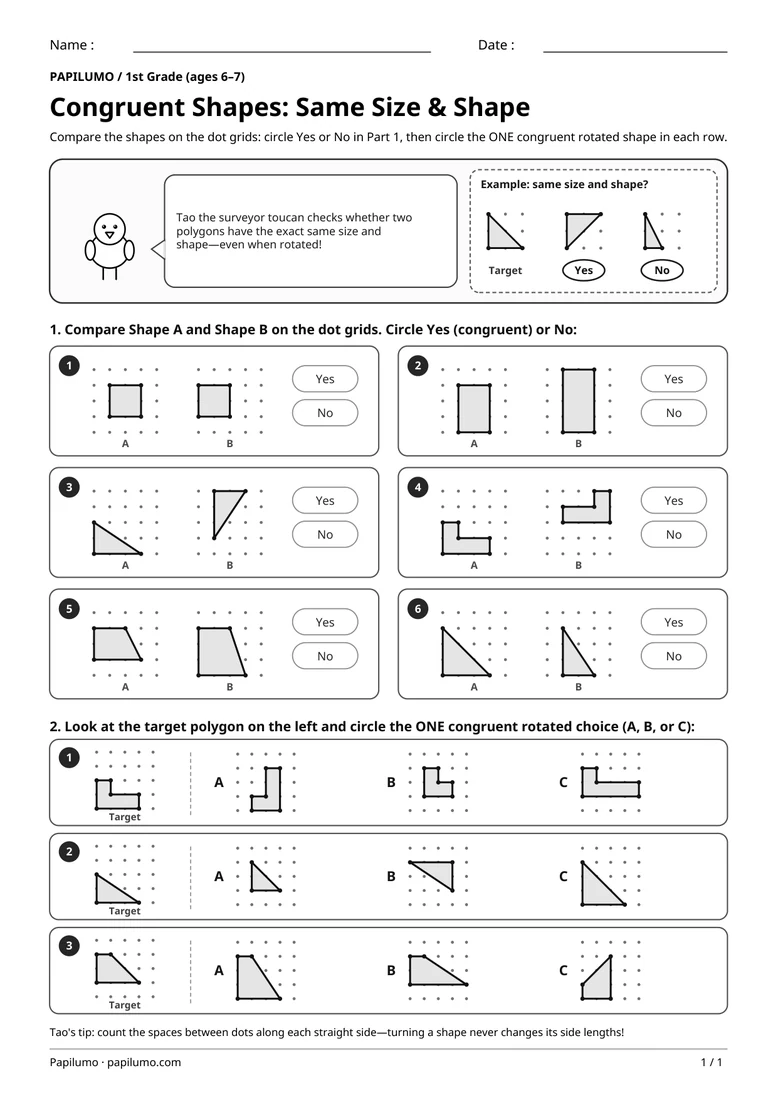
Part 1 displays six spacious numbered cards arranged in a mixed order compared with the word bank: a wide rectangle, a round circle, a vertical diamond, a triangle, a horizontal oval, and a square. Under each clean figure, students carefully write the exact shape name on the guided two-line writing strip. Part 2 presents four 'Who Am I?' clue rows: 4 equal sides and 4 square corners (square), 2 long and 2 short sides (rectangle), 3 straight sides and 3 corners (triangle), and completely round with 0 corners (circle), circling the matching figure and writing its name neatly on the line. To vary the practice, try Congruent Shapes: Same Size and Shape (Rotated) with Tao: Compare the shapes on the dot grids: circle Yes or No in Part 1, then circle the ONE congruent rotated shape in each row.
What to notice and how to check
When reviewing together, place the separate one-page answer key beside your child's sheet to inspect all six filled labels in Part 1 and all four circled and written answers in Part 2. Check spelling details carefully, especially silent letters in triangle and rectangle and the smooth rounding of circle versus oval. If a square and rectangle or diamond were swapped, compare adjacent side lengths together using the edge of an index card or paper strip before making a calm, neat correction.
Making the task easier
Read all six word-bank labels aloud first and trace each shape's sides with your finger before picking up your pencil.
Keep the learning aim, but reduce how much the child has to handle at once. Cover part of the page with another sheet and reveal one task at a time. Demonstrate a separate example, then leave a real opportunity to work something out. An answer reached with support is still a useful attempt; it does not yet show that the same task can be completed independently.
Taking the idea beyond the worksheet
Write your own 'Who Am I?' clue on the back of the sheet for oval or diamond and challenge a partner to name it.
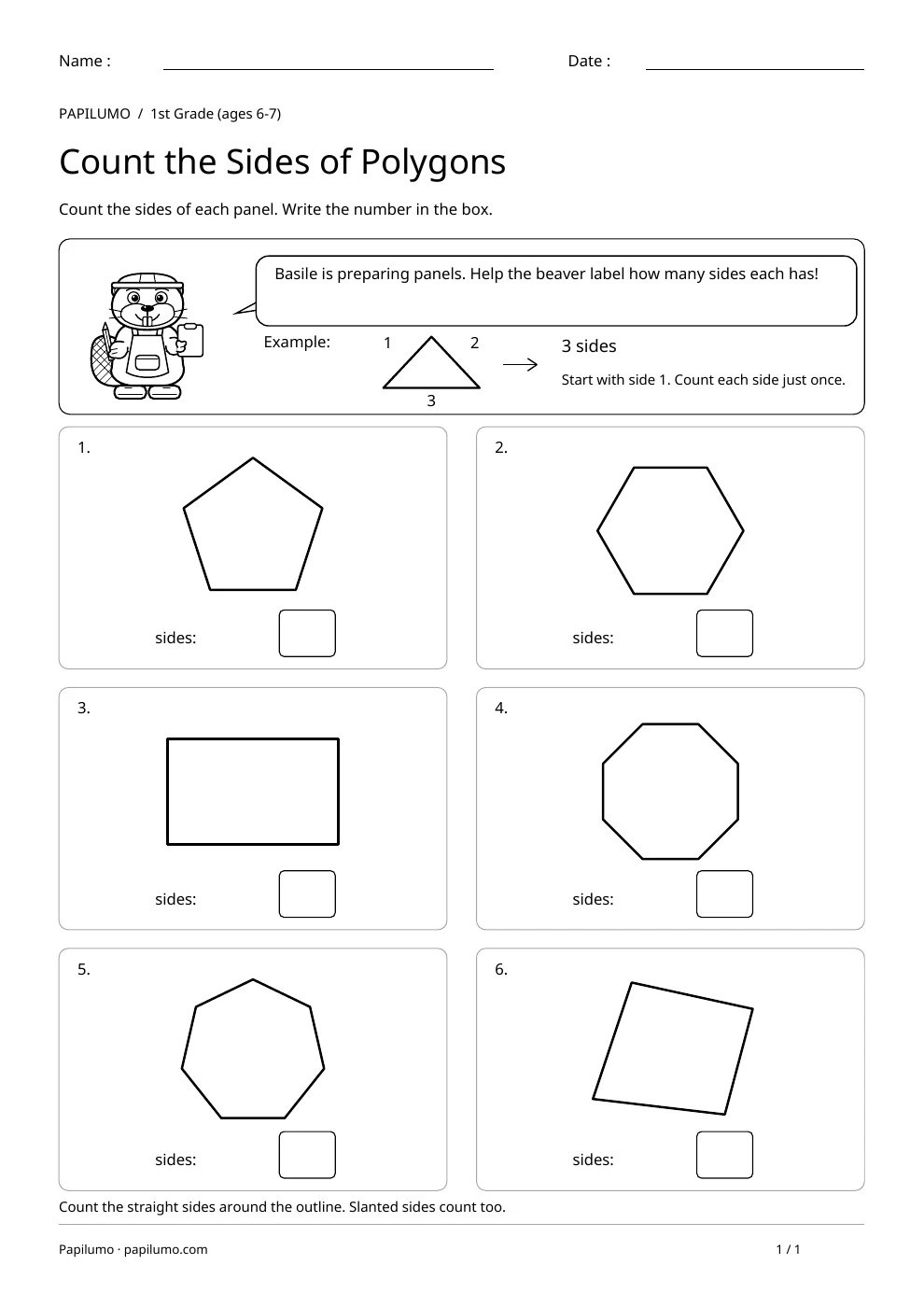
Use the follow-up to meet the same idea in a different setting. Offer it once the first task makes sense, without insisting that the whole page must be perfect. The child might explain a strategy, make an example or set a challenge for an adult. Return to the worksheet only when it helps connect the two situations. A short conversation or a practical activity can be enough to finish the session. To continue exploring, use Count the Sides of Polygons with Basile: Count the sides of each panel. Write the number in the box.
Downloading and printing the PDF
This free PDF contains one worksheet designed for A4 paper. Download the file using the button on this page and open it in your PDF reader. Choose actual size or a 100% scale, check the orientation in the print preview and turn off any browser headers or footers. The illustrations use vector lines, so their outlines stay sharp when printed. Check the margins on one copy before preparing several sheets for a group. The level shown on the page is a guide, rather than a requirement to complete the activity at a particular age.