

What this worksheet helps children practise
Say the hundreds digit first, then the last two digits together, and check your hyphens on 21–99!
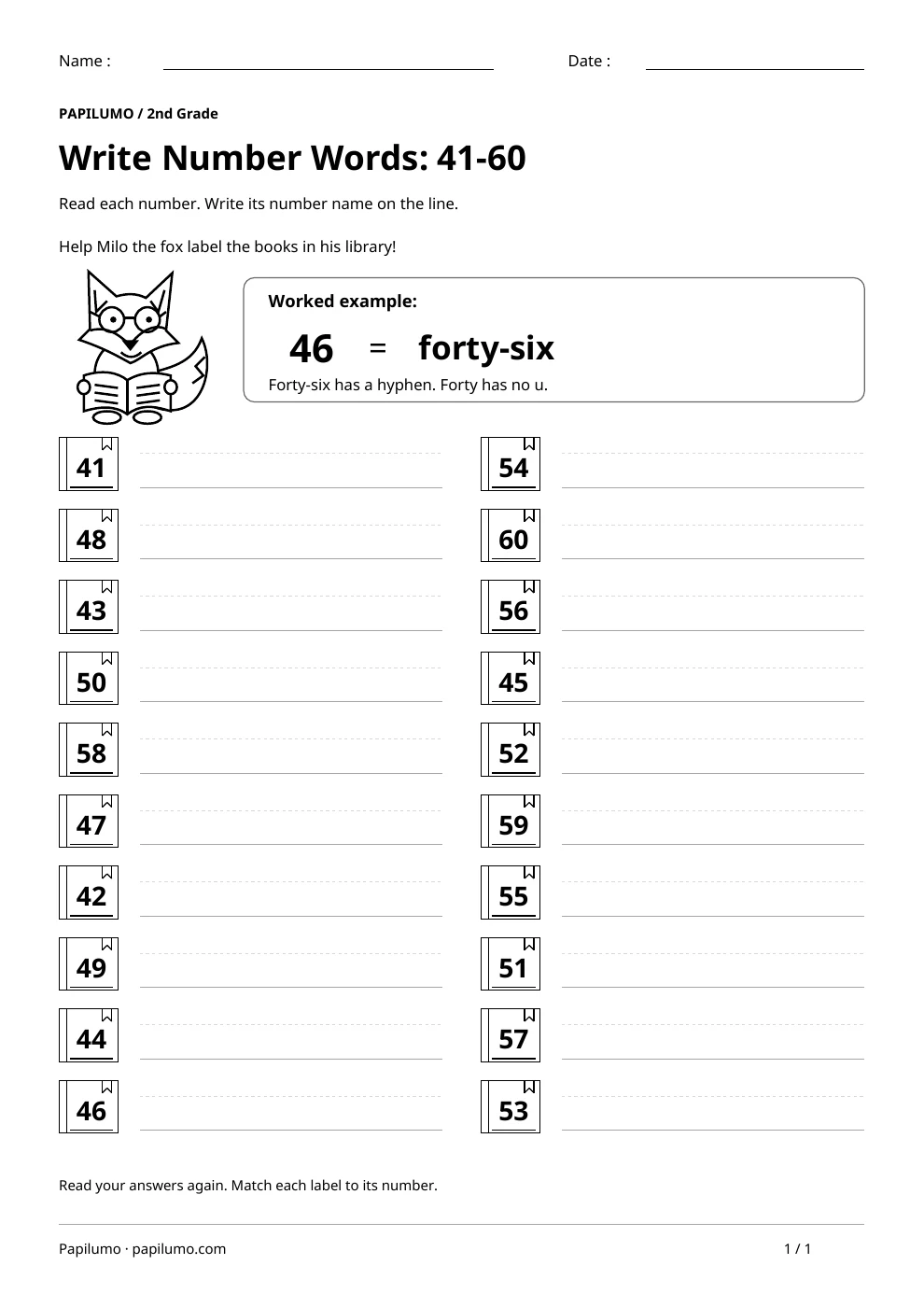
Translating 3-digit numerals into written words is an essential Grade 3 place-value standard that connects base-ten digits directly to spoken and written language. Learners identify the hundreds digit first, notice when a zero sits in the tens or ones place (such as 408, 630, 340, and 509), and apply standard American English number-word conventions: keeping “hundred” singular, omitting extra filler words like “and,” and hyphenating compound numbers from twenty-one through ninety-nine. Accurate number-word spelling prepares third graders for reading word problems, labeling quantities, and comparing multi-digit values reliably. For a related skill, use Writing numbers 41 to 60 in words: Read each number. Write its number name on the line.
Preparing a short session
Print the student worksheet at actual size (100%) on plain white A4 or letter paper without scaling down page margins, and set out a sharpened pencil, a straight ruler for neat matching lines, and a clean eraser. Keep the separate one-page answer key PDF tucked completely out of sight during independent work. Before matching the first parcel, read Milo’s speech bubble rule aloud and scan the 100–900 Word Bank at the bottom of the sheet together so students notice the repeated “hundred” spelling pattern across every multiple.
A concrete example to get started
Inside the framed worked example beside Milo the postal fox, a parcel stamped 342 points cleanly to its address label “three hundred forty-two.” Saying each place value aloud—three hundred, forty, and two—shows students how the three digits map smoothly from left to right into words and reminds them to place a hyphen between forty and two. Examining this completed postal model first eliminates hesitation before pupils tackle the four matching items and four open writing postcards below.
Supporting the activity
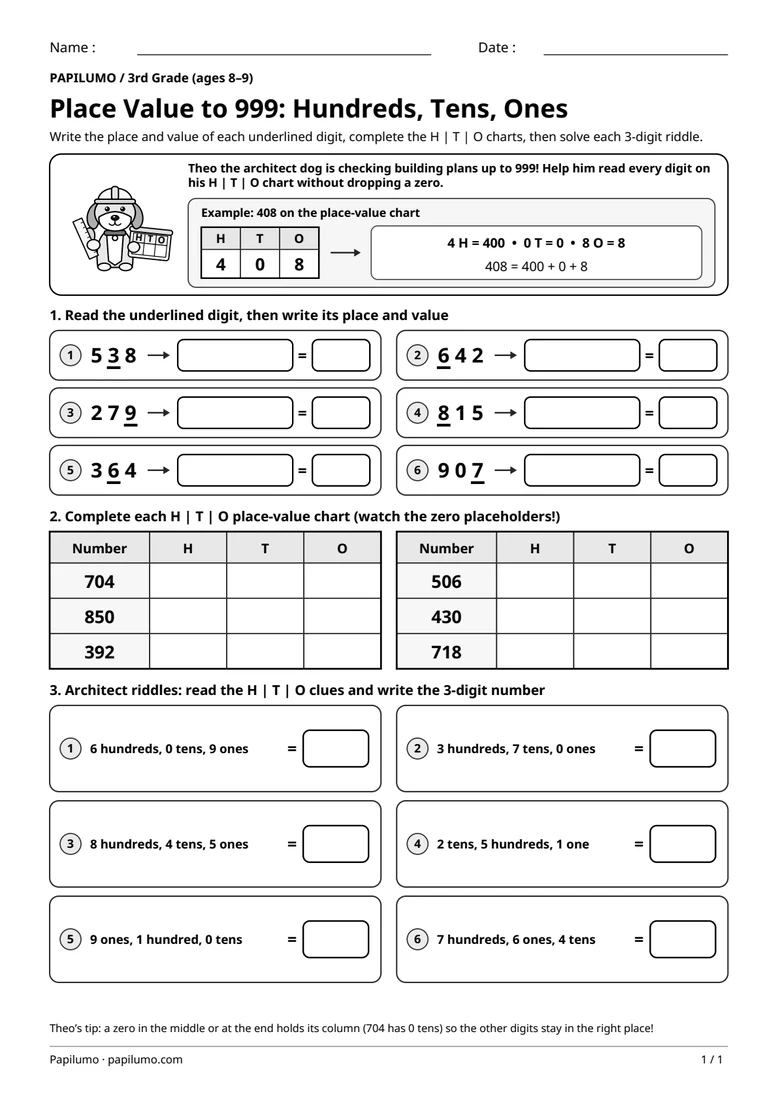
In Part 1, students match each numeral parcel on the left to its shuffled number-name label on the right: 215 pairs with “two hundred fifteen,” 408 pairs with “four hundred eight” (skipping the zero tens place), 630 pairs with “six hundred thirty,” and 874 pairs with “eight hundred seventy-four.” In Part 2, learners use the 100–900 Word Bank and two ruled lines inside each spacious postcard to write four 3-digit numbers in words: 125 becomes [one hundred twenty-five], 340 becomes [three hundred forty], 509 becomes [five hundred nine], and 762 becomes [seven hundred sixty-two]. To vary the practice, try Hundreds, Tens, and Ones up to 999 with Theo the Architect Dog: Write the place and value of each underlined digit, complete the H | T | O charts, then solve each 3-digit riddle.
What to notice and how to check
When checking finished work against the separate one-page PDF answer key, review all four crisp connecting lines in Part 1 first and ask your learner to read each matched number aloud clearly. Next, inspect Part 2 postcard by postcard for exact letter-by-letter spelling: confirm “forty” without a letter u in three hundred forty, verify “hundred” stays singular throughout, check that zero tens in five hundred nine is omitted cleanly, and ensure hyphens appear accurately in twenty-five and sixty-two.
Making the task easier
Cover the last two digits with one finger to copy the hundreds word from the Word Bank first, then add the tens and ones.
Keep the learning aim, but reduce how much the child has to handle at once. Cover part of the page with another sheet and reveal one task at a time. Demonstrate a separate example, then leave a real opportunity to work something out. An answer reached with support is still a useful attempt; it does not yet show that the same task can be completed independently.
Taking the idea beyond the worksheet
Write your three favorite 3-digit numbers between 100 and 999 on the back, then spell each one in words.
Use the follow-up to meet the same idea in a different setting. Offer it once the first task makes sense, without insisting that the whole page must be perfect. The child might explain a strategy, make an example or set a challenge for an adult. Return to the worksheet only when it helps connect the two situations. A short conversation or a practical activity can be enough to finish the session. To continue exploring, use 3-Digit Expanded Form: Break Apart and Build Numbers with Noa: Part A: write each 3-digit number in expanded form. Part B: write each sum in standard form.
Downloading and printing the PDF
This free PDF contains one worksheet designed for A4 paper. Download the file using the button on this page and open it in your PDF reader. Choose actual size or a 100% scale, check the orientation in the print preview and turn off any browser headers or footers. The illustrations use vector lines, so their outlines stay sharp when printed. Check the margins on one copy before preparing several sheets for a group. The level shown on the page is a guide, rather than a requirement to complete the activity at a particular age.