

What this worksheet helps children practise
Have students read each 3-digit number aloud first so they hear the hundreds, tens, and ones values before writing.
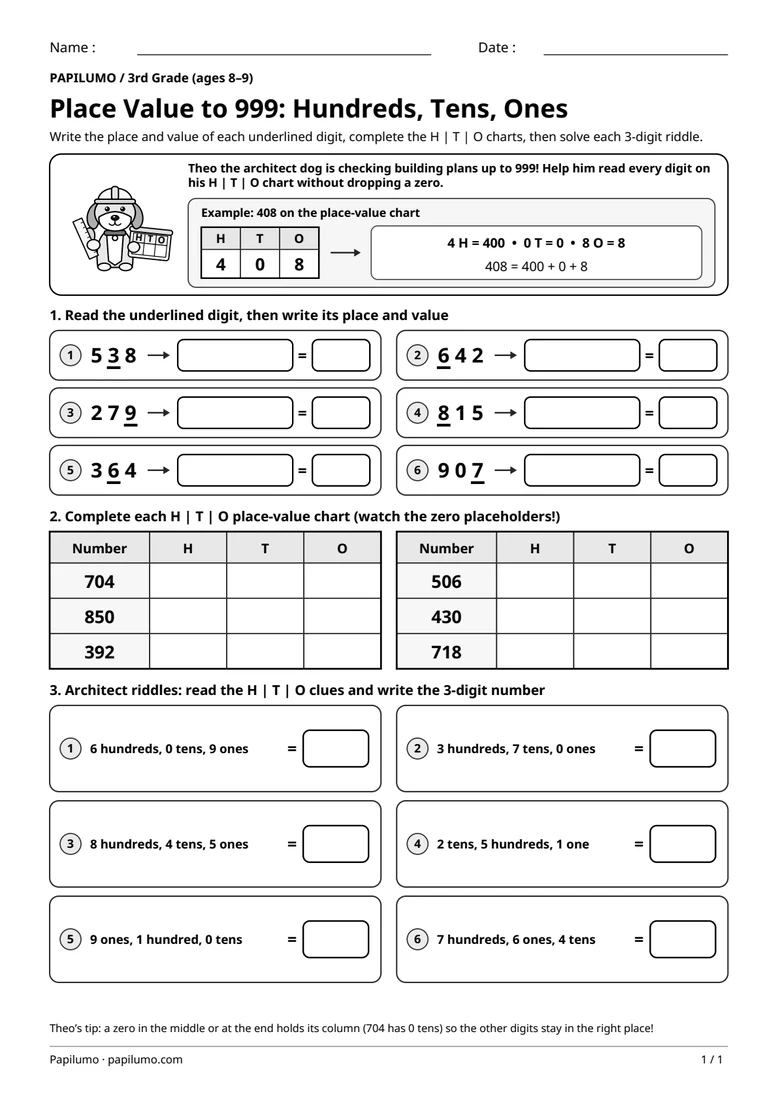
Understanding 3-digit place value requires distinguishing a digit’s face value from its actual positional value inside a number. In 682, the digit 6 stands in the hundreds place and has a value of 600, while the digit 8 in the tens place represents 80. When children only practice expanded form in one direction or without zero placeholders, they often slip on numbers like 405 or sums like 700 + 8, writing 78 instead of 708 because no tens term appears in the addition. By combining expanded-form decomposition (Part A) with standard-form recomposition (Part B)—including zero tens and zero ones—this worksheet builds flexible, reversible place-value reasoning. For a related skill, use Hundreds, Tens, and Ones up to 999 with Theo the Architect Dog: Write the place and value of each underlined digit, complete the H | T | O charts, then solve each 3-digit riddle.
Preparing a short session
Print the student worksheet at 100% scale on standard paper and provide a pencil and eraser. Before starting Item 1, introduce Noa the koala builder and examine the worked model box together. Have the student point to the three 100-flats (300), four 10-rods (40), and seven unit cubes (7) that make 347, then read the reverse example 500 + 20 + 9 = 529. Highlight the reminder note inside the example box: every place value position matters, so whenever a 3-digit number in Part A has zero tens or zero ones, the student writes 0 in that box to complete the three-part sum.
A concrete example to get started
In the top example box, 347 is broken apart into 300 + 40 + 7 because 3 hundreds equal 300, 4 tens equal 40, and 7 ones equal 7; next to it, the expanded sum 500 + 20 + 9 is combined to write 529. In Part A Item 1, the student reads 258 and writes 200 in the first box (hundreds), 50 in the second box (tens), and 8 in the third box (ones), completing 258 = 200 + 50 + 8. In Part B Item 7, the student reads 300 + 60 + 4 and combines the three place values to write 364 in the answer box.
Supporting the activity
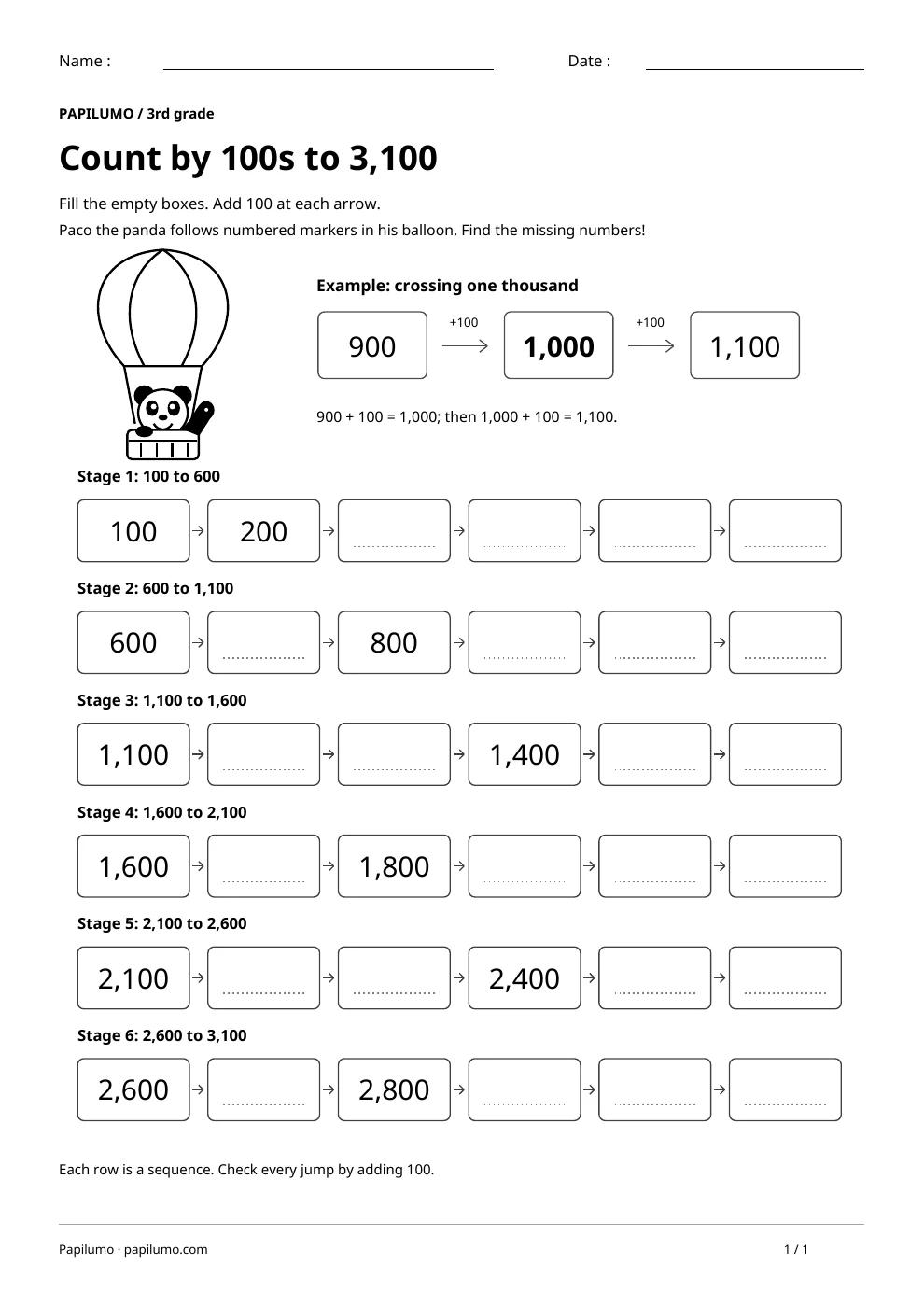
The page is structured into two complementary sections with 22 answer boxes in all. In Part A (Items 1 to 6, 18 boxes), learners break six 3-digit numbers into hundreds + tens + ones: four numbers with nonzero digits in every place (258 = 200 + 50 + 8; 682 = 600 + 80 + 2; 739 = 700 + 30 + 9; 914 = 900 + 10 + 4) and two numbers featuring a zero placeholder (405 = 400 + 0 + 5 with zero tens, and 860 = 800 + 60 + 0 with zero ones). In Part B (Items 7 to 10, 4 boxes), students write four expanded sums in standard form: 300 + 60 + 4 = 364, 800 + 20 + 7 = 827, the two-term zero-tens challenge 700 + 8 = 708, and 600 + 50 + 3 = 653. To vary the practice, try Count by 100s to 3,100 with Paco: Fill the empty boxes. Add 100 at each arrow.
What to notice and how to check
Once all ten items are complete, review the page together before checking the separate answer key PDF. In Part A, confirm that every hundreds box ends with two zeros (200, 400, 600, 800, 700, 900) and every nonzero tens box ends with one zero (50, 80, 60, 30, 10)—writing single digits like 2 + 5 + 8 instead of 200 + 50 + 8 is the most common early place-value mistake. Next, look closely at Item 3 (405 = 400 + 0 + 5) and Part B Item 9 (700 + 8 = 708): ask the child how many tens are in 700 + 8 so they can explain why a 0 must hold the tens place in 708.
Making the task easier
Write H, T, and O lightly above the three digits of each starting number to track hundreds, tens, and ones.
Keep the learning aim, but reduce how much the child has to handle at once. Cover part of the page with another sheet and reveal one task at a time. Demonstrate a separate example, then leave a real opportunity to work something out. An answer reached with support is still a useful attempt; it does not yet show that the same task can be completed independently.
Taking the idea beyond the worksheet
Write 509 and 740 in expanded form, then find the standard 3-digit number for 800 + 9.
Use the follow-up to meet the same idea in a different setting. Offer it once the first task makes sense, without insisting that the whole page must be perfect. The child might explain a strategy, make an example or set a challenge for an adult. Return to the worksheet only when it helps connect the two situations. A short conversation or a practical activity can be enough to finish the session. To continue exploring, use Tens and Ones to 99: Count the tens rods and single squares. Complete each table.
Downloading and printing the PDF
This free PDF contains one worksheet designed for A4 paper. Download the file using the button on this page and open it in your PDF reader. Choose actual size or a 100% scale, check the orientation in the print preview and turn off any browser headers or footers. The illustrations use vector lines, so their outlines stay sharp when printed. Check the margins on one copy before preparing several sheets for a group. The level shown on the page is a guide, rather than a requirement to complete the activity at a particular age.