
What this worksheet helps children practise
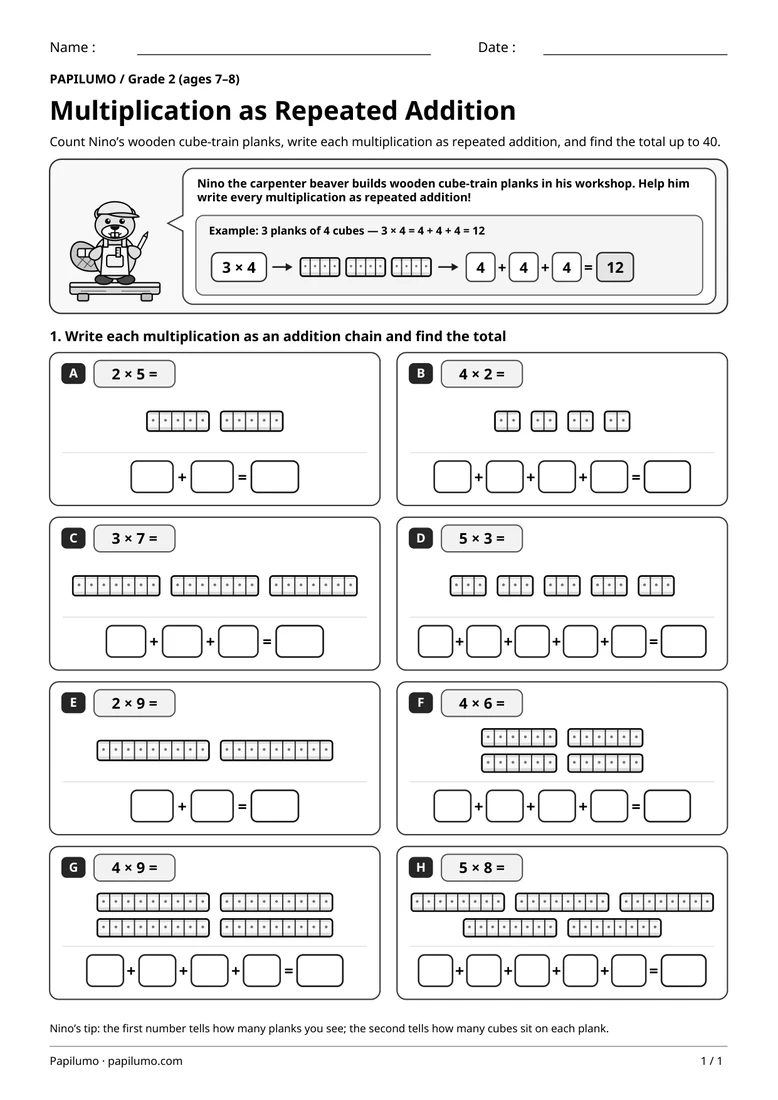
Point to each plank one by one to check how many boxes to fill, then write the plank’s cube count inside!
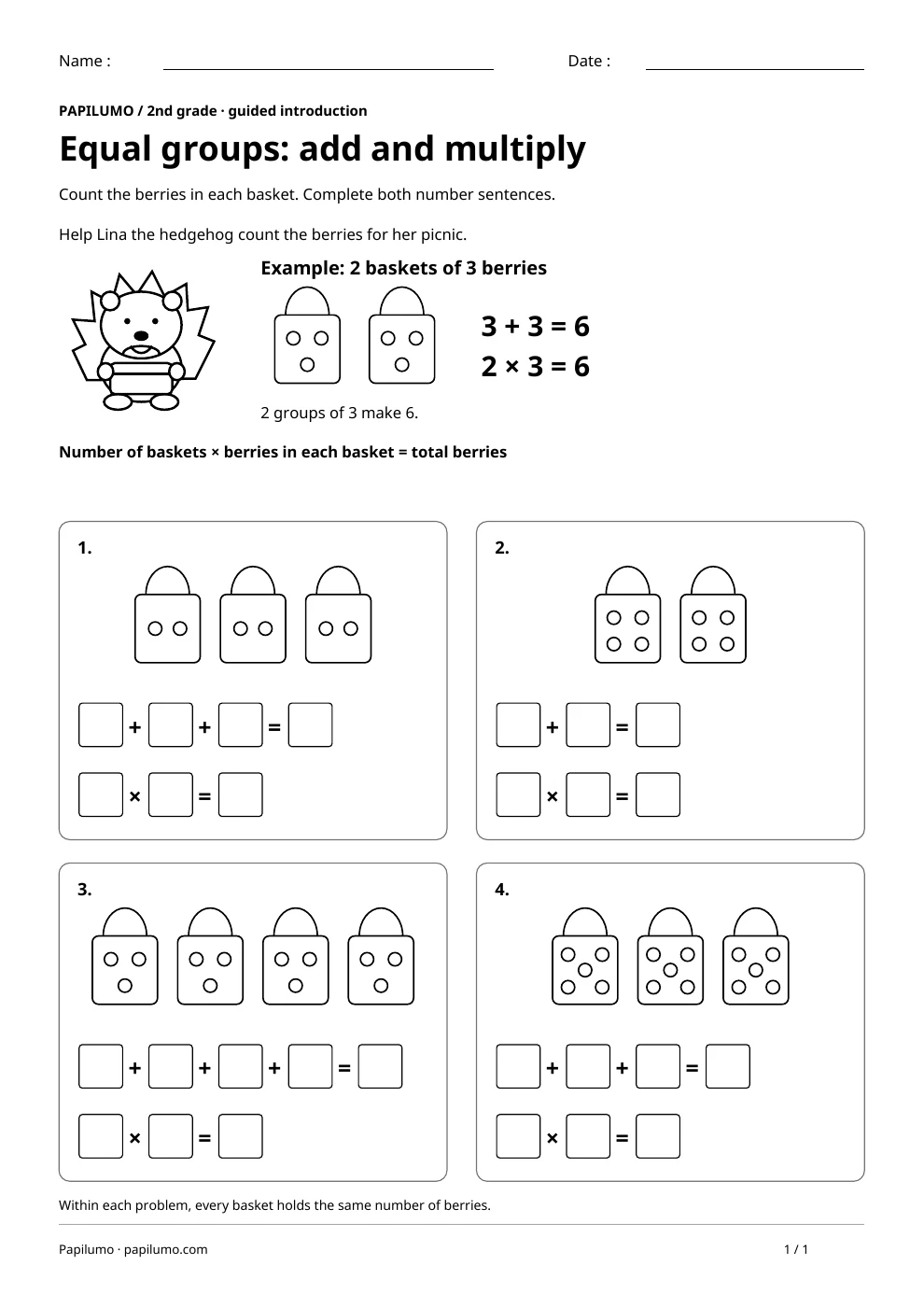
Translating a multiplication fact such as a × b into b + b + … builds genuine conceptual understanding long before children rely solely on memorized times tables. In Grade 2, matching each expression directly to segmented cube-train planks makes it unmistakable that the first factor counts how many equal groups are present, while the second factor gives the exact size of each group. Students strengthen skip-counting fluency, practice careful multi-step addition up to 40, and learn to tell group count apart from group size. For a related skill, use Repeated addition and multiplication: Lina’s berry baskets: Count the berries in each basket. Complete both number sentences.
Preparing a short session
Print the student worksheet at actual size (100%) on plain white letter or A4 paper without shrinking margins, and provide a sharpened pencil, clean eraser, and optional scratch paper for grouping larger sums cleanly. Before your child writes inside any answer box, look together at Nino’s speech bubble near the top of the page, count the three four-cube planks aloud, and read the full addition equation together. Keep the separate one-page answer key PDF tucked out of sight while solving.
A concrete example to get started
In the framed top banner beside Nino the carpenter beaver, the worked model displays 3 × 4 paired with three tidy wooden planks of four unit cubes each. Right beside the planks, the filled model boxes clearly show 4 + 4 + 4 = 12 so students notice right away why the addend 4 appears exactly three times. This concrete visual anchor prevents learners from accidentally writing 3 + 3 + 3 + 3 when converting an expression into a repeated sum.
Supporting the activity
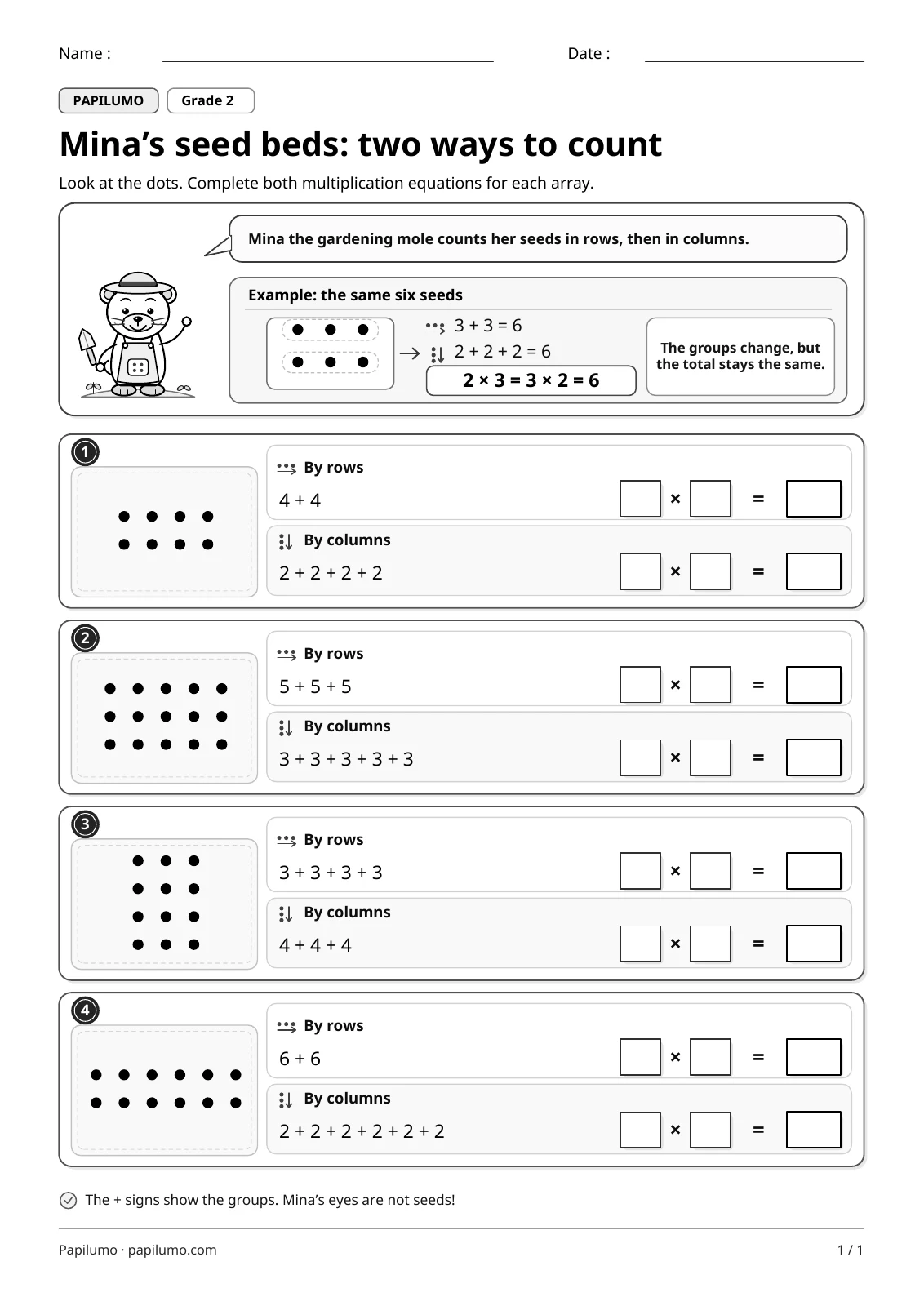
Cards A through H guide learners smoothly from 8 up to 40: 2 × 5 (5 + 5 = 10), 4 × 2 (2 + 2 + 2 + 2 = 8), 3 × 7 (7 + 7 + 7 = 21), 5 × 3 (3 + 3 + 3 + 3 + 3 = 15), 2 × 9 (9 + 9 = 18), 4 × 6 (6 + 6 + 6 + 6 = 24), 4 × 9 (9 + 9 + 9 + 9 = 36), and 5 × 8 (8 + 8 + 8 + 8 + 8 = 40). On each card, pupils verify the number of planks, write that repeated addend in every box, and sum to the total. To vary the practice, try Multiplication arrays: rows and columns with Mina: Look at the dots. Complete both multiplication equations for each array.
What to notice and how to check
When reviewing finished work against the separate answer key, verify first that each repeated addend matches the cube count inside a single plank rather than the number of planks (for example, four 6s for 4 × 6 instead of six 4s). Next, check that every addend box on a card holds the exact same whole number and confirm multi-step totals on cards G and H (36 and 40). If an addition slips, encourage pairing adjacent planks like 9 + 9 = 18 before doubling.
Making the task easier
Touch each cube-train plank as you count aloud by the group size, such as 5, 10, 15, before writing.
Keep the learning aim, but reduce how much the child has to handle at once. Cover part of the page with another sheet and reveal one task at a time. Demonstrate a separate example, then leave a real opportunity to work something out. An answer reached with support is still a useful attempt; it does not yet show that the same task can be completed independently.
Taking the idea beyond the worksheet
On card G (4 × 9), how does finding 9 + 9 = 18 first help you double your way to 36?
Use the follow-up to meet the same idea in a different setting. Offer it once the first task makes sense, without insisting that the whole page must be perfect. The child might explain a strategy, make an example or set a challenge for an adult. Return to the worksheet only when it helps connect the two situations. A short conversation or a practical activity can be enough to finish the session. To continue exploring, use 3 times table: count Teo’s equal groups: Look at the groups of 3 carrots, then complete the facts.
Downloading and printing the PDF
This free PDF contains one worksheet designed for A4 paper. Download the file using the button on this page and open it in your PDF reader. Choose actual size or a 100% scale, check the orientation in the print preview and turn off any browser headers or footers. The illustrations use vector lines, so their outlines stay sharp when printed. Check the margins on one copy before preparing several sheets for a group. The level shown on the page is a guide, rather than a requirement to complete the activity at a particular age.