

What this worksheet helps children practise
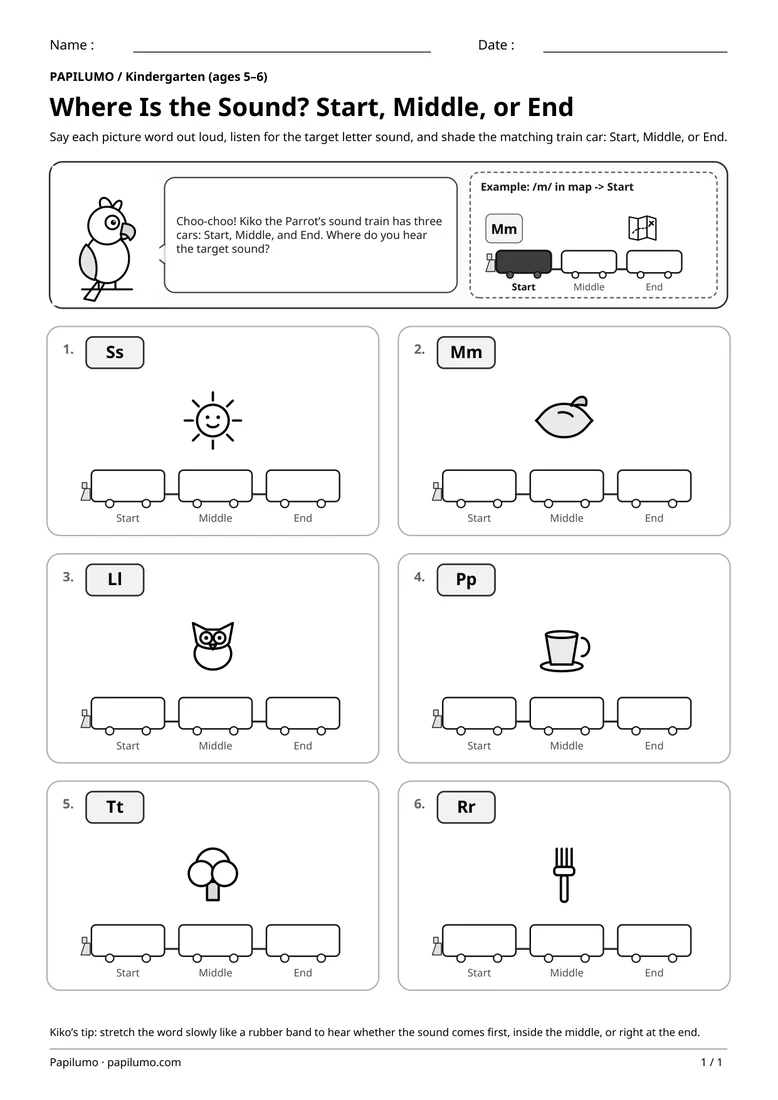
Say each picture word slowly and tap the three train cars to hear if the sound is at the start, middle, or end!
Locating whether a target phoneme appears at the beginning, in the middle, or at the end of a spoken word deepens kindergarten phonemic awareness far beyond initial-sound matching alone. Hearing medial and final consonants trains young students to listen thoughtfully across the entire spoken word rather than stopping right after the first syllable, strengthening both blending and early phonetic spelling readiness. Representing word positions as a concrete three-car train gives beginners a clear left-to-right mental map of spoken sound order before formal reading begins. For a related skill, use Cursive Letter Joins & First Short Words: Connect Letters Smoothly with Plume (1st Grade): Trace the dotted cursive joins smoothly without lifting your pencil between letters, then copy each pair and illustrated word on the ruled lines.
Preparing a short session
Print the student worksheet at actual size (100%) on plain white A4 paper and keep the separate one-page answer key tucked neatly out of view during independent listening work. Seat your child comfortably at a clear, quiet table with a dark graphite pencil or black crayon for shading one train car cleanly per card. Before starting, invite your child to name all six drawings aloud clearly so the exact spoken word is fresh in mind without displaying written spellings that would reveal the letter position early.
A concrete example to get started
Inside the top banner frame beside Kiko the Parrot and his clearly labeled Start, Middle, and End train cars, a dashed worked example box shows letter M paired with a crisp treasure map illustration. Because /m/ is heard right at the opening of the spoken word map, the very first train car labeled Start is shaded cleanly in dark gray ink. Kindergarteners grasp both the left-to-right train metaphor and the shading action within seconds before moving eagerly to the six main puzzle cards.
Supporting the activity
Below the banner, six generous illustrated cards display a clear uppercase-and-lowercase consonant badge, a clean black-and-white drawing, and three outlined train cars ready to shade cleanly without visual clutter or cramped edges. Two cards target beginning positions (sun for /s/, tree for /t/), two target middle positions (lemon for /m/, fork for /r/), and two target ending positions (owl for /l/, cup for /p/). Every picture word contains its target consonant strictly once so children never encounter confusing double-letter traps along the way. To vary the practice, try One-Letter Word Ladders: Climb the Rhyme Stairs with Milo (1st Grade): Climb each word ladder from bottom to top by changing exactly one letter on every rung to spell the matching picture clue.
What to notice and how to check
When all six train cards are shaded cleanly, place the separate one-page answer key alongside your child’s finished sheet to review each answer calmly together and celebrate careful listening. The answer key displays the exact shaded car on every card alongside the written word with its target letter bolded and underlined so adults can verify every sound position at a glance. Say each word slowly together while tapping the Start, Middle, and End train cars smoothly from left to right and inviting optional coloring afterward. Invite your child to trace each bolded target letter once gently with a finger to connect sound awareness directly to early print recognition before bedtime or classroom centers.
Making the task easier
Stretch the word slowly out loud with an adult (such as lll-e-mmm-o-n) while pointing across the three train cars in order.
Keep the learning aim, but reduce how much the child has to handle at once. Cover part of the page with another sheet and reveal one task at a time. Demonstrate a separate example, then leave a real opportunity to work something out. An answer reached with support is still a useful attempt; it does not yet show that the same task can be completed independently.
Taking the idea beyond the worksheet
Think of one new spoken word with /s/ at the start and one new word with /s/ at the very end.
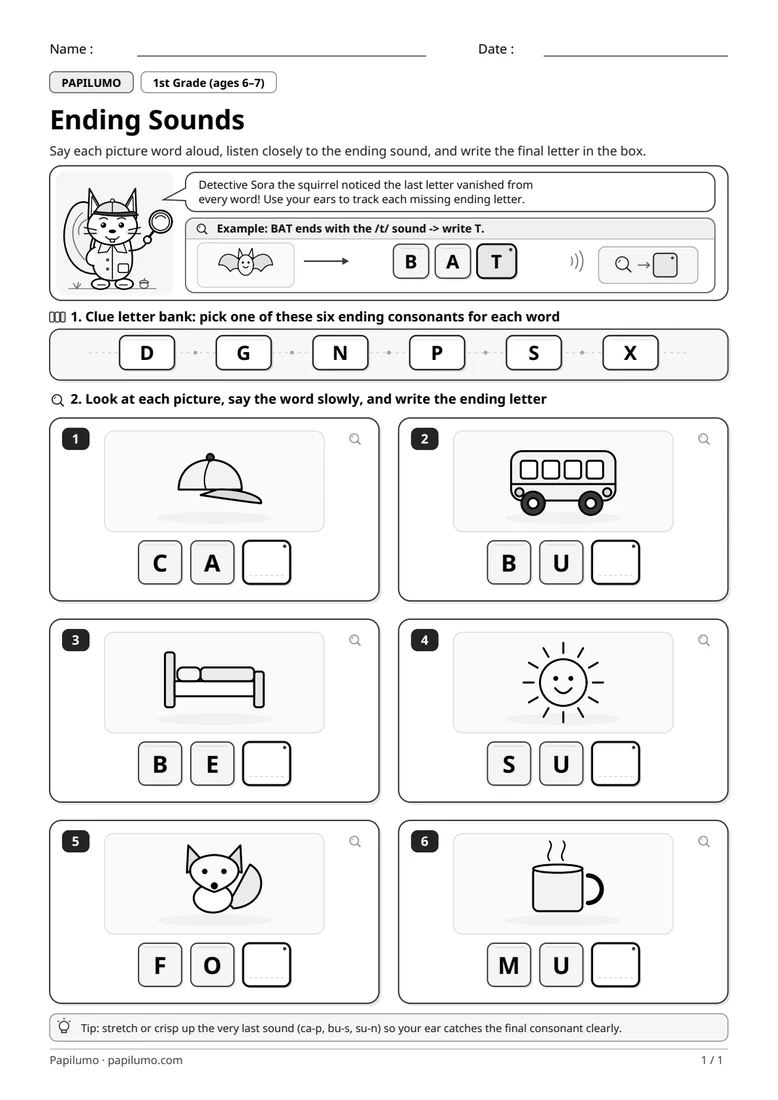
Use the follow-up to meet the same idea in a different setting. Offer it once the first task makes sense, without insisting that the whole page must be perfect. The child might explain a strategy, make an example or set a challenge for an adult. Return to the worksheet only when it helps connect the two situations. A short conversation or a practical activity can be enough to finish the session. To continue exploring, use Ending Sounds Words with Sora the Squirrel: Say each picture word aloud, listen closely to the ending sound, and write the final letter in the box.
Downloading and printing the PDF
This free PDF contains one worksheet designed for A4 paper. Download the file using the button on this page and open it in your PDF reader. Choose actual size or a 100% scale, check the orientation in the print preview and turn off any browser headers or footers. The illustrations use vector lines, so their outlines stay sharp when printed. Check the margins on one copy before preparing several sheets for a group. The level shown on the page is a guide, rather than a requirement to complete the activity at a particular age.