

What this worksheet helps children practise
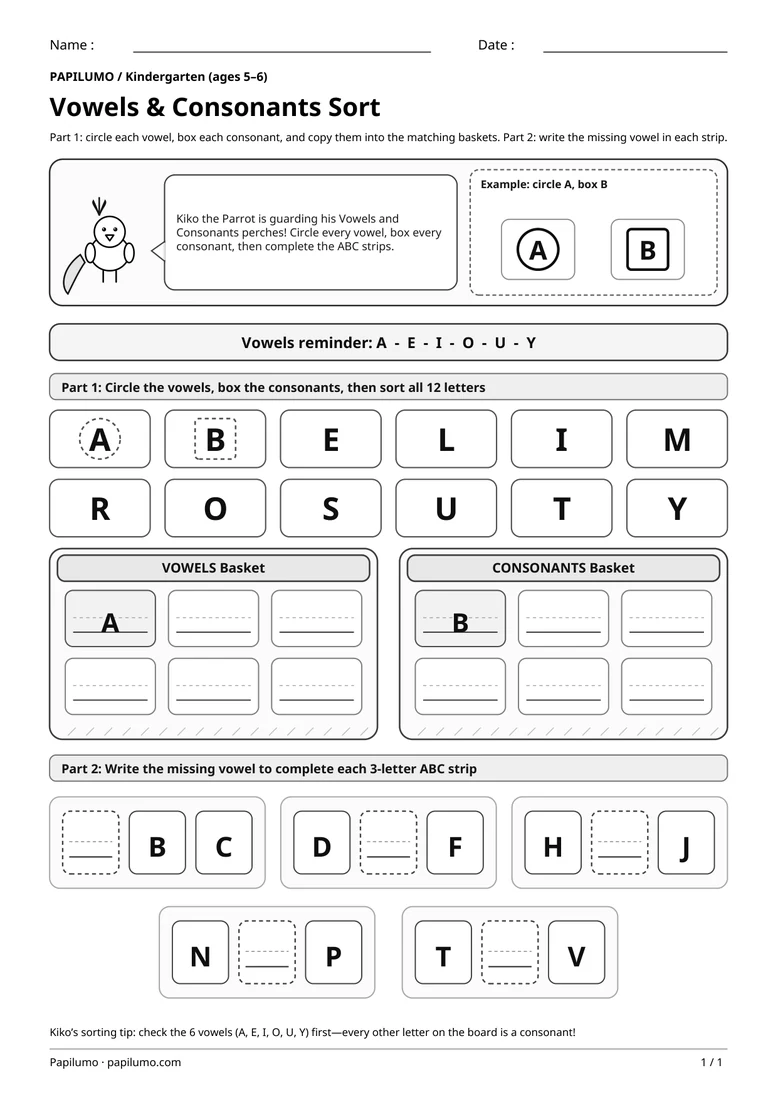
Check the vowel banner (A, E, I, O, U, Y) for each tile: circle it if it matches, or draw a neat square box around it if it is a consonant!
Distinguishing the six vowels from consonants gives Kindergarteners a concrete anchor for phonics, syllable blending, and early spelling ahead of first grade. Pairing two distinct pencil actions—circling vowels and boxing consonants—slows down visual scanning and keeps kids actively classifying each letter instead of guessing quickly. Copying each letter into labeled baskets builds tidy alphabet writing, while completing short three-letter alphabet strips (_ B C through T _ V) strengthens both vowel recall and alphabetical sequence around familiar anchor consonants. For a related skill, use Count Syllables in Words: Clap and Circle with Lulu: Say each picture word out loud while clapping its beats, then circle 1, 2, or 3 for the number of syllables.
Preparing a short session
Print the student worksheet at actual size (100%) without shrinking on crisp white A4 paper and sit at a bright, quiet table with a sharpened pencil and soft eraser. Keep the separate one-page answer key PDF out of view until both Part 1 and Part 2 are complete. Before marking any tiles, chant the six vowels in the reminder banner aloud together (A, E, I, O, U, Y) and point out how A and B are already written as helpful starters inside the two baskets.
A concrete example to get started
Inside the framed top banner beside Kiko the Parrot and his friendly story speech bubble, a clear worked example displays both marking rules side by side: vowel A inside a crisp circle and consonant B inside a neat square box. Below in Part 1, those same two letters appear as pre-filled examples inside the very first slot of the Vowels basket and Consonants basket, so young learners know right away how to mark, sort, and copy the remaining ten letters cleanly.
Supporting the activity
Part 1 presents twelve large letter tiles (A, B, E, L, I, M, R, O, S, U, T, Y) above two roomy six-slot baskets with clear baselines. Students circle every vowel, box every consonant, and copy the remaining five vowels (E, I, O, U, Y) and five consonants (L, M, R, S, T) neatly into the matching slots. In Part 2, five clear ABC strips (_ B C, D _ F, H _ J, N _ P, T _ V) invite students to fill in A, E, I, O, and U. To vary the practice, try Lowercase Letter Heights: Short, Tall and Tail Letters with Timo: Trace each light guide letter, write a copy beside it in the same height zone, then circle the matching height icon below.
What to notice and how to check
When both baskets hold six letters and all five ABC strips are filled, place the separate one-page answer key PDF next to the worksheet to check together calmly. Verify that A, E, I, O, U, and Y are circled and sorted into Vowels, that B, L, M, R, S, and T are boxed and sorted into Consonants, and that A, E, I, O, and U sit neatly inside the five alphabet strips. Point out how clean and organized every basket looks and celebrate steady Kindergarten handwriting.
Making the task easier
Place a tiny check mark lightly under each tile after copying it into its basket so no letter gets skipped or counted twice.
Keep the learning aim, but reduce how much the child has to handle at once. Cover part of the page with another sheet and reveal one task at a time. Demonstrate a separate example, then leave a real opportunity to work something out. An answer reached with support is still a useful attempt; it does not yet show that the same task can be completed independently.
Taking the idea beyond the worksheet
Sing the alphabet song together and clap gently every time you reach one of the vowels A, E, I, O, U, or Y.
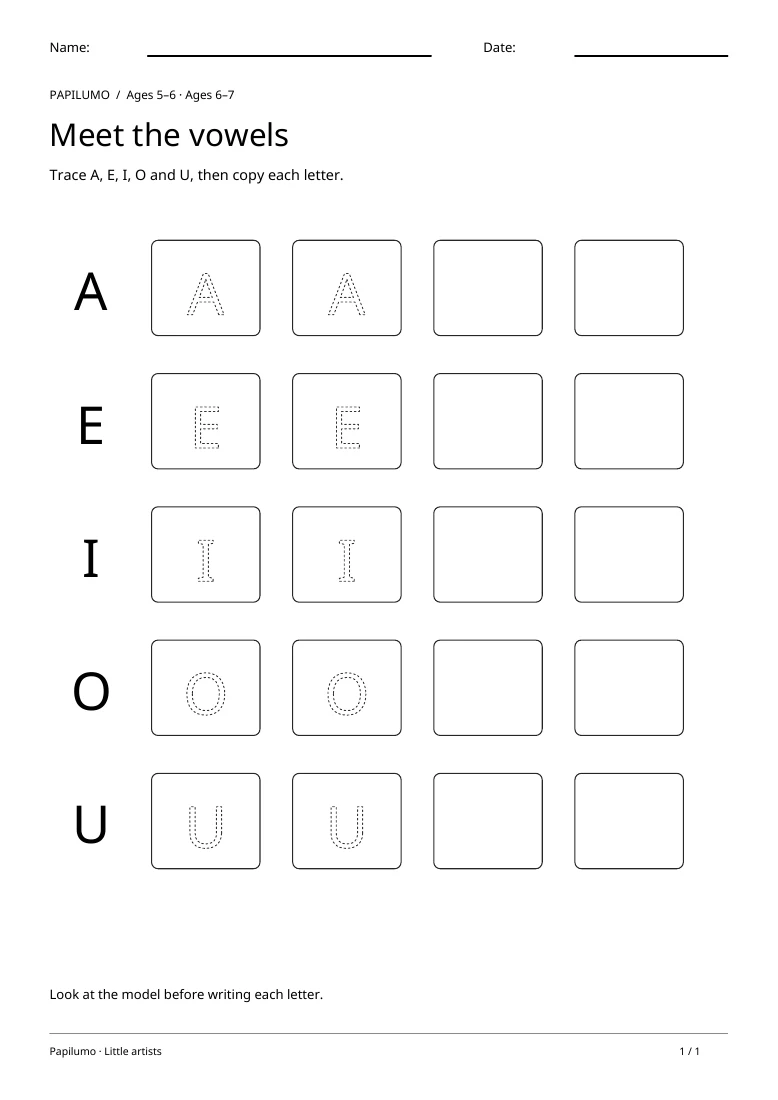
Use the follow-up to meet the same idea in a different setting. Offer it once the first task makes sense, without insisting that the whole page must be perfect. The child might explain a strategy, make an example or set a challenge for an adult. Return to the worksheet only when it helps connect the two situations. A short conversation or a practical activity can be enough to finish the session. To continue exploring, use Vowel Tracing Worksheet: Uppercase A, E, I, O, U: Trace A, E, I, O and U, then copy each letter.
Downloading and printing the PDF
This free PDF contains one worksheet designed for A4 paper. Download the file using the button on this page and open it in your PDF reader. Choose actual size or a 100% scale, check the orientation in the print preview and turn off any browser headers or footers. The illustrations use vector lines, so their outlines stay sharp when printed. Check the margins on one copy before preparing several sheets for a group. The level shown on the page is a guide, rather than a requirement to complete the activity at a particular age.