


What this worksheet helps children practise
Say the picture word slowly and clap once for each beat before circling 1, 2, or 3 at the bottom of the card.
Hearing and counting spoken syllable beats builds vital phonological awareness well before first-grade decoding, phonics blending, and early spelling take off. By clapping once per spoken word part—one steady beat for sun and star, two beats for tiger, monkey, and robot, and three beats for banana, elephant, and butterfly—Kindergarten children learn to listen carefully to a word’s real sound rhythm rather than judging the physical size of the pictured object or animal. Keeping the student cards free of printed words keeps focus strictly on active listening. For a related skill, use Lowercase Letter Heights: Short, Tall and Tail Letters with Timo: Trace each light guide letter, write a copy beside it in the same height zone, then circle the matching height icon below.
Preparing a short session
Print the student worksheet at actual size (100%) without shrinking on crisp white A4 paper and sit together at a clear, quiet table with a dark graphite pencil or washable crayon. Keep the separate one-page answer key PDF neatly tucked out of sight during the clapping game. Before circling any numbers, walk calmly through all eight picture cards aloud once together so your child uses the exact everyday target word for every drawing—such as sun, star, tiger, monkey, robot, or banana.
A concrete example to get started
Inside the framed top banner beside Lulu the Turtle clapping in rhythm and her friendly speech bubble, a clear worked example card demonstrates the whole activity immediately. The mini example pictures a crisp apple beside two clear clapping beat dots and the number 2 already circled cleanly out of 1, 2, and 3. As your child says “ap-ple” slowly while clapping twice in rhythm, the exact two-step routine—clap aloud and circle—clicks comfortably into place right before Card A on the sheet.
Supporting the activity
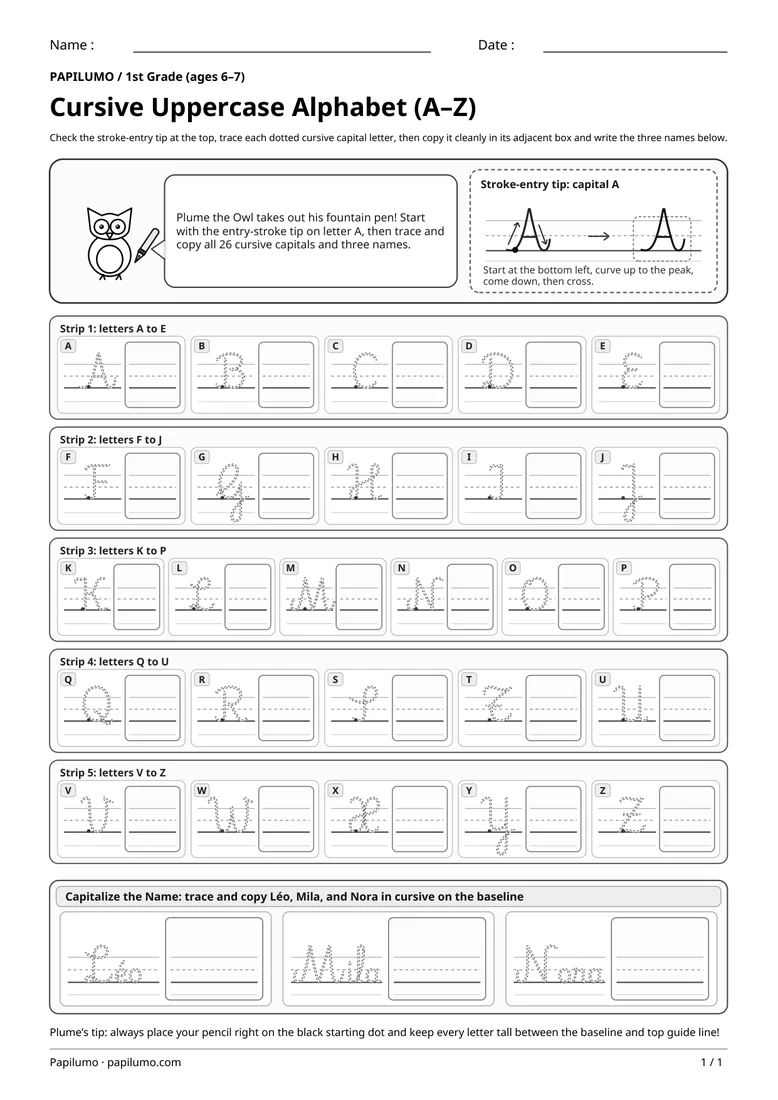
Below the banner, eight generous illustrated cards (labeled A through H) fill two neat columns and four balanced rows with plenty of calm white space. The cards mix one-, two-, and three-syllable words naturally across the worksheet so students stay alert and listen closely on every item: sun (1), tiger (2), banana (3), star (1), monkey (2), elephant (3), robot (2), and butterfly (3). At the bottom of every card sit three bold numbered circles labeled 1, 2, and 3 ready for young hands to circle. To vary the practice, try Cursive Uppercase Alphabet to Trace with Plume (1st Grade): Check the stroke-entry tip at the top, trace each dotted cursive capital letter, then copy it cleanly in its adjacent box and write the three names below.
What to notice and how to check
Once all eight cards have one number circled, place the separate one-page answer key PDF beside your child’s worksheet to celebrate careful listening together. The answer key displays both the circled syllable count and the clean segmented word label under every drawing (sun = 1, ti·ger = 2, ba·na·na = 3, star = 1, mon·key = 2, el·e·phant = 3, ro·bot = 2, but·ter·fly = 3). Re-clap any tricky word slowly together, count the beats out loud, and cheer on every accurate match.
Making the task easier
Tap the table once with a finger or place one small token per syllable so your child can see and count the beats.
Keep the learning aim, but reduce how much the child has to handle at once. Cover part of the page with another sheet and reveal one task at a time. Demonstrate a separate example, then leave a real opportunity to work something out. An answer reached with support is still a useful attempt; it does not yet show that the same task can be completed independently.
Taking the idea beyond the worksheet
Pick four favorite toys in the room and clap out whether each toy’s name has 1, 2, or 3 syllables.
Use the follow-up to meet the same idea in a different setting. Offer it once the first task makes sense, without insisting that the whole page must be perfect. The child might explain a strategy, make an example or set a challenge for an adult. Return to the worksheet only when it helps connect the two situations. A short conversation or a practical activity can be enough to finish the session. To continue exploring, use Build Words from Two Syllables with Sora the Owl: Look at each picture, put the two syllable tiles in order, and write the word on the line.
Downloading and printing the PDF
This free PDF contains one worksheet designed for A4 paper. Download the file using the button on this page and open it in your PDF reader. Choose actual size or a 100% scale, check the orientation in the print preview and turn off any browser headers or footers. The illustrations use vector lines, so their outlines stay sharp when printed. Check the margins on one copy before preparing several sheets for a group. The level shown on the page is a guide, rather than a requirement to complete the activity at a particular age.