
Teaching the Bridge-Sentence Habit With Zelie’s Scale
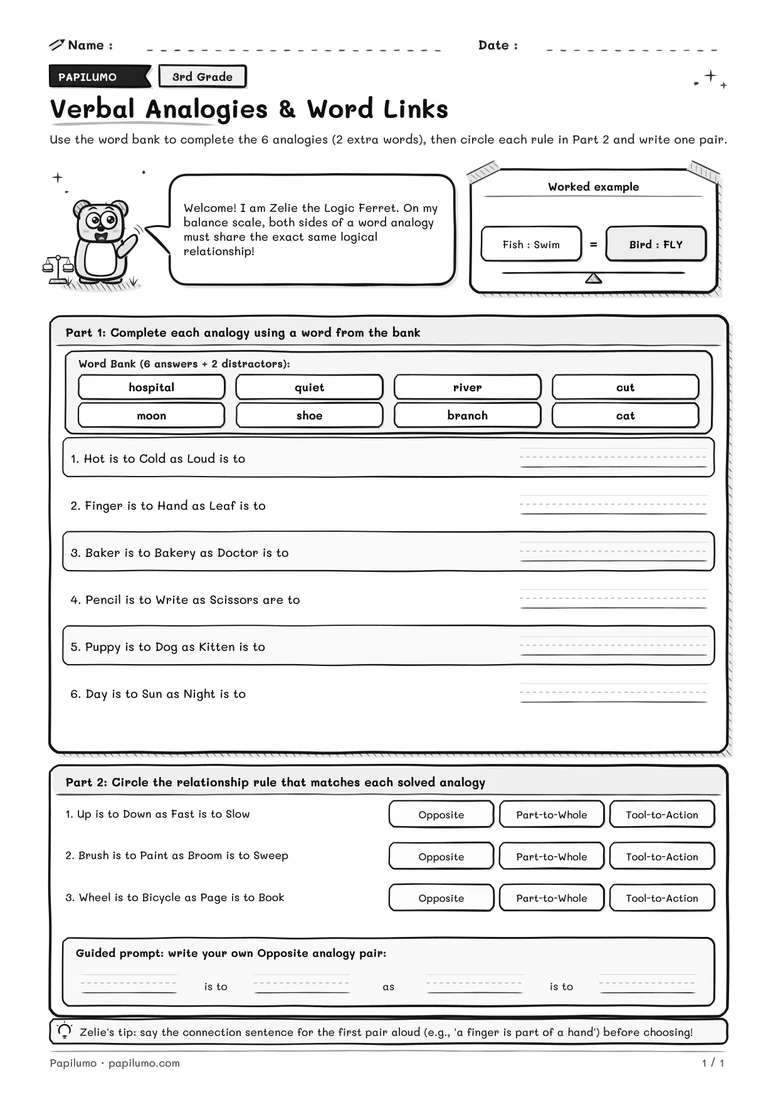
Colon notation looks mysterious the very first time eight- and nine-year-olds meet it, so Zelie’s wooden balance scale does heavy instructional lifting right in the banner. Seeing 'Fish : Swim' balanced evenly with 'Bird : FLY' makes the core rule visual: both pans must follow the exact same relationship. Coach students to whisper a short bridge sentence for the left-hand pair—'A fish moves mainly by swimming'—and plug the third word straight into that same frame: 'A bird moves mainly by flying.' Students who already feel confident matching and swapping everyday synonyms catch onto this bridge-sentence rhythm right away.
Why Those Two Extra Bank Words Catch Guessers
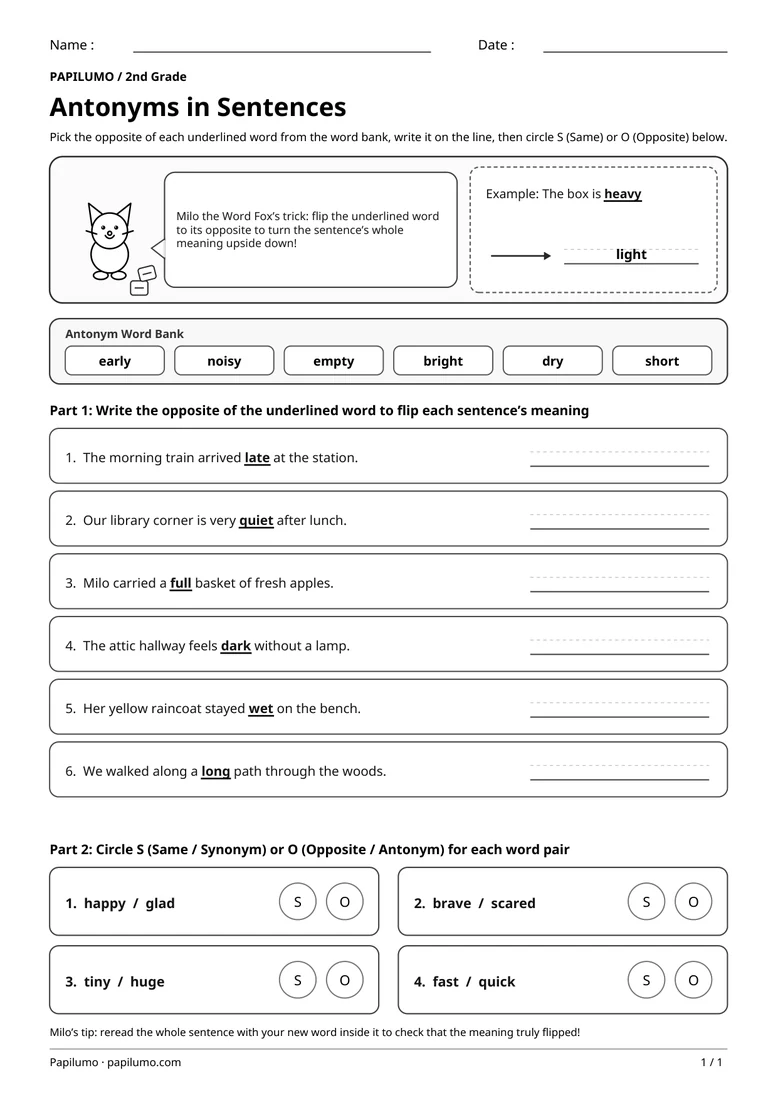
Notice that Part 1 gives an eight-word bank for just six blanks, leaving two extra distractor words untouched at the end. That small design choice stops process-of-elimination guessing cold! The classic third-grade mistake is loose topic association: a child sees a word connected to trees, kitchens, or tools and grabs the first thematically related word in the bank—landing straight on a distractor—or flips Part-to-Whole into Whole-to-Part. Unblock stuck thinkers by making them keep strict left-to-right word order in their bridge sentence and lightly cross off used choices, building on earlier practice trading underlined words for opposites.
Naming Relationship Types and Authoring Original Pairs
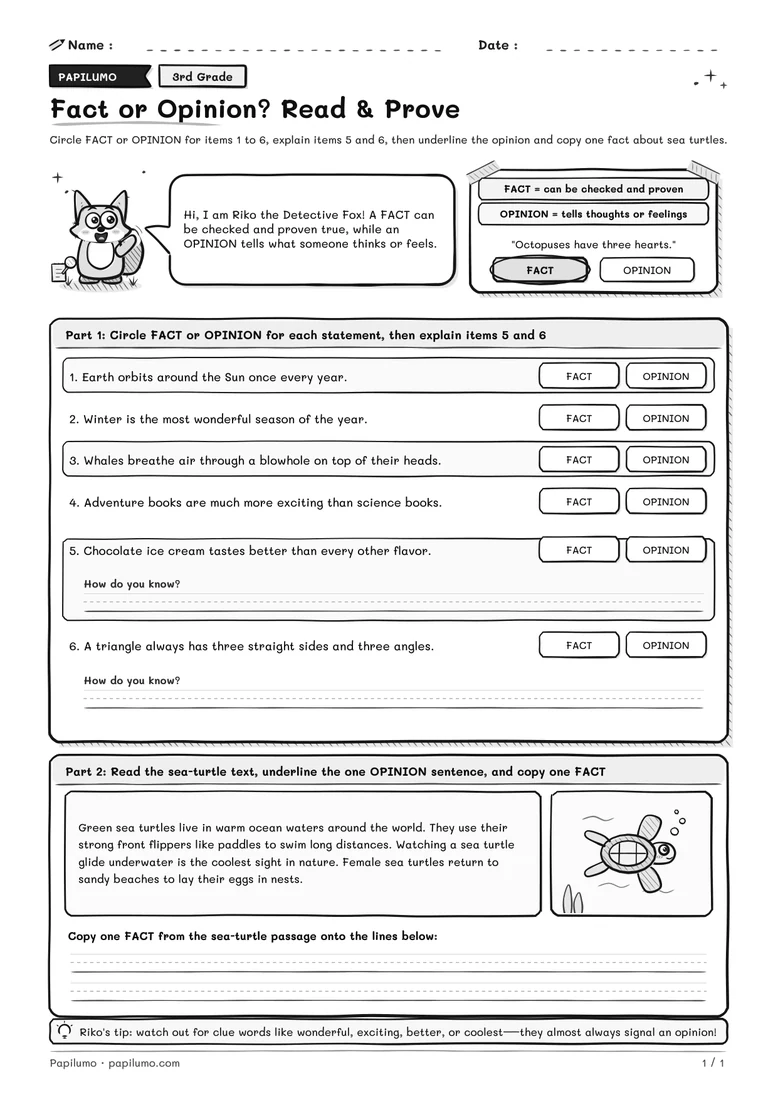
Part 2 pushes beyond filling blanks by asking readers to circle the underlying logic rule—such as Tool-to-Action or Part-to-Whole—and invent a balanced pair of their own. Naming why two words belong together strengthens vocabulary networks far deeper than rote memorization, demanding the same clear-headed justification students use when backing up reading claims with proof during comprehension lessons. During partner share, let students read just the first three words of their homemade analogy aloud to see if a classmate can solve the fourth word; if two different answers fit, partners refine their clue together.
Running a Two-Leftover Audit and Back-Page Challenge
Before students turn their papers into the basket, train them to run a five-second 'two-leftover check' on the Part 1 word bank: if fewer or more than two distractor words remain uncrossed, they know right away to re-test their bridge sentences! Ready thinkers can then flip the page to draft one Tool-to-Action analogy—like 'Scissors : Cut'—and one Part-to-Whole analogy—like 'Petal : Flower'—leaving the fourth spot blank for a tablemate to solve during afternoon wrap-up.