

What this worksheet helps children practise
For a sum above ten, children may count on from the larger number or use counters. Once the total is secure, ask them to identify the numbers that traded places and explain why the same answer can be used on the next line.
This first-grade activity introduces the commutative property of addition through concrete groups and paired number sentences. Children do not need to memorize the technical term to understand the idea. Three seeds and five seeds make the same total as five seeds and three seeds. The groups move, but no seed is added or removed. All addends are single-digit numbers, with totals up to sixteen. The aim is to notice the relationship between two facts and use a known answer thoughtfully, rather than treating every line as an unrelated problem. For a related skill, use Adding zero: the number stays the same with Lumi: Write 0 for the empty tray. Then complete the total.
Preparing a short session
Print at actual size and provide a pencil, an eraser and a few counters. Make one group of three counters and another group of five. Swap the complete groups without changing their sizes. Ask what moved and what stayed the same. A child who needs to count again can touch each counter once to check. Keep the answer key out of sight during the activity. First allow a spoken explanation of the objects; then connect the groups to the numbers and signs in the written example.
A concrete example to get started
The worked example reads 3 + 5 = 8 and 5 + 3 = 8. Point to the three seeds and then the five seeds in the first picture. In the next picture their places are reversed, but there are still eight seeds altogether. Read each equation aloud. Ask whether moving the groups should change the eight. A useful explanation is simply that the same seeds are still there. The plus sign joins the amounts and the equals sign connects the addition to its total. The picture supports reasoning without asking children to cut anything out.
Supporting the activity
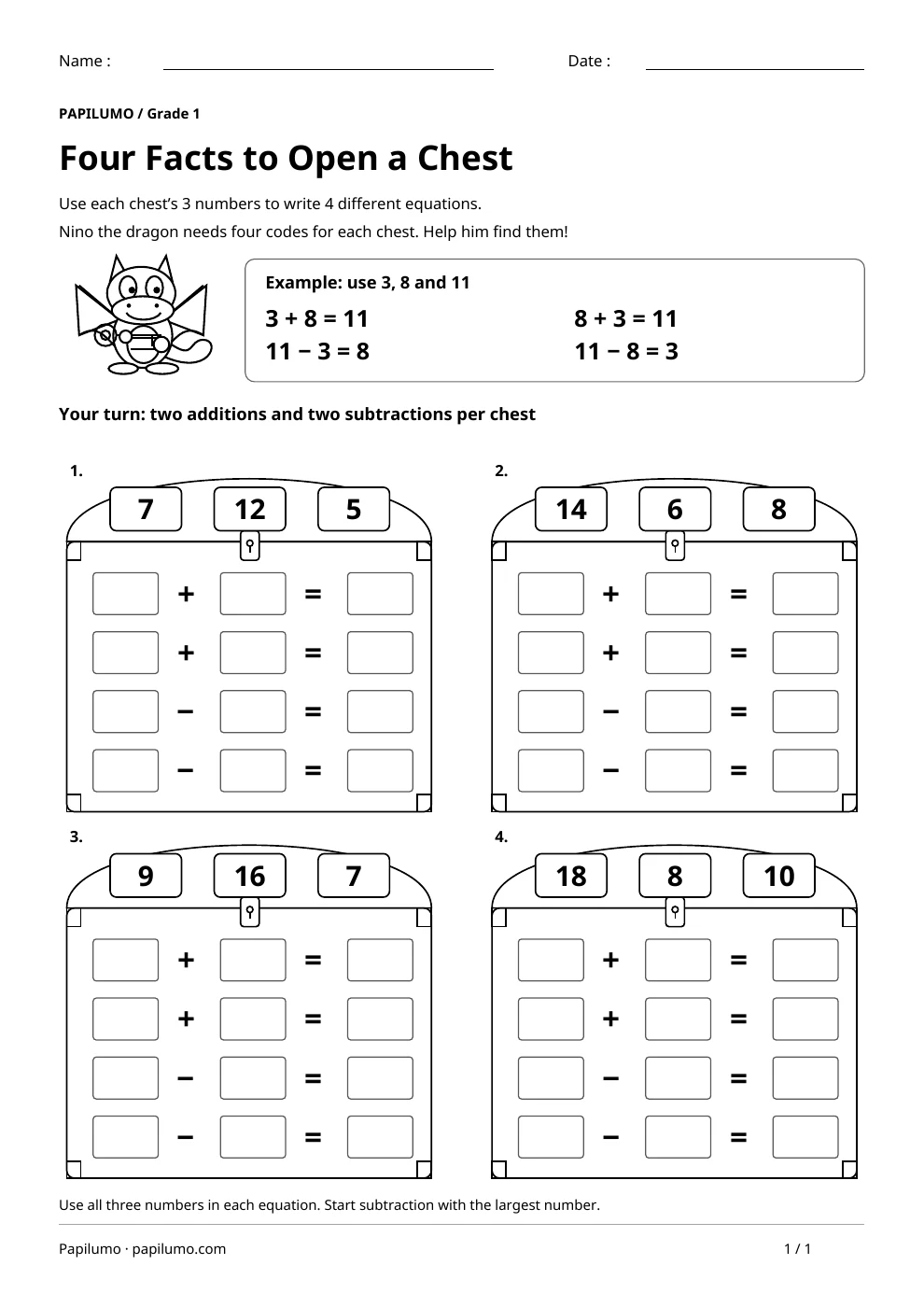
The six cards use 2 + 7 and 7 + 2; 4 + 8 and 8 + 4; 3 + 6 and 6 + 3; 5 + 9 and 9 + 5; 0 + 8 and 8 + 0; then 7 + 9 and 9 + 7. There are twelve answer boxes. For a shorter session, begin with the first two cards and return to the others later. After solving the first line, encourage the child to inspect the numbers in the second line before counting again. The zero card represents an empty group: changing its place still adds no objects. To vary the practice, try Fact Families to 20: Write All Four Equations: Use each chest’s 3 numbers to write 4 different equations.
What to notice and how to check
Both answers on each card are, in order, 9, 12, 9, 14, 8 and 16. Use the separate key to check all twelve entries. Check the first calculation as well as the matching pair: two equal written answers can still share the same arithmetic error. Ask the child to demonstrate one card with counters and explain where both groups appear in each line. If the answers differ, look for a misread number or a group that was counted twice. Keep the conclusion specific to addition; swapping numbers in a subtraction does not generally preserve its result.
Making the task easier
Start with only 2 + 7 and 7 + 2 using two visible groups of counters. An adult can record an answer dictated by the child. Then try the zero card with one empty space and a group of eight counters.
Keep the learning aim, but reduce how much the child has to handle at once. Cover part of the page with another sheet and reveal one task at a time. Demonstrate a separate example, then leave a real opportunity to work something out. An answer reached with support is still a useful attempt; it does not yet show that the same task can be completed independently.
Taking the idea beyond the worksheet
Give a new pair aloud, such as 6 + 4 followed by 4 + 6. Ask for the first answer, then invite the child to predict the next one without recounting. Let the child invent another turnaround pair and explain it with objects.
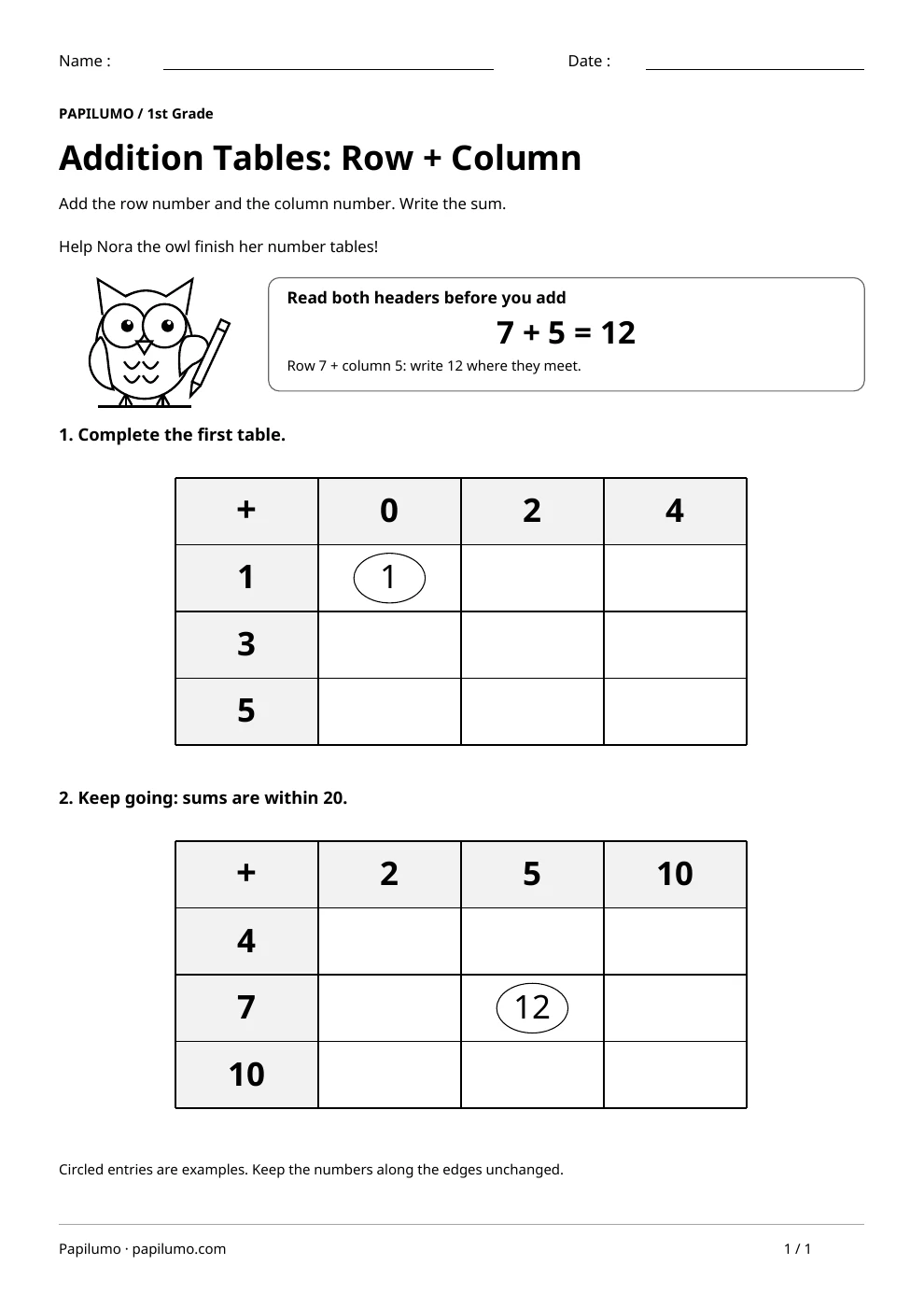
Use the follow-up to meet the same idea in a different setting. Offer it once the first task makes sense, without insisting that the whole page must be perfect. The child might explain a strategy, make an example or set a challenge for an adult. Return to the worksheet only when it helps connect the two situations. A short conversation or a practical activity can be enough to finish the session. To continue exploring, use Addition Tables to Complete Within 20: Add the row number and the column number. Write the sum.
Downloading and printing the PDF
This free PDF contains one worksheet designed for A4 paper. Download the file using the button on this page and open it in your PDF reader. Choose actual size or a 100% scale, check the orientation in the print preview and turn off any browser headers or footers. The illustrations use vector lines, so their outlines stay sharp when printed. Check the margins on one copy before preparing several sheets for a group. The level shown on the page is a guide, rather than a requirement to complete the activity at a particular age.