

What this worksheet helps children practise
Bring down the next digit beside the intermediate remainder.
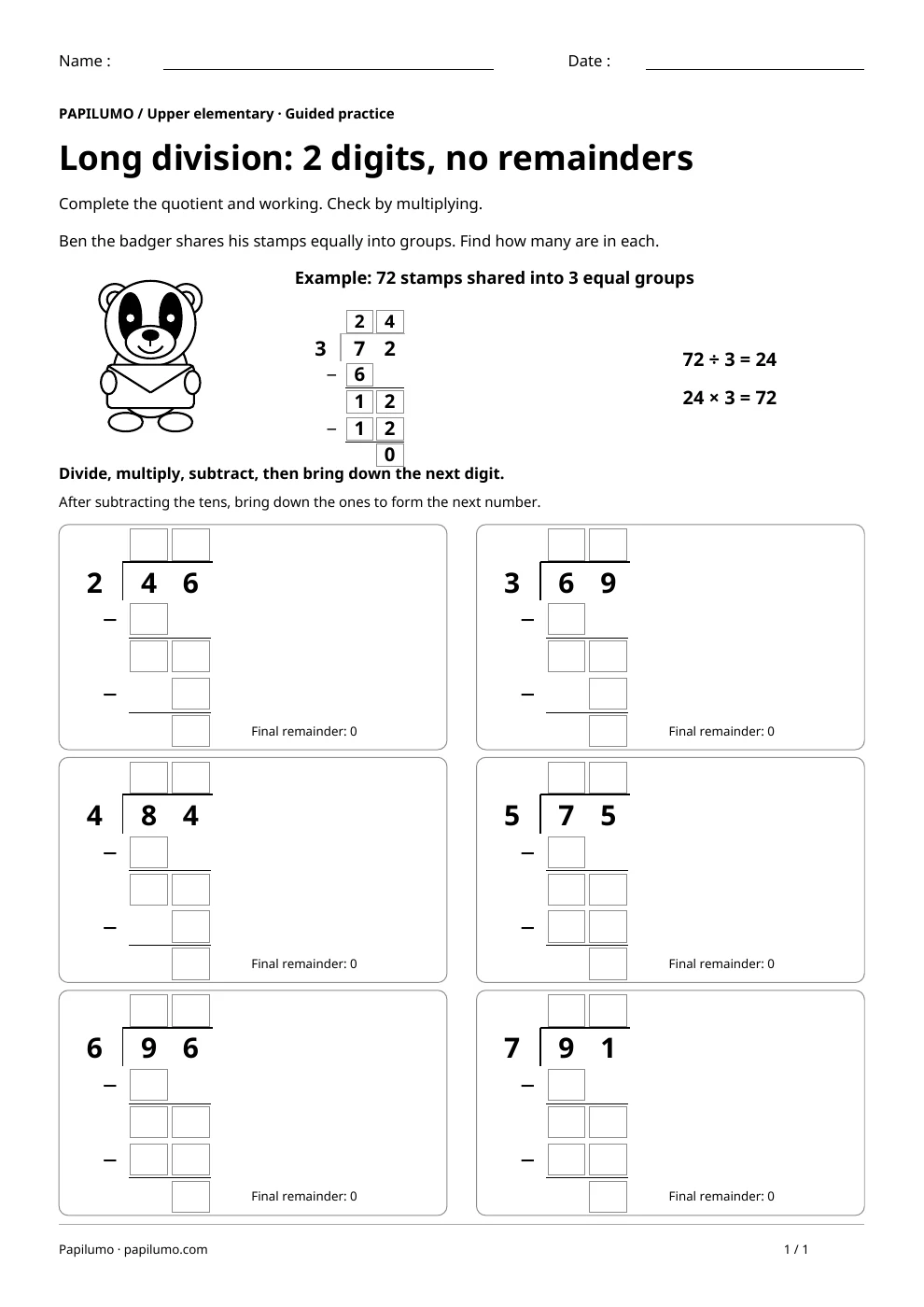
Start with four hundreds in 432 ÷ 3. Each group receives one hundred and one hundred remains. Bring down the 3 to make thirteen tens. Each group receives four tens and one ten remains. Bring down the 2 to make twelve ones. Each group receives four ones and nothing remains. The three quotient digits are 1, 4 and 4 in that order. For a related skill, use 2-Digit by 1-Digit Long Division Without Remainders: Complete the quotient and working. Check by multiplying.
Preparing a short session
Print the worksheet at full size so there is room for each digit in its own box. Read the worked example with the pupil and ask them to point to the next digit before bringing it down. A multiplication chart can help with choosing a quotient digit. After writing each product, ask the pupil to check that subtracting it leaves less than the divisor.
A concrete example to get started
This Grade 4 worksheet gives pupils four written divisions with a three-digit dividend and a one-digit divisor. The boxes align the digits, the products to subtract and the numbers formed by bringing digits down. The worked example shows 432 divided by 3. Use the separate key to compare each written step and find where a calculation first took a different direction. Use place-value blocks to connect the written steps with the quantities. Set out four hundreds, three tens and two ones. Share the hundreds into three groups and trade the leftover hundred for ten tens. Share the thirteen tens, then trade the leftover ten for ten ones. Add the two original ones and share all twelve. Ask the pupil to point to the matching line in the written calculation after each trade. The quotient records what one group receives at each place.
Supporting the activity
In 624 ÷ 4, begin by dividing 6 by 4. Write 1 in the hundreds place of the quotient and subtract 4. The remaining two hundreds become twenty tens. Bring down the 2 to form 22. Five groups of four use 20. Bring down the 4 next to the remaining 2 to make 24. Six groups of four use all of it. To vary the practice, try 3-Digit by 1-Digit Long Division With Remainders (with Paco): Complete each long-division bracket step by step, then fill in the quotient, remainder (less than divisor), and check equation.
What to notice and how to check
Check 756 ÷ 6 by multiplying 126 by 6. The product should be 756. Check 852 ÷ 6 with 142 × 6 and 735 ÷ 5 with 147 × 5. If a check fails, go back to the first subtraction and compare the written products with the digits in the quotient. Follow the same order for every exercise and record the zero in the final box.
Making the task easier
432 ÷ 3 = 144
Keep the learning aim, but reduce how much the child has to handle at once. Cover part of the page with another sheet and reveal one task at a time. Demonstrate a separate example, then leave a real opportunity to work something out. An answer reached with support is still a useful attempt; it does not yet show that the same task can be completed independently.
Taking the idea beyond the worksheet
144 × 3 = 432
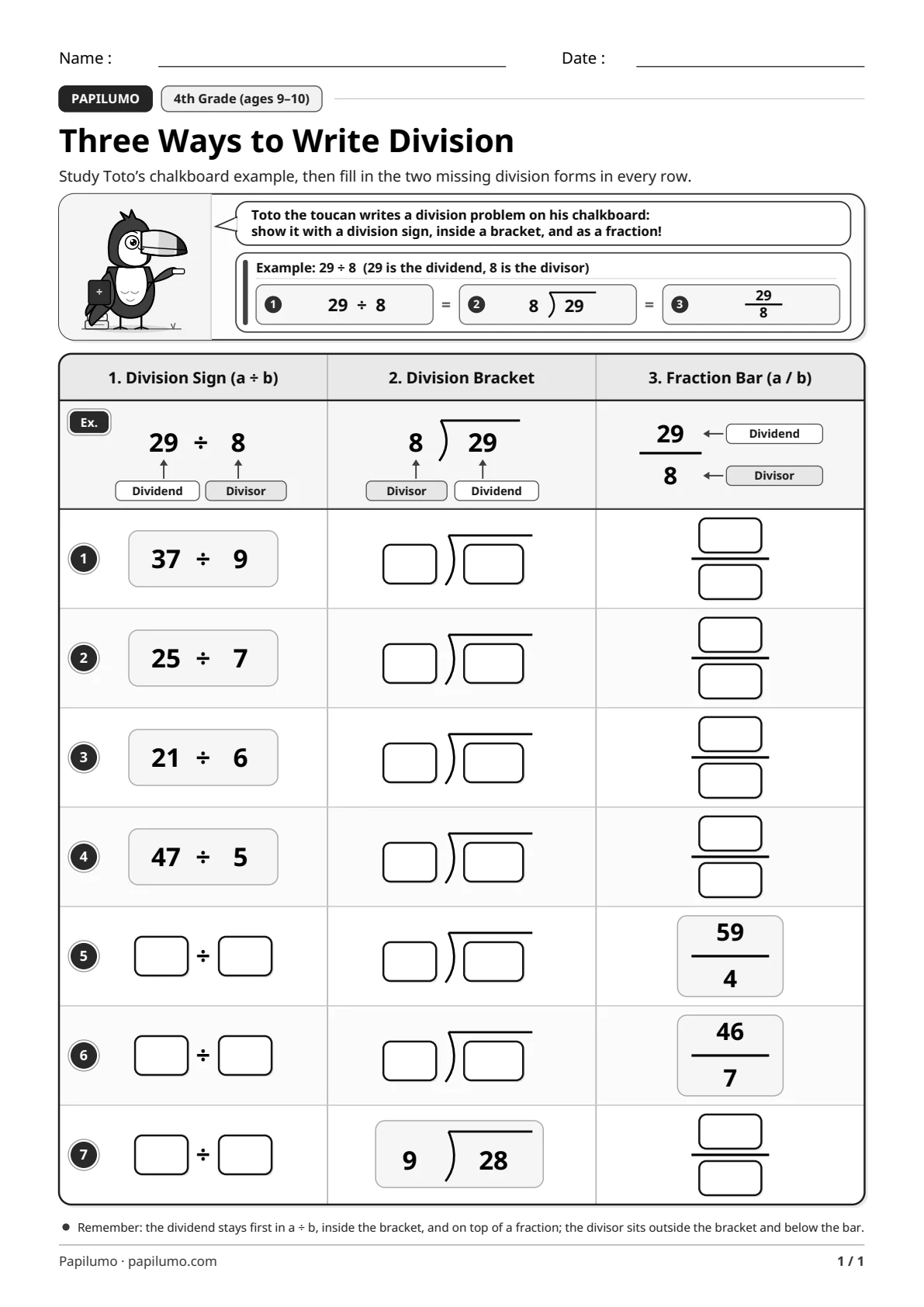
Use the follow-up to meet the same idea in a different setting. Offer it once the first task makes sense, without insisting that the whole page must be perfect. The child might explain a strategy, make an example or set a challenge for an adult. Return to the worksheet only when it helps connect the two situations. A short conversation or a practical activity can be enough to finish the session. To continue exploring, use Three Ways to Write Division with Toto the Toucan: Study Toto’s chalkboard example, then fill in the two missing division forms in every row.
Downloading and printing the PDF
This free PDF contains one worksheet designed for A4 paper. Download the file using the button on this page and open it in your PDF reader. Choose actual size or a 100% scale, check the orientation in the print preview and turn off any browser headers or footers. The illustrations use vector lines, so their outlines stay sharp when printed. Check the margins on one copy before preparing several sheets for a group. The level shown on the page is a guide, rather than a requirement to complete the activity at a particular age.