


What this worksheet helps children practise
Always ask, “Which number times itself makes this area?”—never divide the area by 2!
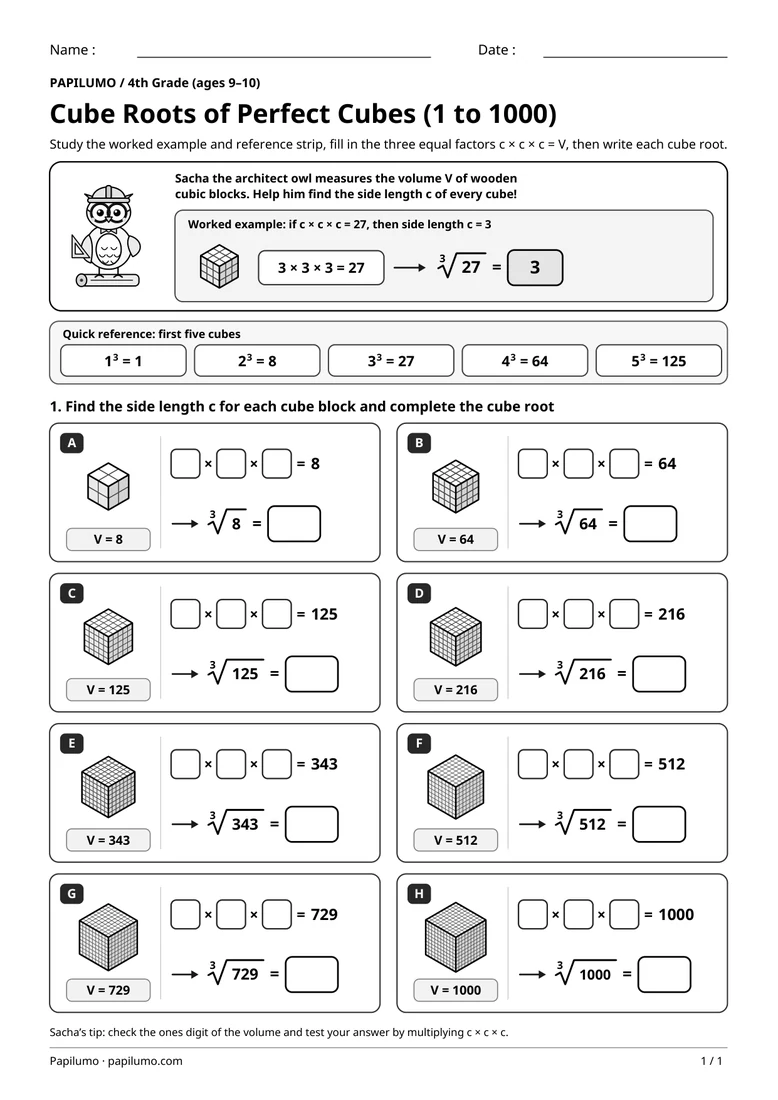
Connecting square grids to square roots gives 4th Graders an intuitive geometric anchor for inverse multiplication facts. By counting tiles along the edge of a square or asking which side produces a given area, learners quickly grasp that taking a square root reverses squaring: because 4 × 4 = 16, √16 = 4. This concrete visual foundation reinforces multiplication fluency up to 12 × 12 = 144, highlights the symmetry of equal factors, and prepares students smoothly for upper-elementary area problems and algebraic thinking. For a related skill, use Cube Roots of Perfect Cubes 1 to 1000 with Sacha the Owl: Study the worked example and reference strip, fill in the three equal factors c × c × c = V, then write each cube root.
Preparing a short session
Print the student worksheet at actual size (100%) on plain white letter or A4 paper without shrinking margins, and provide a sharpened pencil with an eraser. Before filling in any boxes, read the top worked model beside Sacha the architect owl together and ask your child to count one row and one column of the 4 × 4 courtyard aloud. Keep the separate answer key PDF tucked out of sight while learners work independently from the tile grids to the bare radical cards.
A concrete example to get started
Inside the top worked model beside Sacha the architect owl, students see a 4-by-4 tiled courtyard containing 16 tiles in all: Area = 16 tiles leads straight to side = 4, paired with the mathematical statement √16 = 4 (because 4 × 4 = 16). Seeing the tiled grid right next to the radical sign clarifies immediately that √16 simply asks, “Which number times itself equals 16?” That geometric meaning prevents the classic beginner mistake of halving the area instead of finding an equal side.
Supporting the activity
In Part 1, learners inspect six tiled squares labeled with their total area: 9 tiles ([3] × [3] = 9), 25 tiles ([5] × [5] = 25), 36 tiles ([6] × [6] = 36), 49 tiles ([7] × [7] = 49), 64 tiles ([8] × [8] = 64), and 81 tiles ([9] × [9] = 81), filling twelve boxes in total. In Part 2, students work without grids to complete six direct square-root cards: √4 = [2], √100 = [10], √121 = [11], √144 = [12], √1 = [1], and √81 = [9]. To vary the practice, try Perfect Squares 1² to 20² with Sacha the Owl: Fill the missing 1²–10² squares, compute 11² through 20², then solve both inverse square challenges.
What to notice and how to check
When checking work against the separate answer key PDF, look first for accidental halving (such as writing 8 for √16, 18 for √36, or 50 for √100). Verify also that both boxes on each Part 1 line contain the exact same digit, since a square must have equal sides. If √121 or √144 slows a student down in Part 2, remind them to anchor at 10 × 10 = 100 and test 11 × 11 and 12 × 12 calmly on scratch paper.
Making the task easier
Trace one top edge and one left edge of each tiled square with your finger before writing the side length in both boxes.
Keep the learning aim, but reduce how much the child has to handle at once. Cover part of the page with another sheet and reveal one task at a time. Demonstrate a separate example, then leave a real opportunity to work something out. An answer reached with support is still a useful attempt; it does not yet show that the same task can be completed independently.
Taking the idea beyond the worksheet
Sketch a 13 × 13 square (169 tiles) on graph paper or write three square-root riddles for a partner to solve.
Use the follow-up to meet the same idea in a different setting. Offer it once the first task makes sense, without insisting that the whole page must be perfect. The child might explain a strategy, make an example or set a challenge for an adult. Return to the worksheet only when it helps connect the two situations. A short conversation or a practical activity can be enough to finish the session. To continue exploring, use Cubes 1 to 12 Wheel with Hugo the Owl: Study the top model, fill in the ten missing sectors around the cubes wheel, then solve all six cube problems below.
Downloading and printing the PDF
This free PDF contains one worksheet designed for A4 paper. Download the file using the button on this page and open it in your PDF reader. Choose actual size or a 100% scale, check the orientation in the print preview and turn off any browser headers or footers. The illustrations use vector lines, so their outlines stay sharp when printed. Check the margins on one copy before preparing several sheets for a group. The level shown on the page is a guide, rather than a requirement to complete the activity at a particular age.