
What this worksheet helps children practise
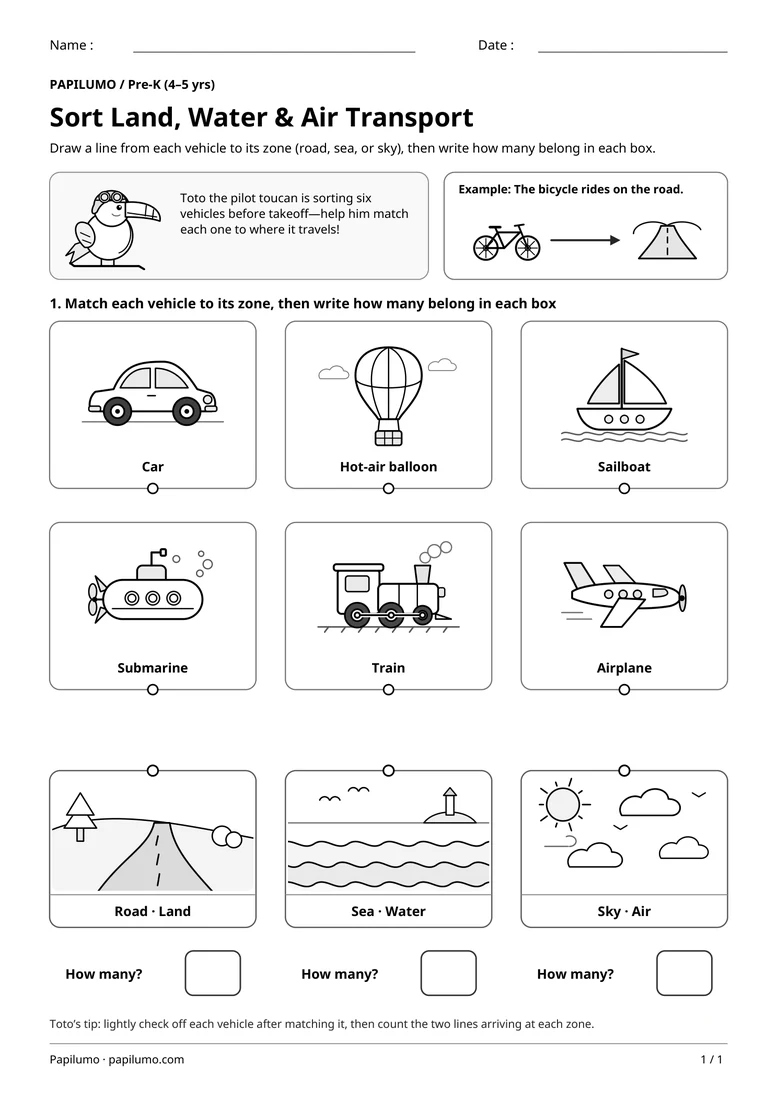
Ask yourself whether the vehicle rolls on wheels, floats on waves, or flies among the clouds before you draw your line!
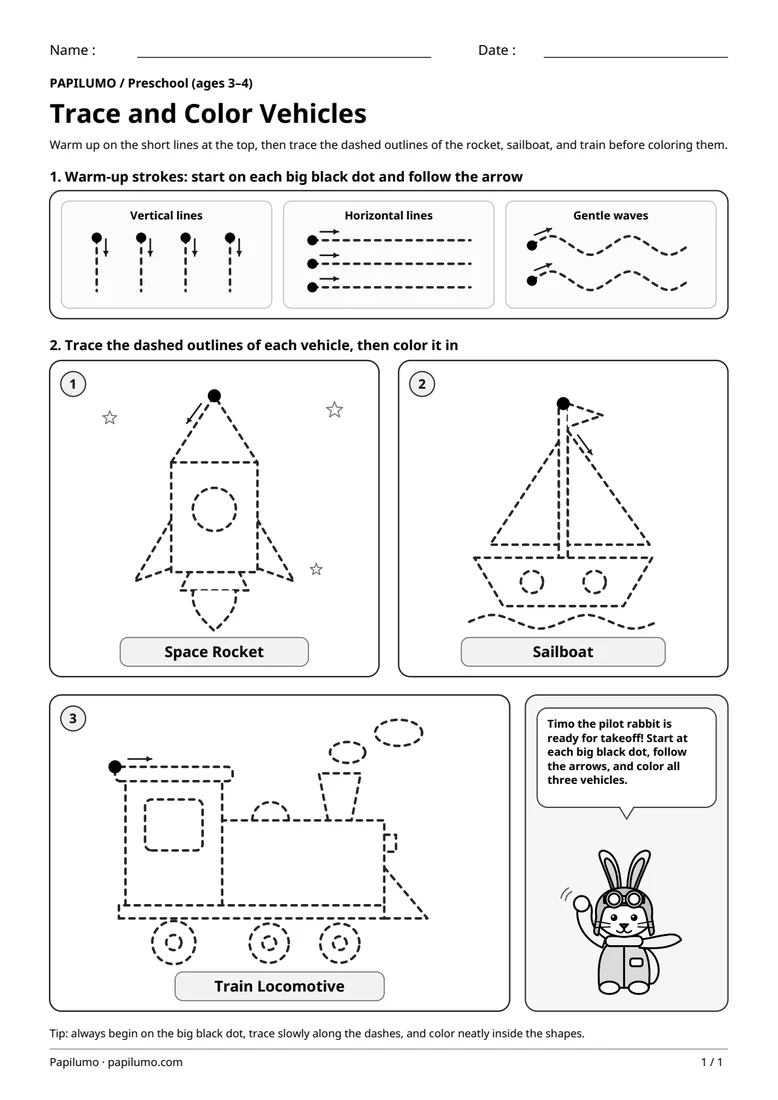
Sorting vehicles into land, water, and air builds early categorization skills, careful visual observation, and everyday transportation vocabulary in Pre-K. As children inspect visual clues such as wheels and train tracks, sails and periscopes, or wings and a wicker basket, they practice explaining why each vehicle belongs in a particular habitat before drawing a steady connecting line between dots. Counting how many vehicles reach each habitat scene then reinforces one-to-one correspondence, small-group counting up to two, and writing the numeral 2 neatly inside a box. For a related skill, use Trace and Color Vehicles (Rocket, Sailboat, Train) with Timo the Rabbit: Warm up on the short lines at the top, then trace the dashed outlines of the rocket, sailboat, and train before coloring them.
Preparing a short session
Print the student page at actual size (100%) on plain white A4 paper without cropping the margins, and keep the separate answer key PDF out of sight while children work. Set out a sharpened pencil and a soft eraser; crayons can wait until the end for coloring the black-and-white drawings. Before drawing any lines, point to all six vehicles in the grid and name the three scenes below—road, sea, and sky—so every learner recognizes both the pictures and the travel habitats before starting.
A concrete example to get started
Inside the top example box beside Toto the pilot toucan, a small bicycle is already connected by a clean arrow to a winding road icon. This visual cue demonstrates the exact matching motion without giving away any of the six activity cards below: start at the dot beneath a vehicle card, decide whether it travels on land, in water, or through the air, and draw a clear line down to the target dot on top of the matching scene.
Supporting the activity
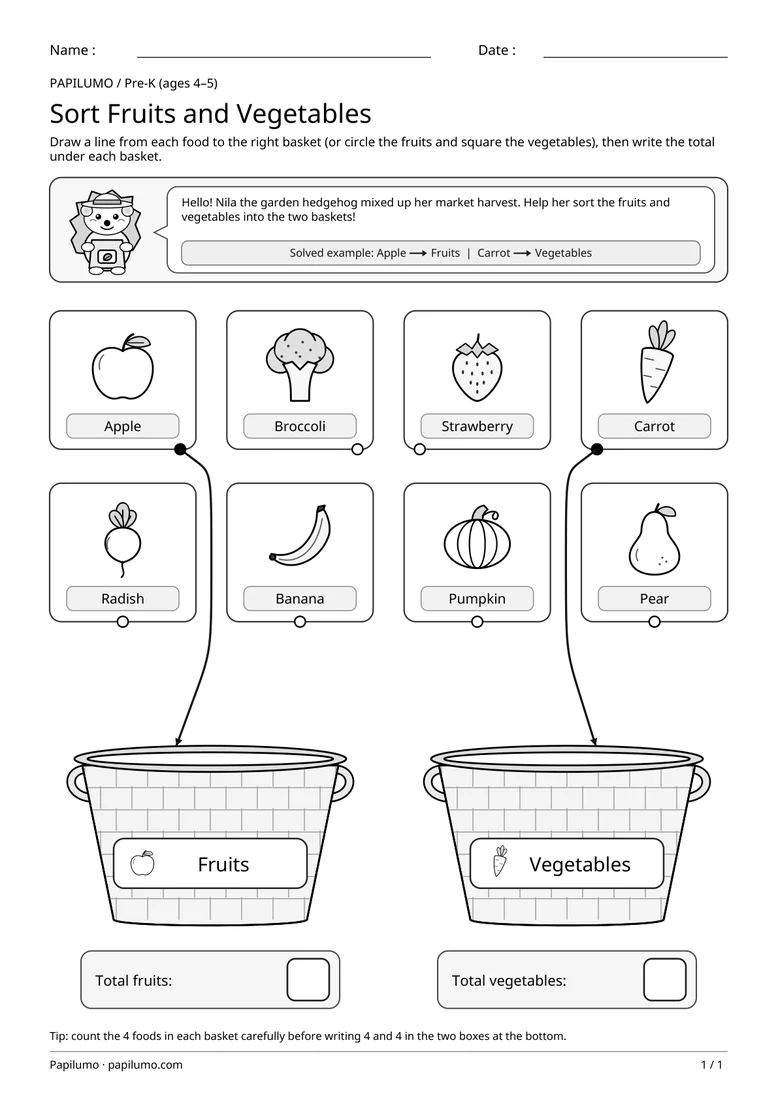
Working across the two rows of vehicles, the child connects the car and train to Road · Land (2 vehicles), the sailboat and submarine to Sea · Water (2 vehicles), and the hot-air balloon and airplane to Sky · Air (2 vehicles). Because the six cards are mixed across the two rows, learners must look closely at each drawing rather than guessing straight down. Once all six lines are drawn, they count the lines arriving at each habitat and write 2 in the box underneath. To vary the practice, try Sort Fruits and Vegetables (Observe, Match, and Count) with Nila: Draw a line from each food to the right basket (or circle the fruits and square the vegetables), then write the total under each basket.
What to notice and how to check
When reviewing with the separate one-page answer key, trace each path together by finger while saying the vehicle name and habitat aloud: car and train on the road, sailboat and submarine in the sea, hot-air balloon and airplane in the sky. Confirm that each bottom box holds the number 2, making six sorted vehicles in total. If a child mixes up the submarine or hot-air balloon, point out the bubbles and periscope underwater versus the clouds floating around the balloon.
Making the task easier
Point with your finger to the road, the sea, or the sky for each picture before picking up your pencil.
Keep the learning aim, but reduce how much the child has to handle at once. Cover part of the page with another sheet and reveal one task at a time. Demonstrate a separate example, then leave a real opportunity to work something out. An answer reached with support is still a useful attempt; it does not yet show that the same task can be completed independently.
Taking the idea beyond the worksheet
On the back of the sheet, draw one more vehicle you know and talk about whether it travels on land, water, or air.
Use the follow-up to meet the same idea in a different setting. Offer it once the first task makes sense, without insisting that the whole page must be perfect. The child might explain a strategy, make an example or set a challenge for an adult. Return to the worksheet only when it helps connect the two situations. A short conversation or a practical activity can be enough to finish the session. To continue exploring, use Same and Different Pictures with Lila the Ladybug: Circle the TWO identical pictures in each top row, then cross out the ONE different picture in each bottom row.
Downloading and printing the PDF
This free PDF contains one worksheet designed for A4 paper. Download the file using the button on this page and open it in your PDF reader. Choose actual size or a 100% scale, check the orientation in the print preview and turn off any browser headers or footers. The illustrations use vector lines, so their outlines stay sharp when printed. Check the margins on one copy before preparing several sheets for a group. The level shown on the page is a guide, rather than a requirement to complete the activity at a particular age.