

What this worksheet helps children practise
Tap the first picture with your finger, then check one detail at a time across the row before drawing your circle.
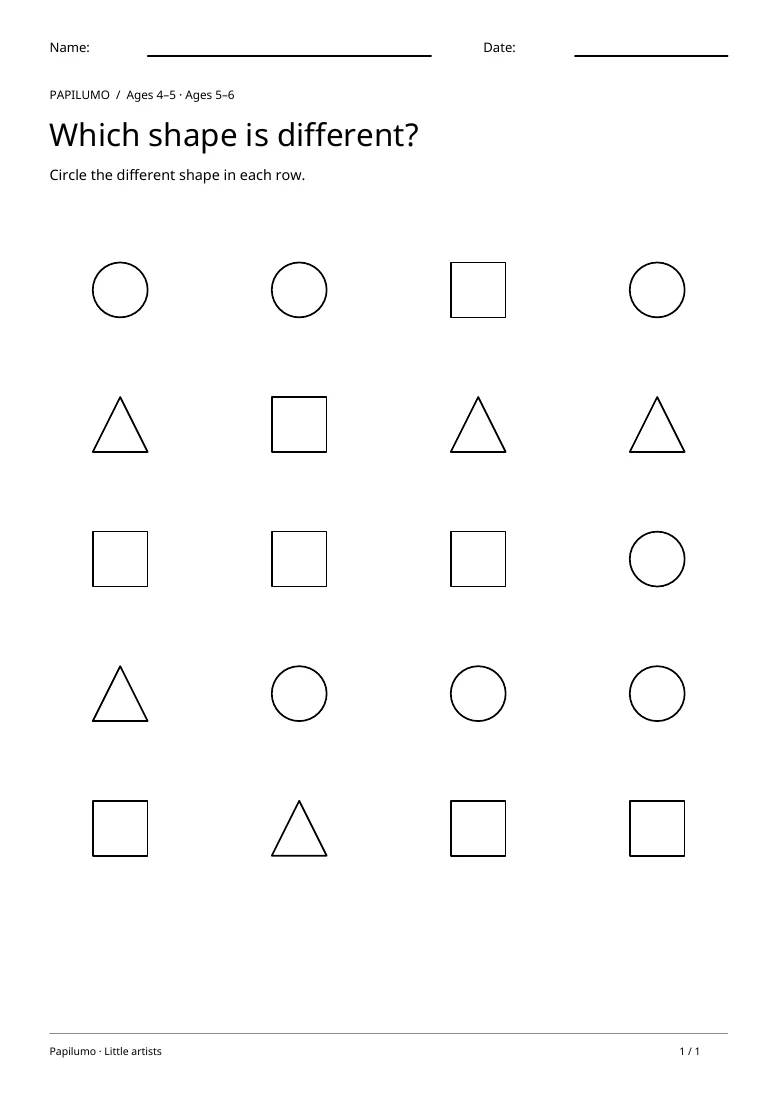
Distinguishing same from different in preschool strengthens visual discrimination, selective attention, and careful scanning from left to right. When three- and four-year-olds compare sailboats, cozy cottages, or friendly robots that look nearly alike, they learn to pause and inspect specific details—such as which way a flag points, how many portholes appear, where a chimney sits, or what badge sits on a robot’s chest. Those steady observation habits lay essential groundwork for noticing subtle letter, numeral, and shape differences later in kindergarten and first grade. For a related skill, use Odd One Out Shapes Worksheet: Circle the different shape in each row.
Preparing a short session
Print the student page at actual size (100%) on plain white letter or A4 paper without shrinking margins, and provide a thick crayon, washable marker, or chunky pencil easy for little fingers to grip. Keep the separate one-page answer key tucked out of sight while your child searches each row independently. Before making any marks, chat briefly about the objects together—sailboats, houses, robots, butterflies, cupcakes, and fish—encouraging curiosity without hinting ahead of time which specific detail changes across the pictures.
A concrete example to get started
Inside the top example box beside Lila the ladybug, children see three neat drawings in a row: a smiling sun, a puffy cloud, and a second smiling sun identical to the first, with both twin suns already circled by bold loops. Point slowly to each circled sun and say aloud, “Look closely—these two suns have the exact same rays and smiling face, so both matching suns get a circle!” Seeing the completed example right away makes the first circling rule immediately clear.
Supporting the activity
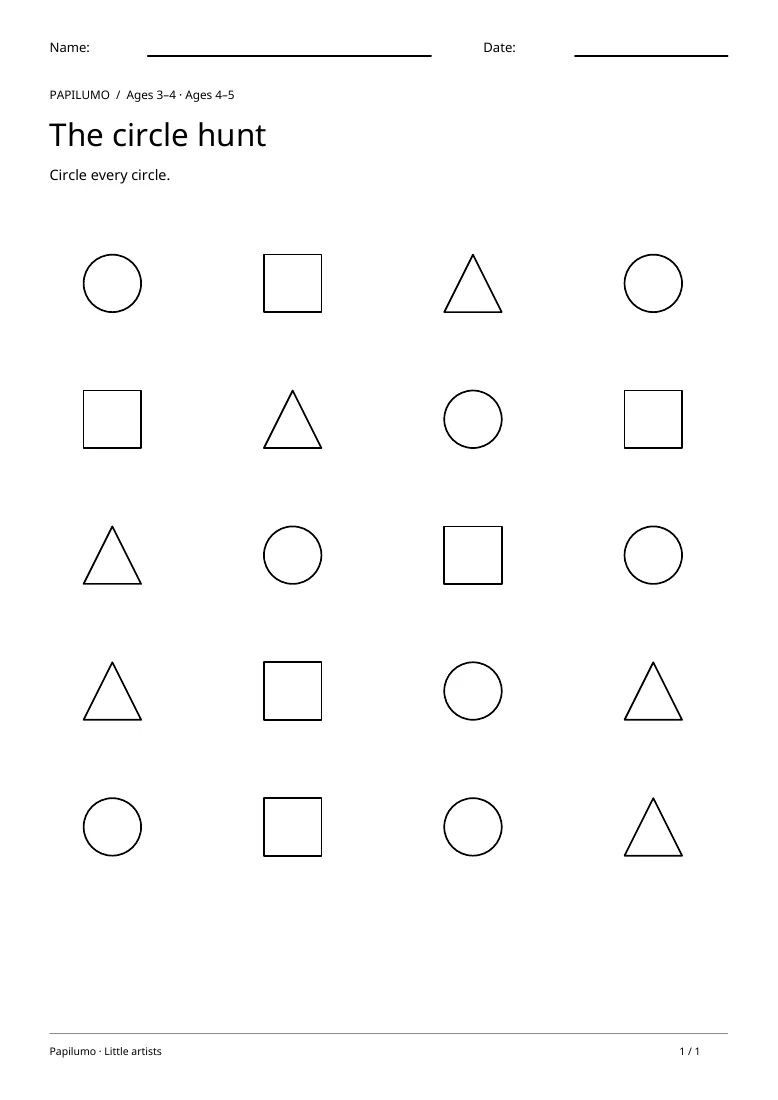
In Part 1, children inspect four roomy pictures per row and circle the two exact twins: in row A, the two sailboats with a right-pointing pennant and two round portholes (1st and 3rd); in row B, the two cottages with a right-side chimney and arched center door (2nd and 4th); and in row C, the two friendly robots with one round bobble antenna and a chest heart (1st and 4th). In Part 2, learners cross out the lone different picture: the striped butterfly without spots in row D (3rd), the candle cupcake in row E (1st), and the striped spiky fish in row F (4th). To vary the practice, try Preschool Shape Worksheet: Find the Circles: Circle every circle.
What to notice and how to check
When checking together with the separate answer key PDF showing all six thick circles in Part 1 and three bold X-crosses in Part 2, invite your child to explain each choice aloud: “How can you tell this boat is not the match?” If a clever distractor caught their eye, place one finger on each picture side by side and compare one feature at a time—square window versus round portholes, left chimney versus right chimney, or double antennas—so they spot the clue themselves with confidence.
Making the task easier
Cover the bottom section with a blank sheet of paper and focus on finding just one matching pair in row A first.
Keep the learning aim, but reduce how much the child has to handle at once. Cover part of the page with another sheet and reveal one task at a time. Demonstrate a separate example, then leave a real opportunity to work something out. An answer reached with support is still a useful attempt; it does not yet show that the same task can be completed independently.
Taking the idea beyond the worksheet
Line up four spoons or four socks on a table with one slightly different item and challenge an adult to spot the odd one.
Use the follow-up to meet the same idea in a different setting. Offer it once the first task makes sense, without insisting that the whole page must be perfect. The child might explain a strategy, make an example or set a challenge for an adult. Return to the worksheet only when it helps connect the two situations. A short conversation or a practical activity can be enough to finish the session. To continue exploring, use Oval, Diamond, Star, and Heart Shapes with Lila the Firefly: Trace the four dashed shapes, match each everyday object to its shape, then count the shapes in Lila’s garden box.
Downloading and printing the PDF
This free PDF contains one worksheet designed for A4 paper. Download the file using the button on this page and open it in your PDF reader. Choose actual size or a 100% scale, check the orientation in the print preview and turn off any browser headers or footers. The illustrations use vector lines, so their outlines stay sharp when printed. Check the margins on one copy before preparing several sheets for a group. The level shown on the page is a guide, rather than a requirement to complete the activity at a particular age.