


What this worksheet helps children practise
Touch each shape inside Lila’s box—or make a tiny pencil dot on it—as you count so none get counted twice!
Recognizing ovals, diamonds, stars, and hearts builds visual discrimination and early geometry language in preschool. Children notice what makes each outline distinct: a smooth stretched curve for an oval, four pointed corners for a diamond, five radiating points for a star, and two rounded top lobes meeting at a bottom point for a heart. Linking each dashed trace to familiar real-world pictures and then counting mixed items by category strengthens fine-motor control, shape vocabulary, and accurate one-to-one counting up to four. For a related skill, use Same and Different Pictures with Lila the Ladybug: Circle the TWO identical pictures in each top row, then cross out the ONE different picture in each bottom row.
Preparing a short session
Print the student worksheet at actual size (100%) on plain white paper without cropping margins, and provide a sharpened pencil and a soft eraser. Keep the separate one-page answer key out of reach while your child works. Before picking up the pencil, trace each large dashed shape at the top with one finger starting right on the black dot, naming oval, diamond, star, and heart aloud together. Briefly name the four left-hand pictures—kite, egg, heart cookie, and starfish—so every everyday object is instantly recognizable.
A concrete example to get started
The top guide strip acts as a clear visual anchor across the entire page. Each large dashed shape shows a bold black starting dot right at the top point so little hands know exactly where to place their pencil to trace the stretched oval, four-corner diamond, five-pointed star, and balanced heart. Having these four large labeled guides directly above both exercises lets children compare contours easily before drawing matching lines in Part 1 or scanning the twelve mixed shapes in Part 2.
Supporting the activity
In Part 1, children look at the four numbered objects on the left and draw a clean line to the matching shape badge on the right: the kite (1) connects to Diamond (B), the decorated egg (2) connects to Oval (A), the heart cookie (3) connects to Heart (D), and the starfish (4) connects to Star (C). In Part 2, learners scan Lila’s garden box, point or lightly mark each shape as they count, and record the four totals neatly inside the boxes: 3 ovals, 2 diamonds, 4 stars, and 3 hearts. To vary the practice, try Skip Counting by 11s and 12s to 144 with Kiko: Complete the 4 trails by adding +11 or +12 from one stone to the next.
What to notice and how to check
When reviewing with the separate answer key showing all four connecting lines and the filled count boxes, confirm first that every object matched its true shape rather than going straight across. Make sure the egg was not mistaken for a circle or the diamond for a tilted square. Next check the four garden-box totals in order: 3 ovals, 2 diamonds, 4 stars, and 3 hearts, adding up to twelve shapes altogether. If any count is off by one, ask your child to touch and recount only that single shape inside the box before erasing and updating the box.
Making the task easier
Cover the bottom garden box with a blank sheet while working on Part 1 so the page stays calm and easy to scan.
Keep the learning aim, but reduce how much the child has to handle at once. Cover part of the page with another sheet and reveal one task at a time. Demonstrate a separate example, then leave a real opportunity to work something out. An answer reached with support is still a useful attempt; it does not yet show that the same task can be completed independently.
Taking the idea beyond the worksheet
Go on a quick shape hunt around the room to find one oval, one diamond, one star, and one heart to sketch on the back.
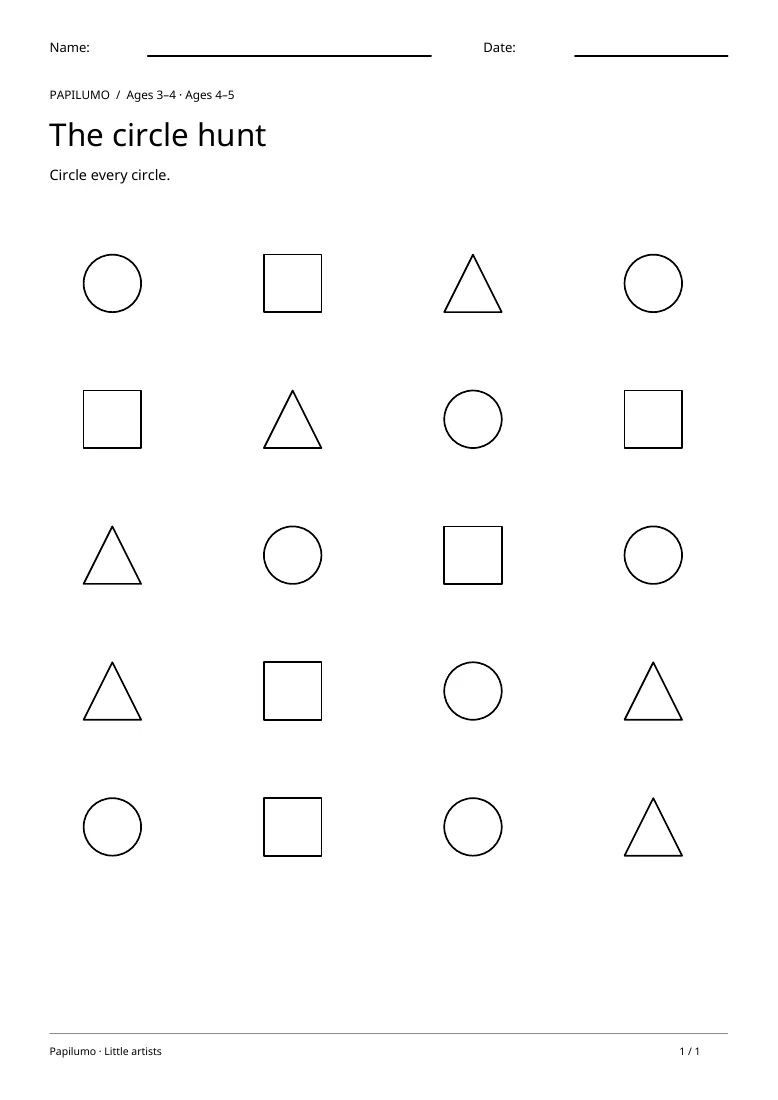
Use the follow-up to meet the same idea in a different setting. Offer it once the first task makes sense, without insisting that the whole page must be perfect. The child might explain a strategy, make an example or set a challenge for an adult. Return to the worksheet only when it helps connect the two situations. A short conversation or a practical activity can be enough to finish the session. To continue exploring, use Preschool Shape Worksheet: Find the Circles: Circle every circle.
Downloading and printing the PDF
This free PDF contains one worksheet designed for A4 paper. Download the file using the button on this page and open it in your PDF reader. Choose actual size or a 100% scale, check the orientation in the print preview and turn off any browser headers or footers. The illustrations use vector lines, so their outlines stay sharp when printed. Check the margins on one copy before preparing several sheets for a group. The level shown on the page is a guide, rather than a requirement to complete the activity at a particular age.