
What this worksheet helps children practise
Find the next even number with your eyes by adding +2 before drawing each straight line!
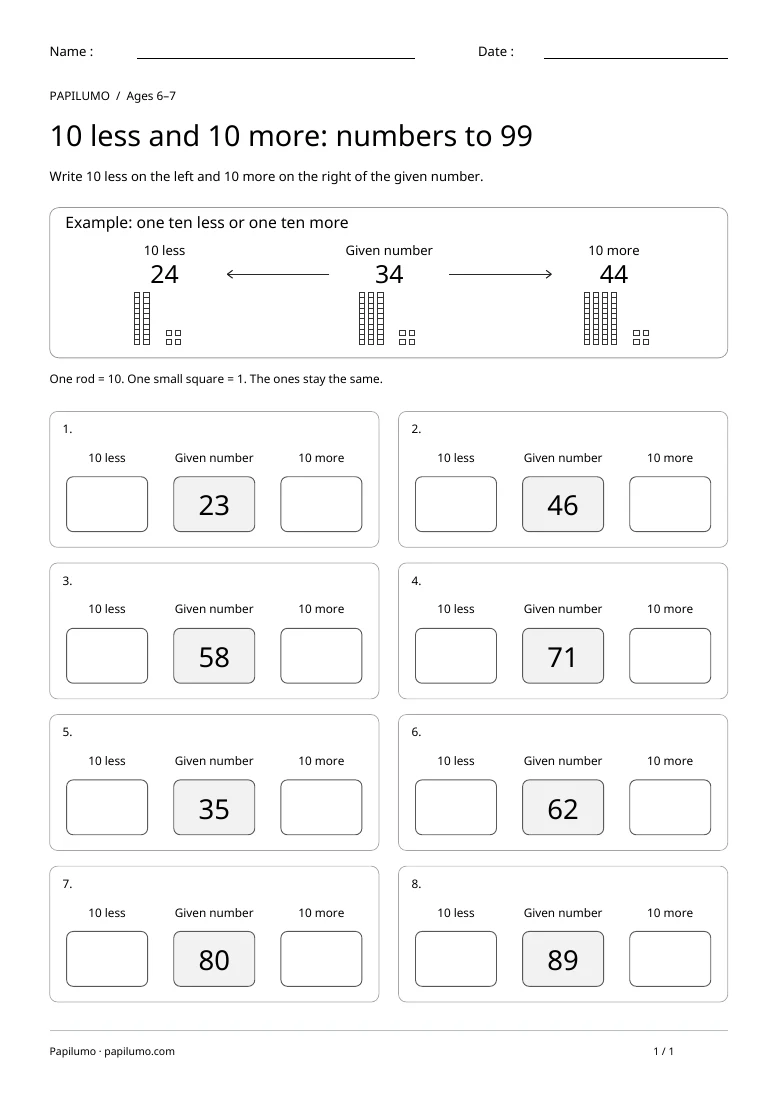
Practicing skip-counting by 2s to 50 in 1st Grade builds fluent command of even numbers while laying essential groundwork for doubling and the 2 times table. Children notice that the ones digits cycle predictably through 2, 4, 6, 8, and 0 even when crossing into a new ten, such as stepping from 18 to 20, 28 to 30, or 48 to 50. Scanning the dolphin silhouette for the next even number also strengthens visual tracking, number sense, and steady pencil control from start to finish. For a related skill, use 10 less and 10 more: numbers to 99: Write 10 less on the left and 10 more on the right of the given number.
Preparing a short session
Print the student sheet at actual size (100%) on plain white letter or A4 paper without shrinking the margins, and provide a freshly sharpened pencil with a clean eraser. Keep the separate one-page answer key PDF out of sight while your child works independently. Before drawing the first straight line, run one finger together along the 2, 4, 6, 8, 10, 12, 14, 16 warm-up strip beneath the ocean waves, then help your student spot the start ring, star, and guide arrow beside dot 2.
A concrete example to get started
Inside the worked example box beside Lulu’s speech bubble, four crisp dots arranged in a gentle wave show exactly how to begin: place the pencil tip on dot 2 marked by a start ring and small star, follow the directional arrow straight to 4, and continue smoothly through 6 and 8. Previewing those first four even numbers removes hesitation right at the start and makes the +2 jump rule completely concrete before tracing the full twenty-five-dot dolphin outline.
Supporting the activity
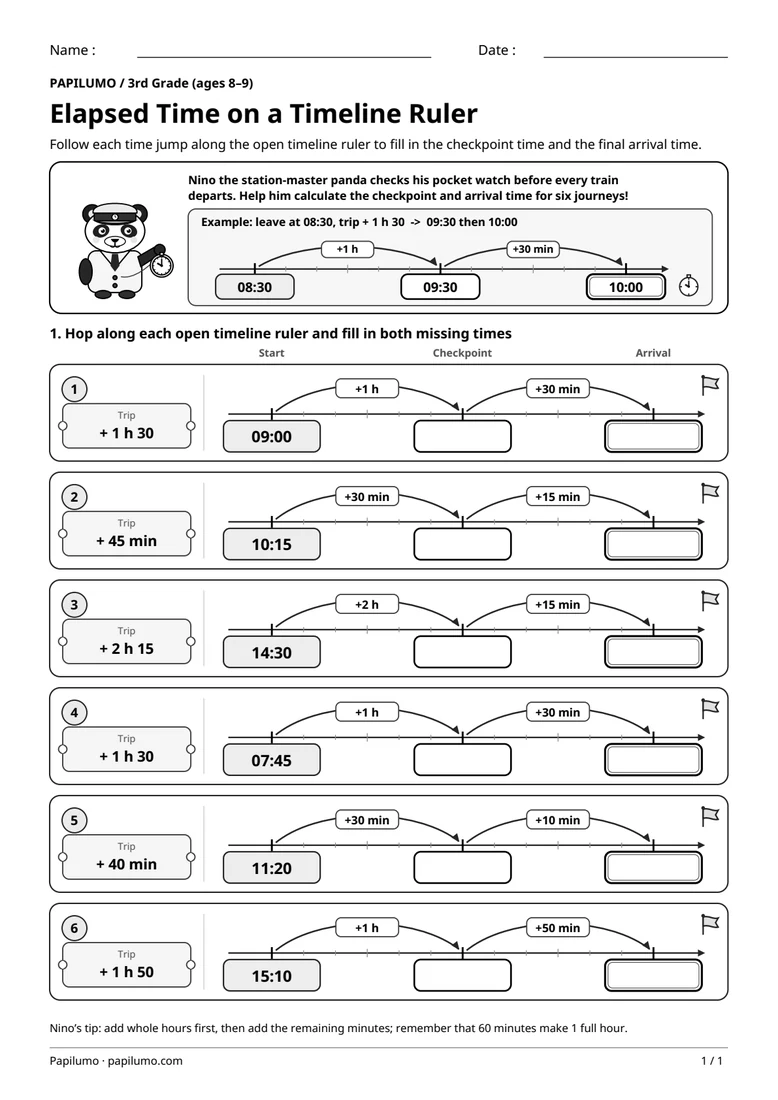
On the main ocean canvas, students connect all twenty-five even numbers from 2 to 50 in order without crossing a single line: starting at the lower jaw (2), tracing the chin and throat (4, 6), outlining the pectoral fin (8, 10, 12), curving along the arched belly (14 to 18), shaping both tail flukes (20, 22, 24), sweeping up the back and curved dorsal fin (26 to 38), and finishing the forehead and upper beak to 50. Below, they fill in 18 plus 2 equals 20, 34 plus 2 equals 36, and 48 plus 2 equals 50. To vary the practice, try Elapsed Time on an Open Timeline Ruler with Nino the Panda: Follow each time jump along the open timeline ruler to fill in the checkpoint time and the final arrival time.
What to notice and how to check
When reviewing together with the separate one-page answer key PDF, inspect the completed dolphin outline first: pointed pectoral fin below, split tail flukes on the left, swept dorsal fin high on the back, and smiling beak around the friendly eye above the ocean splash waves. Check that no stray line cuts across the body and verify every decade crossing (18 to 20, 28 to 30, 38 to 40, and 48 to 50). Finally, verify the three bottom boxes (20, 36, and 50) and celebrate a neat job.
Making the task easier
Tap along the 2 to 16 warm-up strip below the ocean waves whenever you need a quick +2 reminder.
Keep the learning aim, but reduce how much the child has to handle at once. Cover part of the page with another sheet and reveal one task at a time. Demonstrate a separate example, then leave a real opportunity to work something out. An answer reached with support is still a useful attempt; it does not yet show that the same task can be completed independently.
Taking the idea beyond the worksheet
After checking your dolphin, count backward by 2s from 50 down to 2 while pointing to each dot!
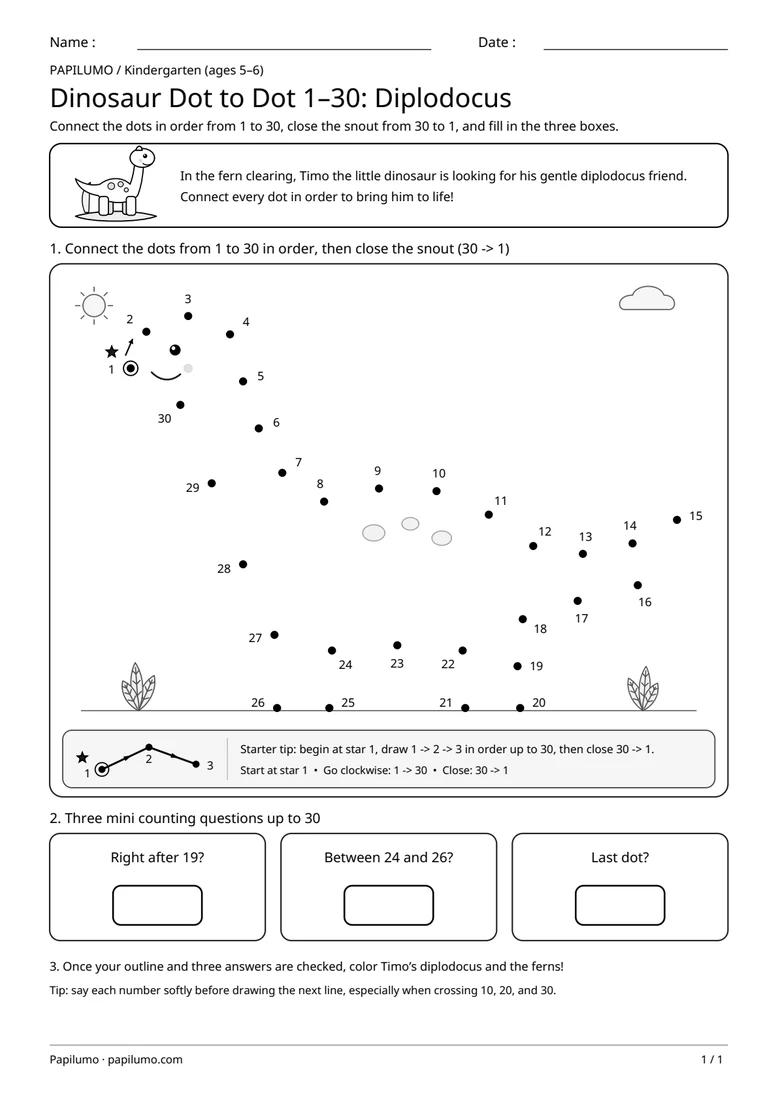
Use the follow-up to meet the same idea in a different setting. Offer it once the first task makes sense, without insisting that the whole page must be perfect. The child might explain a strategy, make an example or set a challenge for an adult. Return to the worksheet only when it helps connect the two situations. A short conversation or a practical activity can be enough to finish the session. To continue exploring, use Dinosaur Dot to Dot 1 to 30: Friendly Diplodocus with Timo: Connect the dots in order from 1 to 30, close the snout from 30 to 1, and fill in the three boxes.
Downloading and printing the PDF
This free PDF contains one worksheet designed for A4 paper. Download the file using the button on this page and open it in your PDF reader. Choose actual size or a 100% scale, check the orientation in the print preview and turn off any browser headers or footers. The illustrations use vector lines, so their outlines stay sharp when printed. Check the margins on one copy before preparing several sheets for a group. The level shown on the page is a guide, rather than a requirement to complete the activity at a particular age.