

What this worksheet helps children practise
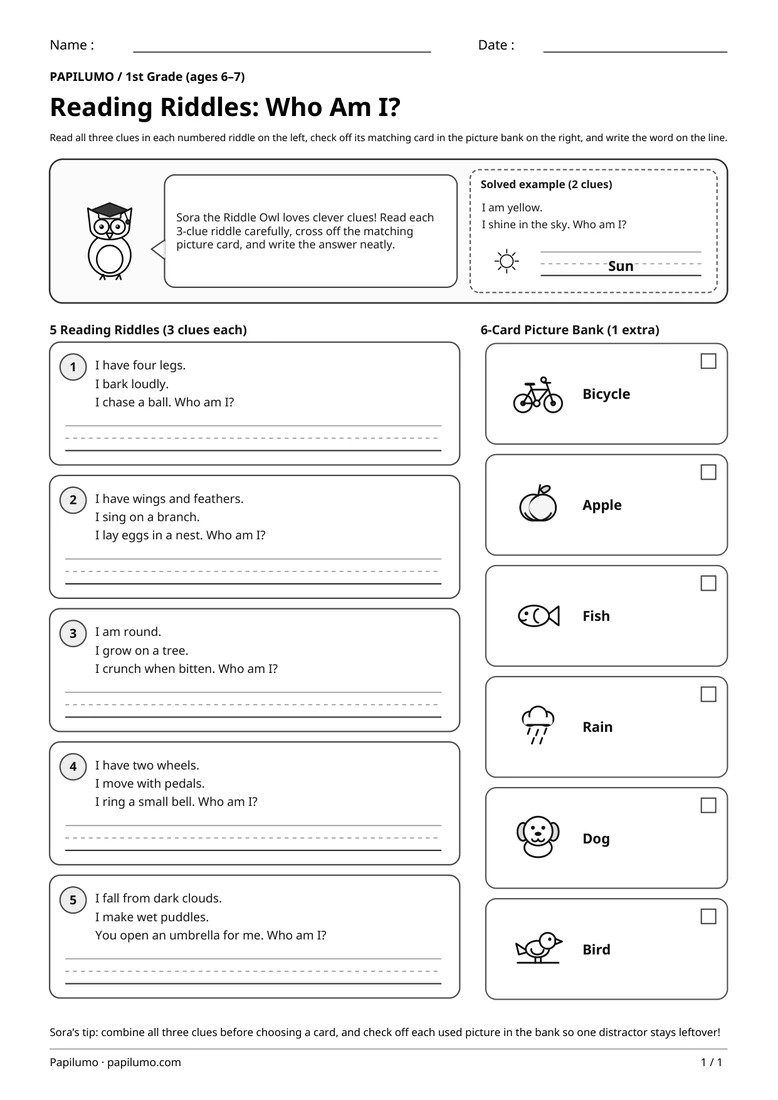
Read all three clues together before picking a picture card, then cross off each used card in the bank!
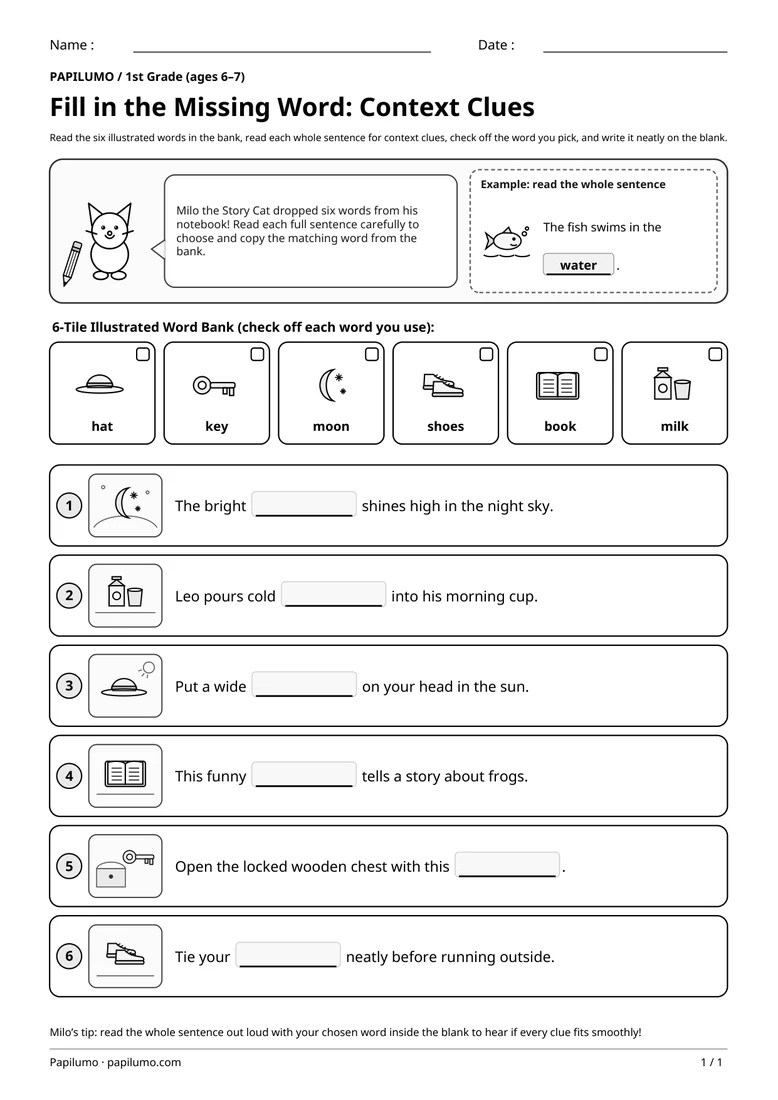
Solving three-clue reading riddles in 1st grade develops inferential comprehension, careful sentence-by-sentence decoding, and semantic synthesis across clues. Rather than jumping to a quick guess after reading only one trait — such as having four legs or being round — young readers practice combining all three clues together before eliminating unrelated choices in the bank. Copying each confirmed word onto wide primary double lines also strengthens accurate spelling, neat letter proportion, baseline control, and smooth handwriting. For a related skill, use Fill in the Missing Word: Sentence Context Clues with Milo (1st Grade): Read the six illustrated words in the bank, read each whole sentence for context clues, check off the word you pick, and write it neatly on the blank.
Preparing a short session
Print the student worksheet at actual size (100%) on plain white A4 paper so all five clue cards on the left and all six labeled picture cards on the right remain spacious and sharp. Seat your child at a calm, bright table with a sharpened pencil and soft eraser while keeping the separate one-page answer key PDF tucked away out of sight. Before tackling Riddle 1, quickly read through the six labels in the right-hand picture bank together (Bicycle, Apple, Fish, Rain, Dog, Bird) so every word is familiar.
A concrete example to get started
Inside the framed top banner beside Sora the Riddle Owl in her cozy thinking cap and friendly speech bubble, a dashed example box shows one solved two-clue riddle right before the exercises begin. It reads « I am yellow. I shine in the sky. Who am I? » alongside a crisp sun illustration and the printed answer word Sun. Seeing this short completed example immediately shows first graders how clues narrow down one exact answer to copy cleanly onto the writing line.
Supporting the activity
The left column stacks five numbered three-clue riddles leading cleanly to Dog, Bird, Apple, Bicycle, and Rain, each featuring a roomy primary double-line writing strip along the bottom edge. Beside them, the right column displays six shuffled labeled picture cards with small corner check boxes: five true matches and one clever distractor (Fish). Students decode every clue carefully from start to finish, check off each used picture card in the right-hand bank, and copy the matching answer word accurately onto its primary double line. To vary the practice, try Question Words (Who, Where, When, What) Picture Comprehension with Zelie (1st Grade): Check the legend, read each short story A to D, circle the best answer, and match the four question words below.
What to notice and how to check
When all five primary lines on the left are filled neatly and five picture cards are checked off on the right, place the separate one-page answer key PDF on plain white paper beside your child’s worksheet for a warm, celebratory check together. The answer key displays Dog, Bird, Apple, Bicycle, and Rain neatly printed on all five primary lines and matched directly to the five highlighted picture bank cards, leaving Fish completely untouched. Ask which clue gave away each riddle best, then create a brand-new three-clue riddle together out loud for the leftover Fish card.
Making the task easier
Underline the strongest action word in each riddle (bark, nest, crunch, pedals, umbrella) before scanning the picture bank.
Keep the learning aim, but reduce how much the child has to handle at once. Cover part of the page with another sheet and reveal one task at a time. Demonstrate a separate example, then leave a real opportunity to work something out. An answer reached with support is still a useful attempt; it does not yet show that the same task can be completed independently.
Taking the idea beyond the worksheet
Use the leftover Fish card to invent a brand-new three-clue Who Am I riddle aloud for a family member.
Use the follow-up to meet the same idea in a different setting. Offer it once the first task makes sense, without insisting that the whole page must be perfect. The child might explain a strategy, make an example or set a challenge for an adult. Return to the worksheet only when it helps connect the two situations. A short conversation or a practical activity can be enough to finish the session. To continue exploring, use Read Short Sentences and Match to Pictures with Milo: Read each sentence on the left carefully, then draw a line to the matching picture on the right.
Downloading and printing the PDF
This free PDF contains one worksheet designed for A4 paper. Download the file using the button on this page and open it in your PDF reader. Choose actual size or a 100% scale, check the orientation in the print preview and turn off any browser headers or footers. The illustrations use vector lines, so their outlines stay sharp when printed. Check the margins on one copy before preparing several sheets for a group. The level shown on the page is a guide, rather than a requirement to complete the activity at a particular age.