

Slowing Down Eager Detectives Across All Five Clues
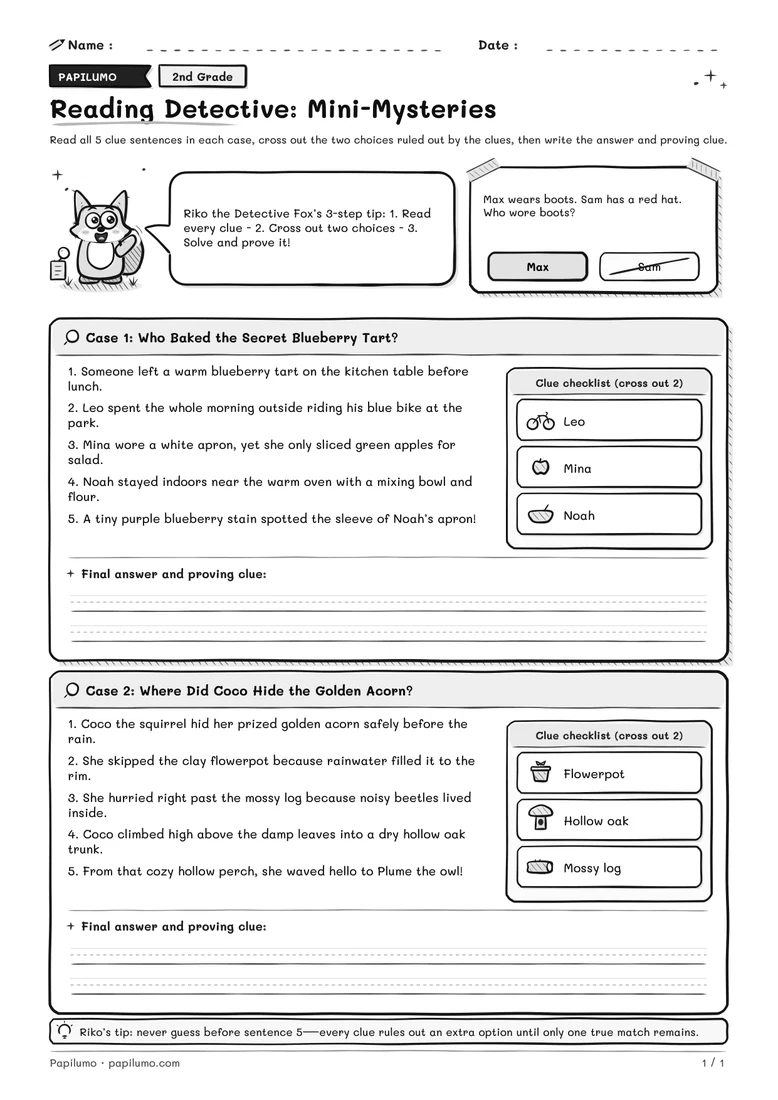
Put a magnifying-glass mystery in front of a second grader and their first impulse is to shout out a winner after reading clue number one! Up in the rounded banner, Riko the Detective Fox shows why real sleuths hold their horses: beside his 'Read, Cross out, Solve' rule, the two-sentence warm-up ('Max wears boots. Sam has a red hat. Who wore boots?') cleanly crosses out 'Sam' on the mini checklist before circling 'Max.' In each of the two main cases below, five clue sentences work together as a team—so jumping to a conclusion before sentence five is a guaranteed trap.
If your child is just stepping up from shorter first-grade stories and feels intimidated by five clues at once, warming up by finding one clue word in mini-stories builds steady text-checking habits before juggling deductive elimination.
Catching Skipped 'Not' Words and Vague Proof Lines
The number-one mistake at the second-grade reading table is skimming right past tiny negative words such as 'not,' 'no,' or 'without': an eager reader spots a familiar color or object word in sentence three, misses the 'not' right in front of it, and circles the exact suspect or item that the clue just eliminated! A second classic shortcut shows up on the proof line, where kids write 'because it is left' or 'I knew it' instead of quoting the text fact.
Unblock both issues with two light pencil habits: first, have your reader underline the key clue phrase—including any 'not'—inside each of the five sentences before looking at the three-box illustrated checklist. Second, require two crossed-out boxes in the checklist before they write the final answer and copy the specific proving clue onto the bottom line.
Writing Homemade Mysteries and Evidence-Based Responses
Training young readers to justify every conclusion with a concrete detail from the passage—rather than a hunch—builds the exact analytical muscle they need when they sort verifiable facts from opinions across second-grade reading units.
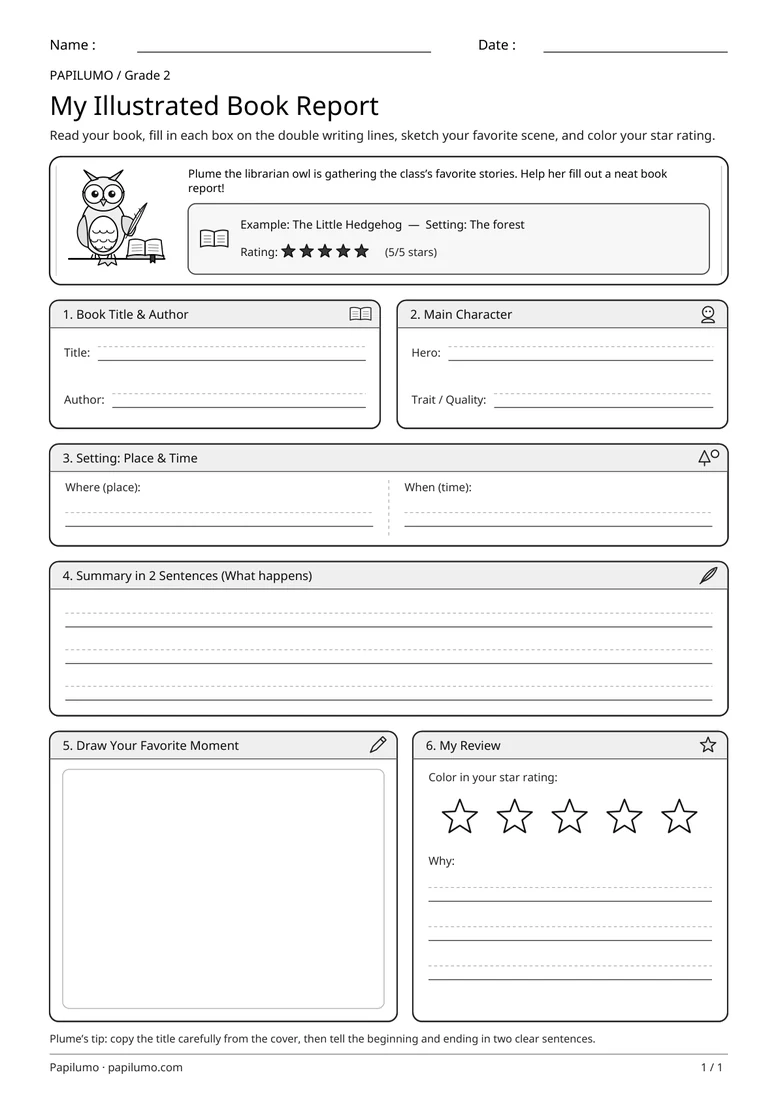
After cracking both cases, let your detective flip the sheet over and write a three-sentence mystery about three everyday items from their schoolbag—like a ruler, an eraser, and a glue stick—for a parent or classmate to solve, or keep their momentum going on longer mysteries by filling out an illustrated book report after finishing a favorite chapter book.