


What this worksheet helps children practise
Start on the left black dot, sweep smoothly up like a rainbow bridge, and curve down to the right star!
Tracing wide concentric arches from left to right in preschool develops smooth wrist rotation, shoulder-to-finger coordination, and continuous curved line control without stopping mid-stroke. By starting each rainbow band at a bold black dot on the left, sweeping gracefully up over the crown, and curving steadily down to an anchor star on the right, young children internalize both left-to-right tracking and classic upward arch motion. Mastering smooth arch curves prepares little hands directly for curved lowercase letters like m, n, r, and h. For a related skill, use Trace the Curved Path: Hungry Critters to Snacks with Zia (Preschool): Start at each big black dot on the left and trace along the dotted curved trail to help every hungry critter reach its snack.
Preparing a short session
Print the student worksheet at actual size (100%) on plain white A4 or letter paper without cropping margins, and set out a chunky triangular pencil, soft wax crayon, or thick washable marker at a tidy table. Keep the separate one-page answer key PDF tucked out of sight while your child traces independently. Before picking up the marker, draw tall rainbow bridges across the air together from left to right with one arm, then slowly finger-trace several dotted arches on the paper. Ask your child to keep their helper hand resting steadily on the bottom margin of the page.
A concrete example to get started
Inside the framed top banner beside Lili the swallow flying lightly above the baseline, a pointing speech bubble introduces the sky scene right next to a worked mini rainbow box. A two-band miniature arch shows a bold black start dot on the left, a smooth curved directional arrow sweeping upward over the ridge, and a solid traced arc landing right on a small anchor star on the right. Even non-readers immediately recognize the starting dot, arch motion, and finish target.
Supporting the activity
Guide your child smoothly from the big sky centerpiece down to the repeated smaller arches below. In Section 1, one large five-band dotted rainbow spans generously across two grassy hill tufts; bold black start dots anchor every arc on the left so fingers sweep comfortably up and over to the matching stars on the right. In Section 2, three medium double-arc dotted rainbows sit evenly across the lower half between fluffy clouds for six extra curved practice strokes. Notice how the generous spacing between bands lets thick crayons glide smoothly without crowding. To vary the practice, try Trace and Color Rainy Day Umbrella and Boots with Plume (Pre-K): Warm up on the J-hooks and scalloped arches, then trace each dotted rainy-day drawing from the bold black start dots and color it.
What to notice and how to check
When all eleven rainbow arcs are drawn, place the separate smooth-line answer key PDF beside your child’s worksheet to celebrate fluid curved motion and steady focus. Check together calmly that the five large concentric arches and all six smaller arches begin right on their left black dots, curve smoothly over the top without sharp angles, and meet their anchor stars cleanly. If a band flattened out, finger-trace that curve once more together, then invite your child to color the rainbow bands. Every rainbow arch turns careful tracing into bright sky art.
Making the task easier
Trace the five big rainbow arcs twice with your pointer finger from left to right before picking up a marker.
Keep the learning aim, but reduce how much the child has to handle at once. Cover part of the page with another sheet and reveal one task at a time. Demonstrate a separate example, then leave a real opportunity to work something out. An answer reached with support is still a useful attempt; it does not yet show that the same task can be completed independently.
Taking the idea beyond the worksheet
Color each band of the big centerpiece rainbow, the grassy hill tufts, fluffy clouds, and Lili the swallow afterward.
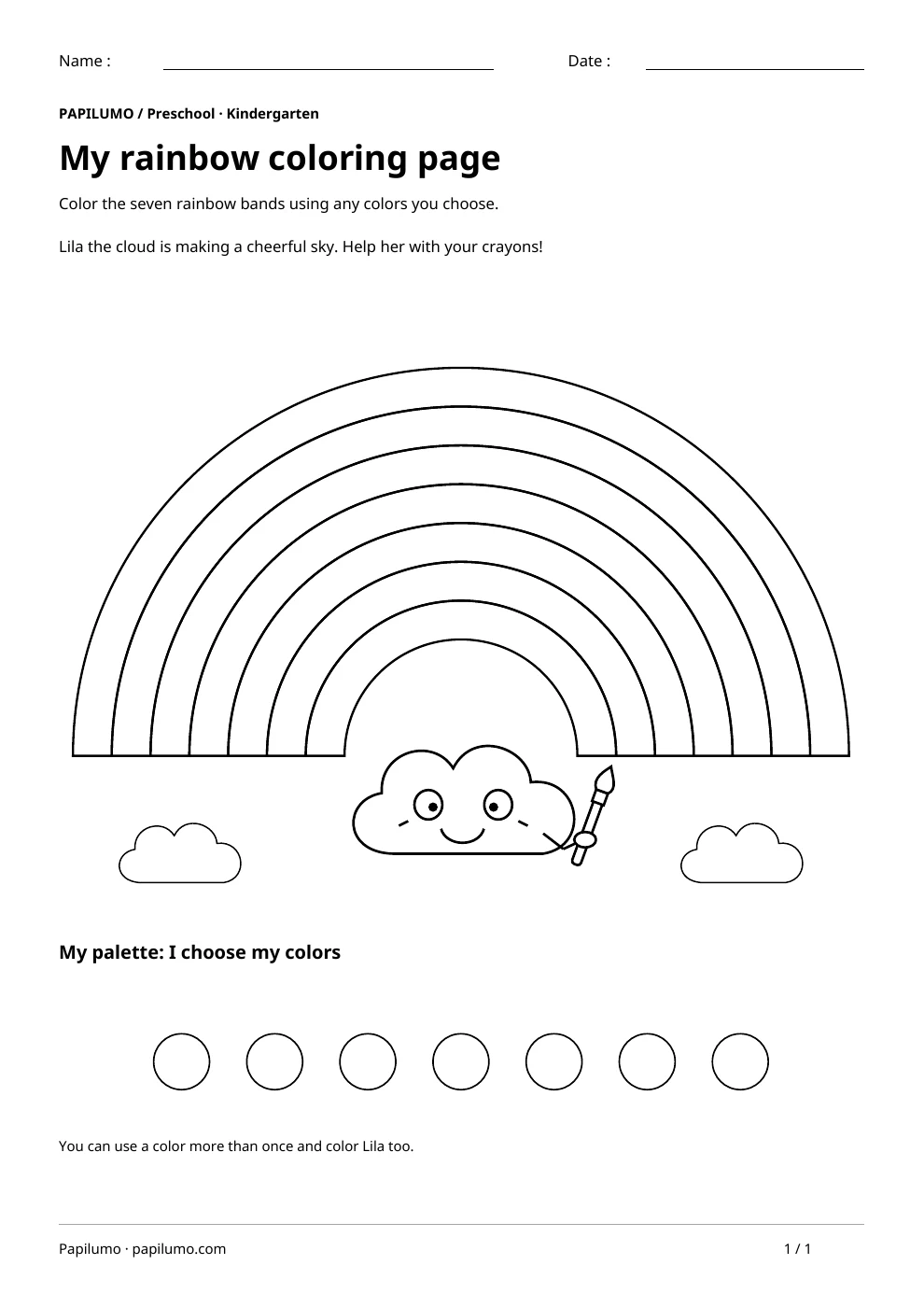
Use the follow-up to meet the same idea in a different setting. Offer it once the first task makes sense, without insisting that the whole page must be perfect. The child might explain a strategy, make an example or set a challenge for an adult. Return to the worksheet only when it helps connect the two situations. A short conversation or a practical activity can be enough to finish the session. To continue exploring, use Rainbow Coloring Page with Lila the Cloud: Color the seven rainbow bands using any colors you choose.
Downloading and printing the PDF
This free PDF contains one worksheet designed for A4 paper. Download the file using the button on this page and open it in your PDF reader. Choose actual size or a 100% scale, check the orientation in the print preview and turn off any browser headers or footers. The illustrations use vector lines, so their outlines stay sharp when printed. Check the margins on one copy before preparing several sheets for a group. The level shown on the page is a guide, rather than a requirement to complete the activity at a particular age.