

What this worksheet helps children practise
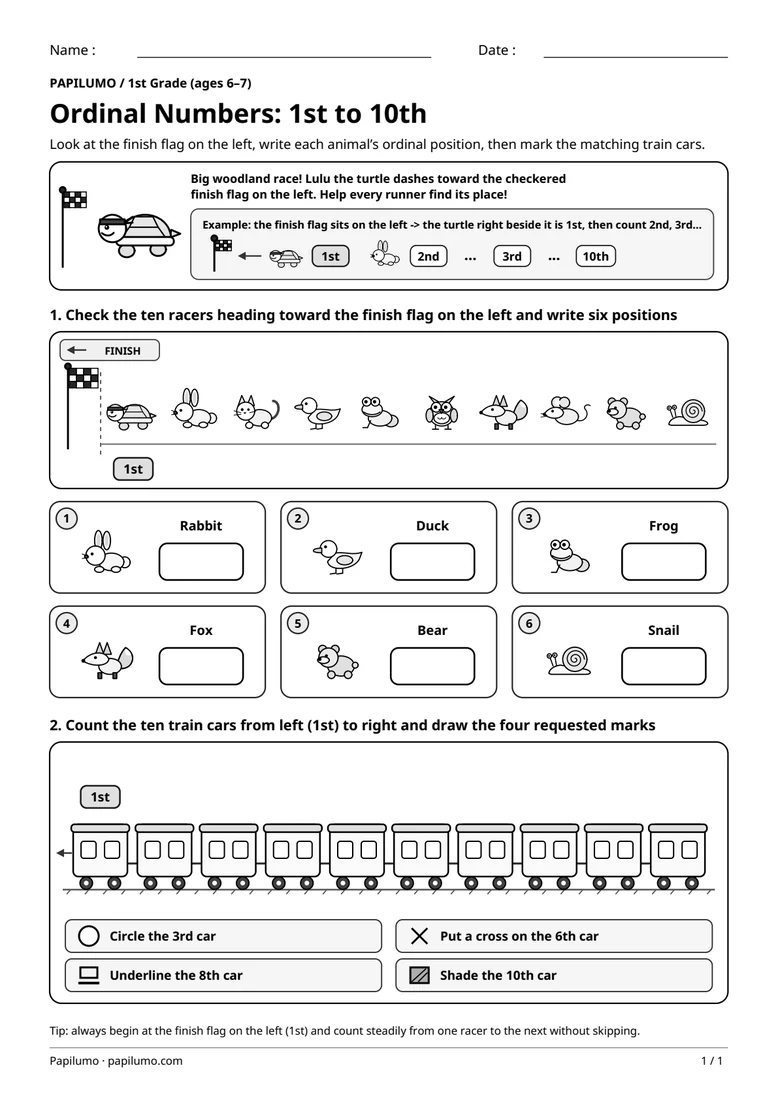
Point to 1st beside the finish flag and whisper “1st, 2nd, 3rd…” as you tap each animal before writing.
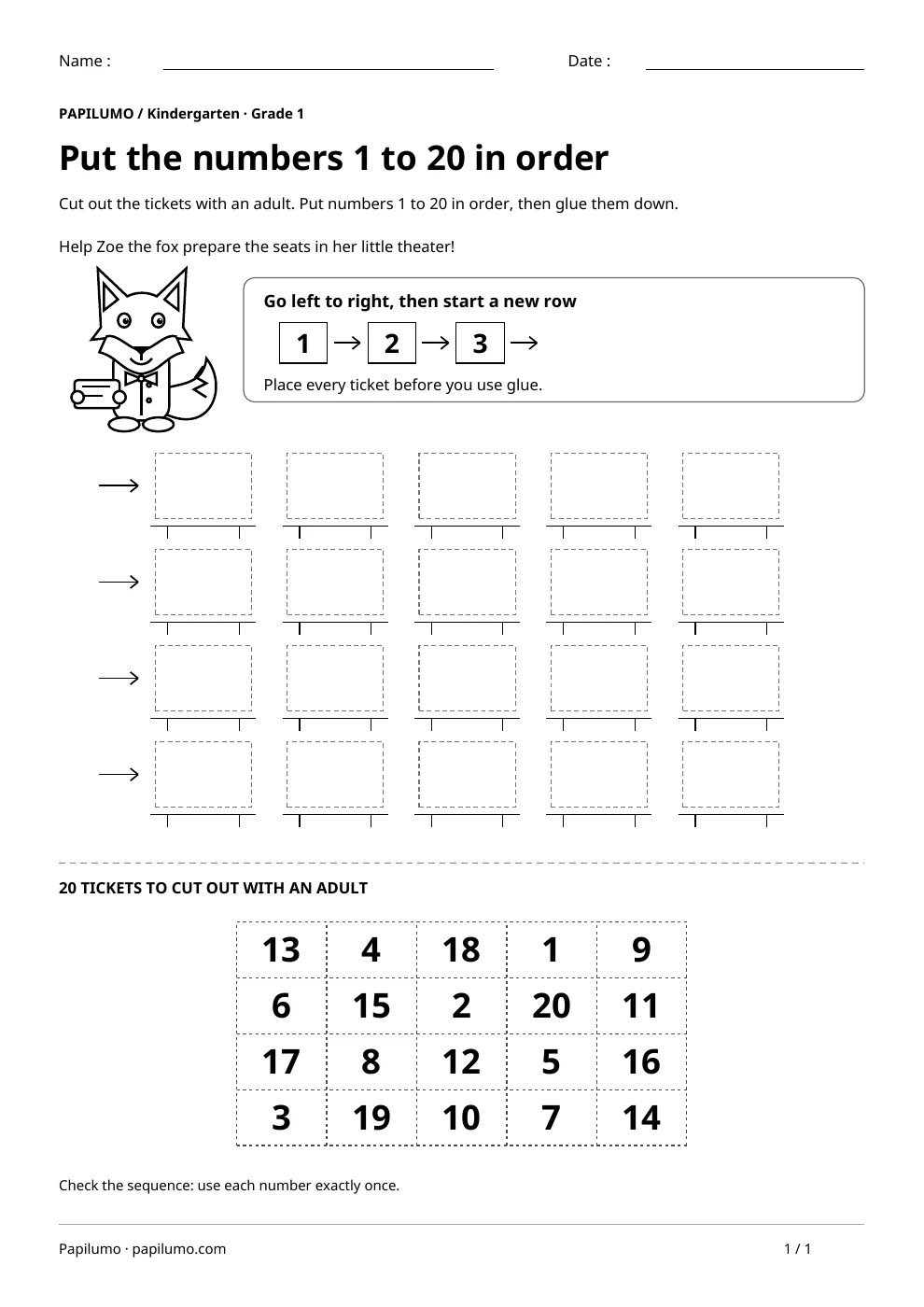
Mastering ordinal numbers in 1st grade builds the crucial bridge between counting how many objects appear in a group and naming an object’s exact rank in an ordered line. Unlike cardinal numbers, ordinals depend entirely on where the starting reference sits. By anchoring the checkered finish flag on the left and showing Lulu the turtle labeled 1st directly beside it, children learn to verify direction first, read and write standard English ordinal suffixes (-st, -nd, -rd, -th) accurately, and follow multi-step spatial instructions with care. For a related skill, use Ordering Numbers 1–20: Cut and Paste: Cut out the tickets with an adult. Put numbers 1 to 20 in order, then glue them down.
Preparing a short session
Print the student page at actual size (100%) on plain white letter or A4 paper without shrinking margins, and provide a sharpened pencil and soft eraser. Keep the separate PDF answer key tucked away until work is finished. Before writing, have your child point to the checkered finish flag on the left and name all ten animal runners in order from left to right: turtle, rabbit, cat, duck, frog, owl, fox, mouse, bear, and snail. Read the top directions and Lulu the turtle’s worked example together.
A concrete example to get started
In the top banner beside Lulu the turtle, the worked model highlights the anchor rule: because the checkered finish flag stands on the far left, the turtle right next to it is already labeled 1st. Moving one spot to the right brings learners to the rabbit in 2nd place. Showing that 1st badge right beside the flag stops the most common beginner mistake right away—counting backward from the snail on the right or forgetting the irregular endings on 1st, 2nd, and 3rd.
Supporting the activity
In Part 1, students touch each runner starting from the turtle (1st) and fill in the six illustrated cards with neat ordinal notation: 2nd for the rabbit, 4th for the duck, 5th for the frog, 7th for the fox, 9th for the bear, and 10th for the snail trailing at the back. In Part 2, they start at the leftmost train car marked 1st, count steadily across all ten cars, and apply four different marks: circle the 3rd car, put a cross on the 6th car, underline the 8th car below its wheels, and shade the 10th car. To vary the practice, try Comparing Numbers to 20: Compare each pair of numbers. Write <, > or = in the box.
What to notice and how to check
When reviewing with the separate PDF answer key, which labels every position from 1st to 10th under the race and above the train, check the six written ordinals in Part 1 first: 2nd, 4th, 5th, 7th, 9th, and 10th, paying special attention to the suffix -nd on 2nd versus -th on the others. Next, check all four marks on the ten-car train: circle on 3rd, cross on 6th, line under 8th, and shading on 10th. If any item shifted by one spot, recount aloud together from 1st.
Making the task easier
Lightly pencil small numbers 1 to 10 beneath the racers first so you never lose your place while counting.
Keep the learning aim, but reduce how much the child has to handle at once. Cover part of the page with another sheet and reveal one task at a time. Demonstrate a separate example, then leave a real opportunity to work something out. An answer reached with support is still a useful attempt; it does not yet show that the same task can be completed independently.
Taking the idea beyond the worksheet
Ask a partner two extra race riddles aloud: which animal finished 3rd, 6th, or right in front of 9th?
Use the follow-up to meet the same idea in a different setting. Offer it once the first task makes sense, without insisting that the whole page must be perfect. The child might explain a strategy, make an example or set a challenge for an adult. Return to the worksheet only when it helps connect the two situations. A short conversation or a practical activity can be enough to finish the session. To continue exploring, use Build the Greatest and Smallest Number from Digit Cards with Pico: Use each digit card once to write the greatest and smallest valid number (never put 0 first in a 3-digit number!).
Downloading and printing the PDF
This free PDF contains one worksheet designed for A4 paper. Download the file using the button on this page and open it in your PDF reader. Choose actual size or a 100% scale, check the orientation in the print preview and turn off any browser headers or footers. The illustrations use vector lines, so their outlines stay sharp when printed. Check the margins on one copy before preparing several sheets for a group. The level shown on the page is a guide, rather than a requirement to complete the activity at a particular age.