
What this worksheet helps children practise
Look closely at the first letters of each word, count the dots or pictures twice, and draw neat straight matching lines.
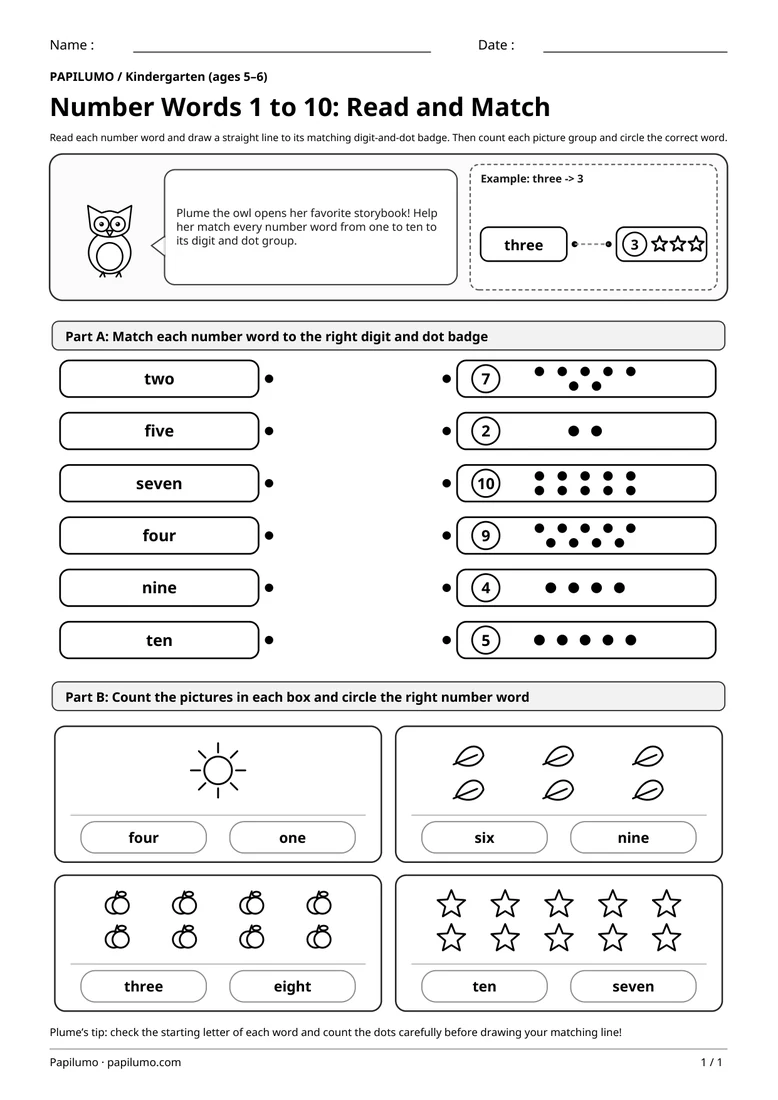
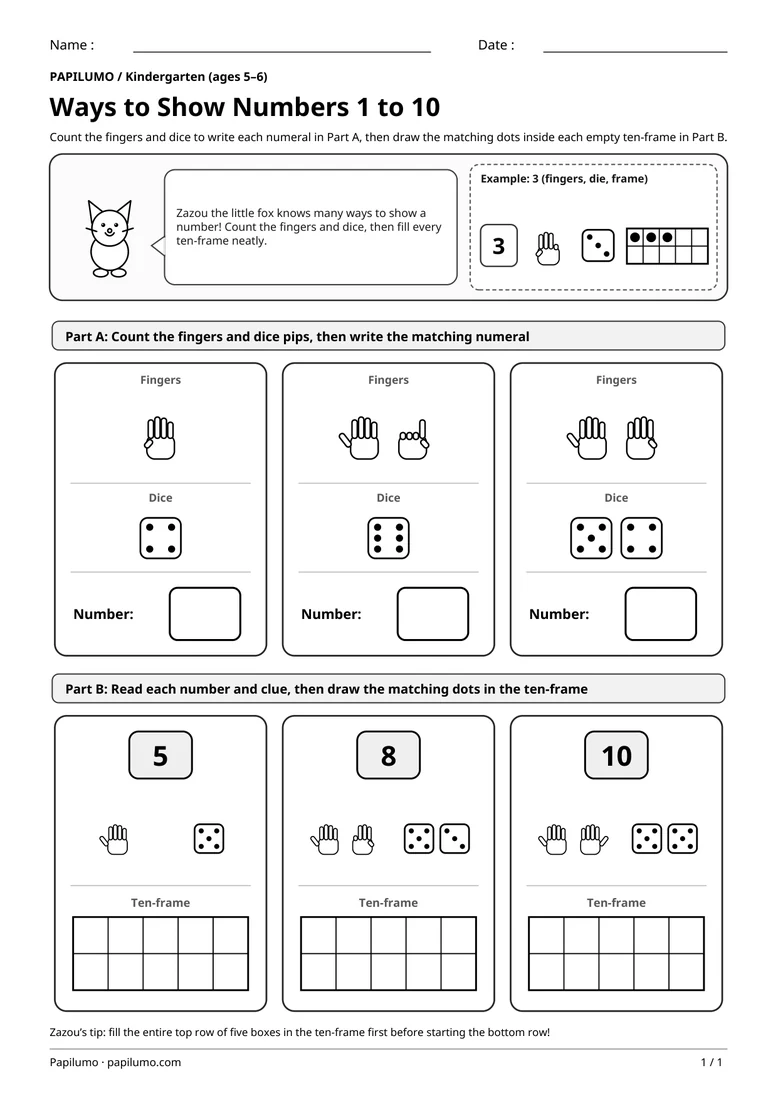
Connecting printed number words to digits and visual quantities bridges early literacy and foundational number sense in Kindergarten. Recognizing high-frequency math words such as one, two, four, five, six, seven, eight, nine, and ten builds reading fluency alongside counting accuracy before first grade. Pairing each digit with structured dot arrangements strengthens subitizing—seeing small groups quickly without recounting every dot from one—while drawing crisp straight matching lines across two columns supports left-to-right visual tracking, steady fine-motor pencil control, and careful self-checking before circling an answer. For a related skill, use Ways to Show Numbers 1 to 10: Fingers, Dice and Ten-Frames (K): Count the fingers and dice to write each numeral in Part A, then draw the matching dots inside each empty ten-frame in Part B.
Preparing a short session
Print the student page at actual size (100%) on plain white A4 paper and keep the separate answer key PDF aside until the whole sheet is finished. Seat your child comfortably at a bright, clear table with a sharpened pencil, a soft eraser, and an optional small ruler for neat matching lines. Before starting, invite your child to count from one to ten on their fingers, then glance down the left column together to spot familiar starting sounds like the t in two, the f in four and five, or the s in six and seven.
A concrete example to get started
Inside the framed top banner next to Plume the owl and her storybook, a dashed worked-example box shows exactly what to do. On the left sits the rounded word card for three; a crisp dashed connecting line travels across to a badge displaying the numeral 3 alongside three neatly arranged stars. Seeing word, numeral, and quantity linked together reassures emerging readers right away so they can tackle all six matches and four picture boxes independently without guessing.
Supporting the activity
Part A displays six number words down the left—two, five, seven, four, nine, and ten—facing six shuffled digit-and-dot badges on the right. Children read each word carefully and draw a straight line from the anchor dot to the matching badge. In Part B, four roomy picture boxes feature one bright sun, six crisp leaves, eight apples, and ten stars. Beneath each group sit two printed number-word options so learners count the objects aloud and circle the single accurate word. To vary the practice, try Number Line Positions and Missing Numbers (0 to 20) with Bibi (1st Grade): Fill the missing tick numbers in the boxes below each line in Part A, then write the exact number on each pointer flag in Part B.
What to notice and how to check
Once all six lines and four circled words are complete, place the separate one-page answer key beside your child’s worksheet to review each item together. Trace every matching line in Part A with a finger while reading the word aloud and verifying the dots on the target badge. In Part B, recount the sun, the six leaves, the eight apples, and the ten stars to confirm each circled word. If any look-alike words such as four and five caused a mix-up, sound out the letters together.
Making the task easier
Start with short familiar words like one, two, and ten first, then use counting dots to confirm the remaining matches.
Keep the learning aim, but reduce how much the child has to handle at once. Cover part of the page with another sheet and reveal one task at a time. Demonstrate a separate example, then leave a real opportunity to work something out. An answer reached with support is still a useful attempt; it does not yet show that the same task can be completed independently.
Taking the idea beyond the worksheet
On the back of the sheet, write your favorite number word from one to ten and draw that many stars beside it.
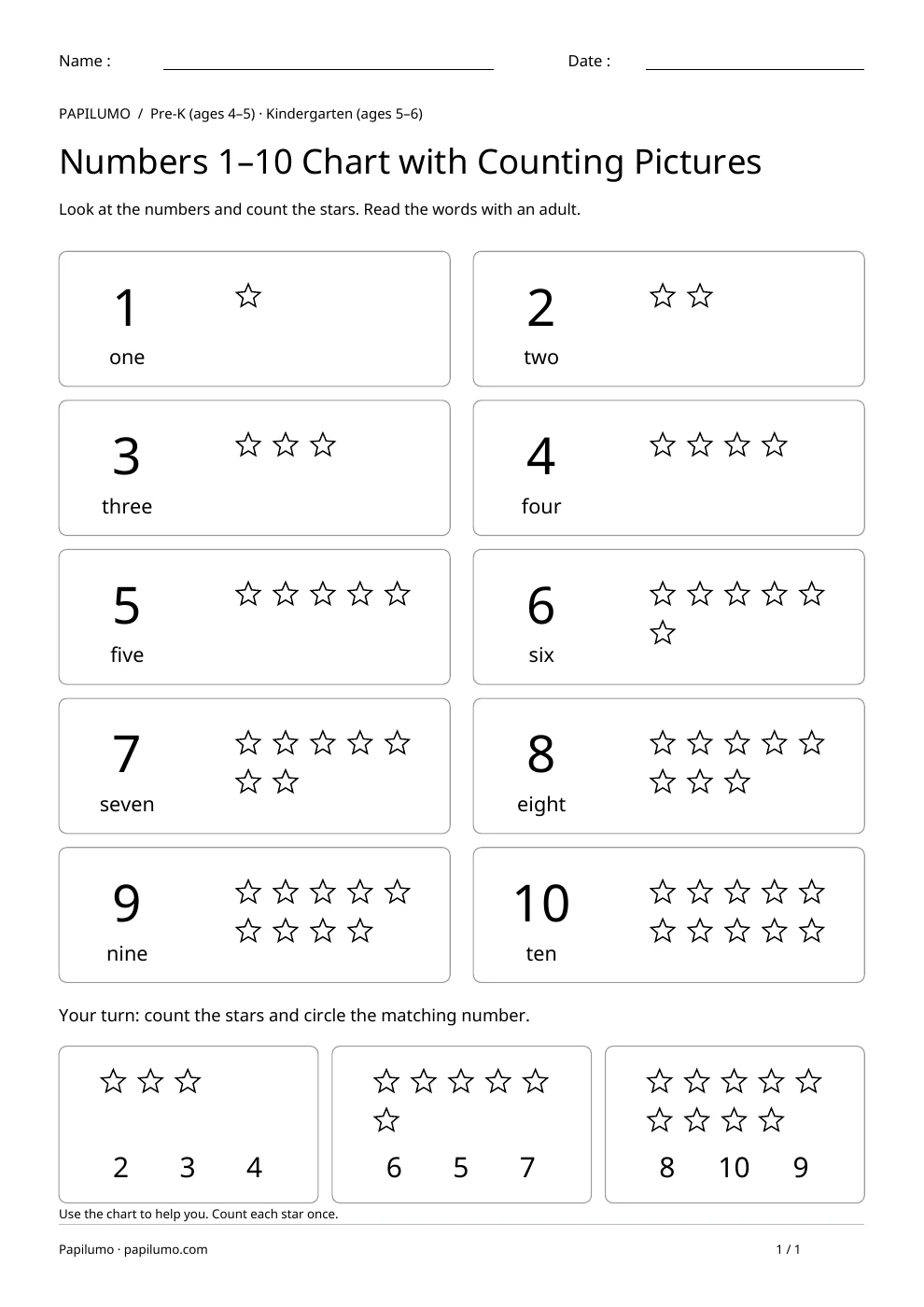
Use the follow-up to meet the same idea in a different setting. Offer it once the first task makes sense, without insisting that the whole page must be perfect. The child might explain a strategy, make an example or set a challenge for an adult. Return to the worksheet only when it helps connect the two situations. A short conversation or a practical activity can be enough to finish the session. To continue exploring, use Numbers 1–10 Chart with Counting Pictures: Look at the numbers and count the stars. Read the words with an adult.
Downloading and printing the PDF
This free PDF contains one worksheet designed for A4 paper. Download the file using the button on this page and open it in your PDF reader. Choose actual size or a 100% scale, check the orientation in the print preview and turn off any browser headers or footers. The illustrations use vector lines, so their outlines stay sharp when printed. Check the margins on one copy before preparing several sheets for a group. The level shown on the page is a guide, rather than a requirement to complete the activity at a particular age.