


What this worksheet helps children practise
Find the two nearest hundreds first, then count halfway ticks by 50s on the big line and small ticks by 10s on zoomed lines!
Reading and plotting numbers on a 0 to 1,000 number line in 3rd Grade develops proportional number sense, place-value estimation, and genuine scale flexibility across multi-digit numbers. Moving smoothly from a wide 1,000-unit trail (counting by 100s and halfway 50s) to zoomed 100-unit intervals (counting carefully by 10s) trains learners to locate clear benchmarks before counting smaller steps. Framing three-digit numbers such as 462 cleanly between 400 and 500 also builds the core mental habit needed for rounding to the nearest hundred and checking calculations. For a related skill, use Multiples of 2, 5, and 10: Divisibility Rules & Venn Sort with Zia (3rd Grade): Use Zia’s rule for 30, tick the multiples table (A), sort the 8 tickets into the Venn loops (B), and answer both questions (C).
Preparing a short session
Print the student worksheet at 100% actual size on crisp white A4 paper without scaling down the margins, and provide a sharpened pencil along with a clean eraser. Keep the separate one-page answer key PDF neatly out of sight until all three parts are completely finished. Before beginning, count aloud together by 100s from 0 to 1,000, then point out that every medium tick positioned midway between two hundreds marks an exact +50 halfway step along the full number trail.
A concrete example to get started
Inside the top banner beside Timo the hedgehog, a clean model segment runs from 300 to 400 with one midpoint tick clearly marked halfway across. A bold black dot sits right on the midpoint beneath a pointer flag reading 350, paired directly underneath with the inequality 300 < 350 < 400. This worked guide immediately anchors the two-part strategy before exercise 1: identify the lower and upper hundred boundaries first, then read or place the exact midpoint or ten-step position accurately.
Supporting the activity
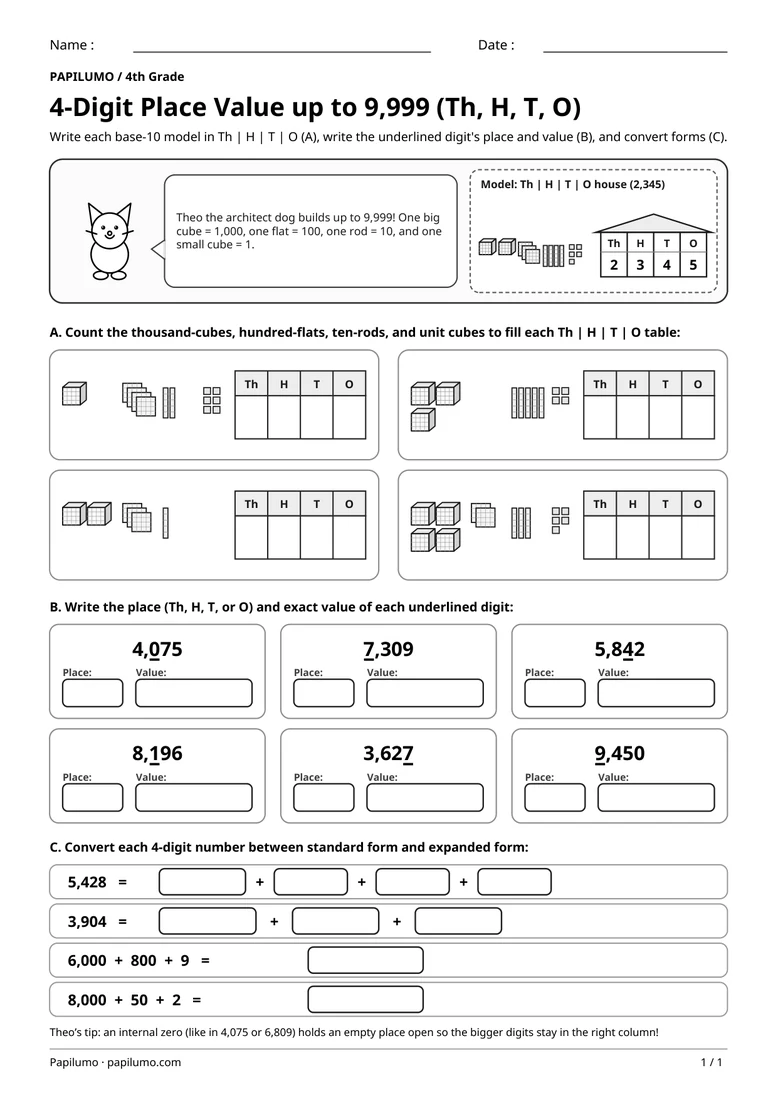
Part A spans the full 0 to 1,000 trail line graduated by 100s and 50s: students fill three missing hundred posts (200, 500, and 800) and read four pointer flags placed cleanly at 150, 450, 600, and 850. Part B zooms into three 100-unit intervals ticked clearly by 10s: 200–300 (read flag 230 and plot a bold black dot at 270), 500–600 (read flag 580 and plot 520), and 700–800 (read flag 740 and plot 790). Finally, Part C asks learners to frame 462, 835, 178, and 604 between consecutive hundreds. To vary the practice, try 4-Digit Place Value up to 9,999 (Thousands, Hundreds, Tens, Ones) with Theo (4th Grade): Write each base-10 model in Th | H | T | O (A), write the underlined digit's place and value (B), and convert forms (C).
What to notice and how to check
Once the worksheet is complete, place the separate one-page answer key beside your child’s page to verify every post, flag, plotted dot, and framing box calmly together. In Part A, confirm the missing posts 200, 500, and 800 along with flag readings 150, 450, 600, and 850. In Part B, check the three flag values (230, 580, and 740) and confirm each plotted dot lands cleanly on tick 270, 520, or 790. In Part C, verify 400/500, 800/900, 100/200, and 600/700, asking why 604 sits just above 600.
Making the task easier
Lightly label the midpoint (250, 550, 750) under each zoomed segment in Part B before counting by 10s to plot your dot.
Keep the learning aim, but reduce how much the child has to handle at once. Cover part of the page with another sheet and reveal one task at a time. Demonstrate a separate example, then leave a real opportunity to work something out. An answer reached with support is still a useful attempt; it does not yet show that the same task can be completed independently.
Taking the idea beyond the worksheet
Pick three numbers between 800 and 900, sketch where they sit on a 800–900 line, and frame each between hundreds.
Use the follow-up to meet the same idea in a different setting. Offer it once the first task makes sense, without insisting that the whole page must be perfect. The child might explain a strategy, make an example or set a challenge for an adult. Return to the worksheet only when it helps connect the two situations. A short conversation or a practical activity can be enough to finish the session. To continue exploring, use Rounding Three-Digit Numbers to the Nearest 100 with Bennett (3rd Grade): Check Bennett’s 300–400 segment, mark each number and circle the closer hundred (Part A), then round the 8 numbers (Part B).
Downloading and printing the PDF
This free PDF contains one worksheet designed for A4 paper. Download the file using the button on this page and open it in your PDF reader. Choose actual size or a 100% scale, check the orientation in the print preview and turn off any browser headers or footers. The illustrations use vector lines, so their outlines stay sharp when printed. Check the margins on one copy before preparing several sheets for a group. The level shown on the page is a guide, rather than a requirement to complete the activity at a particular age.