

What this worksheet helps children practise
Ask your child to explain aloud what the Step 1 intermediate number represents before starting Step 2.
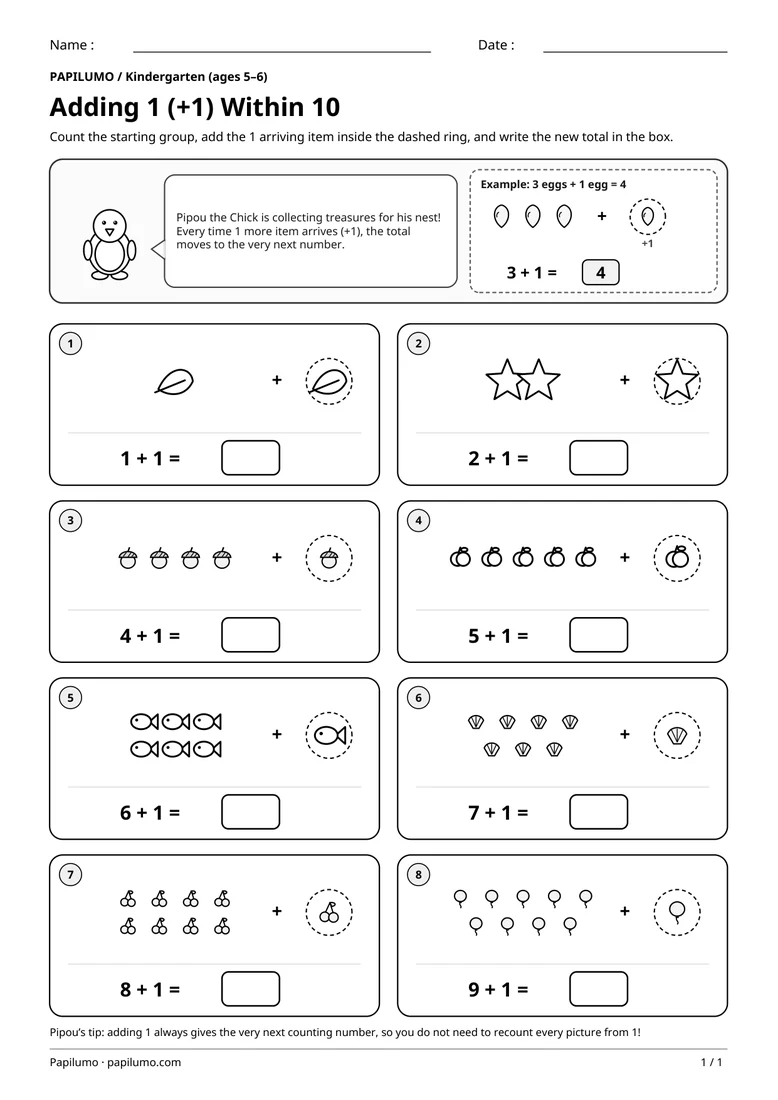
This worksheet strengthens three essential problem-solving habits in 4th Grade: sequencing two distinct operations in logical order, connecting multiplication or division seamlessly with addition or subtraction according to the story context, and checking both numerical reasonableness and concrete units at the end. Dedicated Step 1 and Step 2 work boxes prevent students from stopping after a single calculation, skipping the hidden middle question, or losing track of intermediate totals before finishing. For a related skill, use Adding 1 (+1) Within 10 with Pipou the Chick: Count the starting group, add the 1 arriving item inside the dashed ring, and write the new total in the box.
Preparing a short session
Print the student worksheet at 100% scale on white A4 or letter paper, along with a sharpened pencil and a clean eraser for tidy corrections. Keep the separate one-page answer key out of sight while your child solves all four fair problems independently. Before starting, read Nino's worked fair example in the top banner together and ask why you must multiply 4 packs of 12 badges first before subtracting the 9 badges given away at the booth.
A concrete example to get started
Inside the top banner next to smiling Nino the Panda holding a fresh bamboo stalk, the worked two-step example models the exact structured layout students follow on every card below. For 4 packs of 12 badges minus 9 badges handed out to early booth visitors, Step 1 cleanly prints 4 × 12 = 48, Step 2 carries that exact subtotal 48 forward into 48 − 9 = 39, and the final answer line clearly states Answer: 39 badges. Keeping both work steps and the unit visible side by side gives 4th graders a reliable blueprint before solving their own four school-fair stories independently.
Supporting the activity
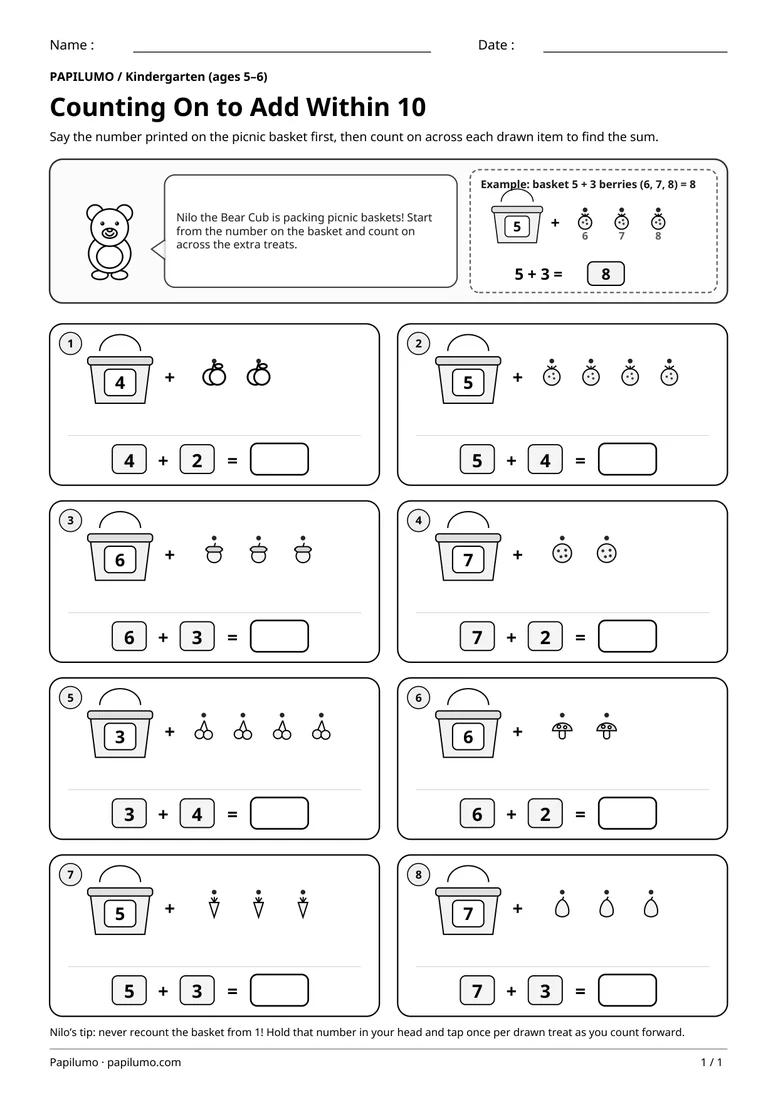
Four spacious full-width cards cover four distinct operation pairs within 1,000 so students analyze every school-fair story carefully rather than repeating one simple routine. Problem 1 pairs multiplication then subtraction (8 × 25 = 200, then 200 − 35 = 165 bookmarks). Problem 2 combines multiplication then addition (6 × 45 = 270, then 270 + 85 = 355 marbles). Problem 3 runs addition then division (132 + 108 = 240, then 240 ÷ 6 = 40 muffins), and Problem 4 subtraction then division (520 − 160 = 360, then 360 ÷ 8 = 45 stickers). Every card reserves generous room for writing clear step-by-step equations. To vary the practice, try Counting On to Add Within 10 with Nilo the Bear Cub: Say the number printed on the picnic basket first, then count on across each drawn item to find the sum.
What to notice and how to check
When all four cards are finished, place the separate one-page answer key beside the student sheet to inspect every step calmly together. Verify each Step 1 intermediate total first (200, 270, 240, and 360), confirm that exact value carried cleanly into Step 2 without copying mistakes, and check all four bold final answers along with their units: 165 bookmarks, 355 marbles, 40 muffins, and 45 stickers. If an intermediate number slipped, talk through what it represents before recomputing both equations.
Making the task easier
Prompt with the hidden question between steps: 'What total or remainder must we find before sharing or subtracting?'
Keep the learning aim, but reduce how much the child has to handle at once. Cover part of the page with another sheet and reveal one task at a time. Demonstrate a separate example, then leave a real opportunity to work something out. An answer reached with support is still a useful attempt; it does not yet show that the same task can be completed independently.
Taking the idea beyond the worksheet
Challenge fast finishers to rewrite Problem 3 as a single expression with parentheses: (132 + 108) ÷ 6.
Use the follow-up to meet the same idea in a different setting. Offer it once the first task makes sense, without insisting that the whole page must be perfect. The child might explain a strategy, make an example or set a challenge for an adult. Return to the worksheet only when it helps connect the two situations. A short conversation or a practical activity can be enough to finish the session. To continue exploring, use Two-Step Addition & Subtraction Word Problems with Nino: Read each post office story, solve Step 1 first, carry that result into Step 2, and complete the final unit sentence.
Downloading and printing the PDF
This free PDF contains one worksheet designed for A4 paper. Download the file using the button on this page and open it in your PDF reader. Choose actual size or a 100% scale, check the orientation in the print preview and turn off any browser headers or footers. The illustrations use vector lines, so their outlines stay sharp when printed. Check the margins on one copy before preparing several sheets for a group. The level shown on the page is a guide, rather than a requirement to complete the activity at a particular age.