What this worksheet helps children practise
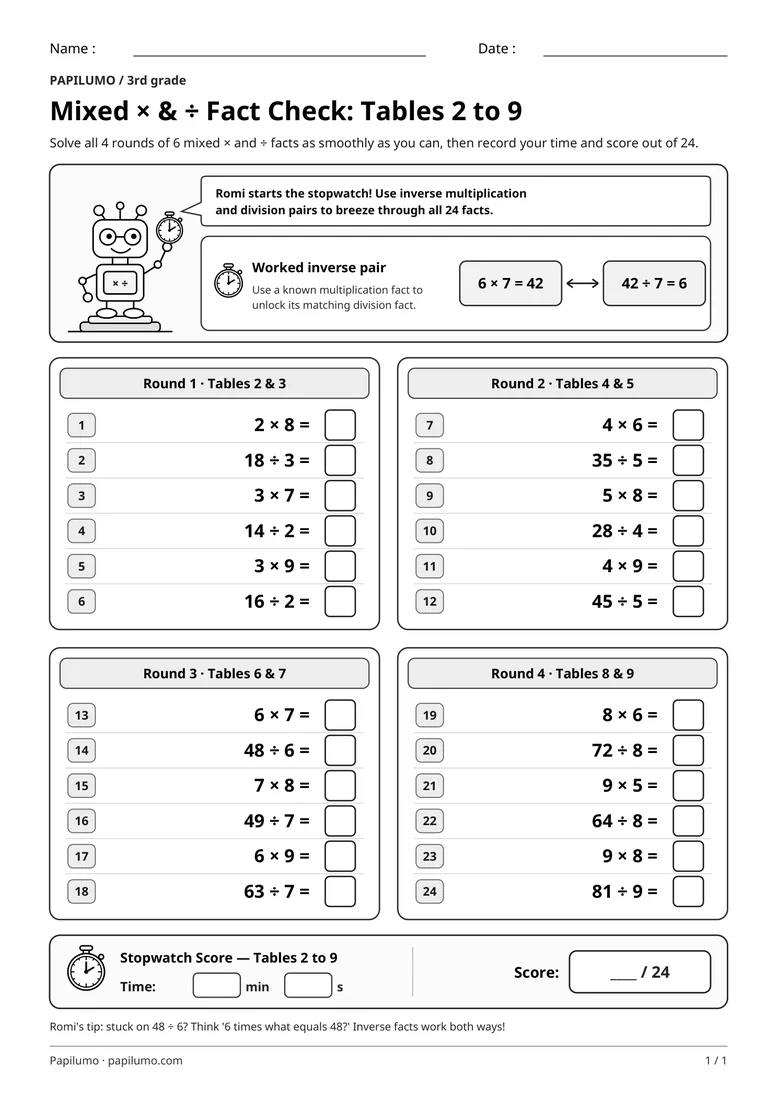
Check the × or ÷ symbol at the start of every row before your brain jumps to an answer!
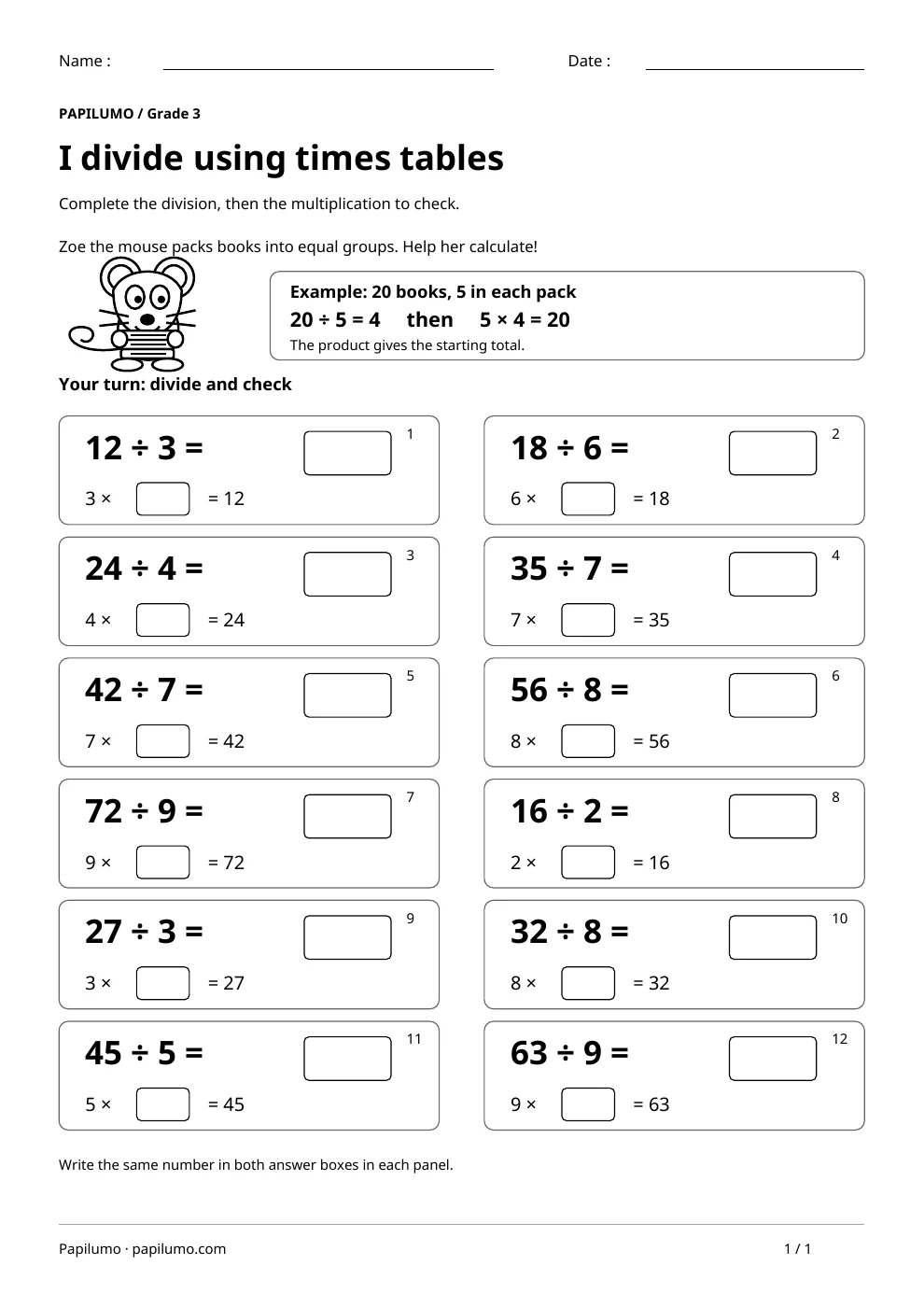
True fact fluency in 3rd grade goes beyond reciting one times table in order—students need to switch smoothly between multiplication and division on consecutive lines. Alternating × and ÷ prompts sharpens symbol attention, strengthens fact-family connections, and trains learners to solve division equations by thinking of the related product rather than counting backward or drawing tallies on scratch paper. For a related skill, use Division Facts: Check with Multiplication: Complete the division, then the multiplication to check.
Preparing a short session
Print the student worksheet at actual size (100%) on plain white A4 or letter paper without shrinking margins, and place a sharpened pencil, eraser, and quiet stopwatch on the desk. Keep the separate answer key PDF out of sight throughout the check. Before starting the clock, read Romi’s speech bubble together and trace the double arrow between 6 × 7 = 42 and 42 ÷ 7 = 6 so the inverse strategy is fresh in mind.
A concrete example to get started
Inside the top banner beside Romi, the worked model places two inverse equations side by side: 6 × 7 = 42 and 42 ÷ 7 = 6. The two-way arrow highlights that every multiplication product immediately unlocks its partner division quotient. Whenever a student pauses on 42 ÷ 7, asking 'what times 7 equals 42?' turns an unfamiliar division problem into a quick, confident retrieval.
Supporting the activity
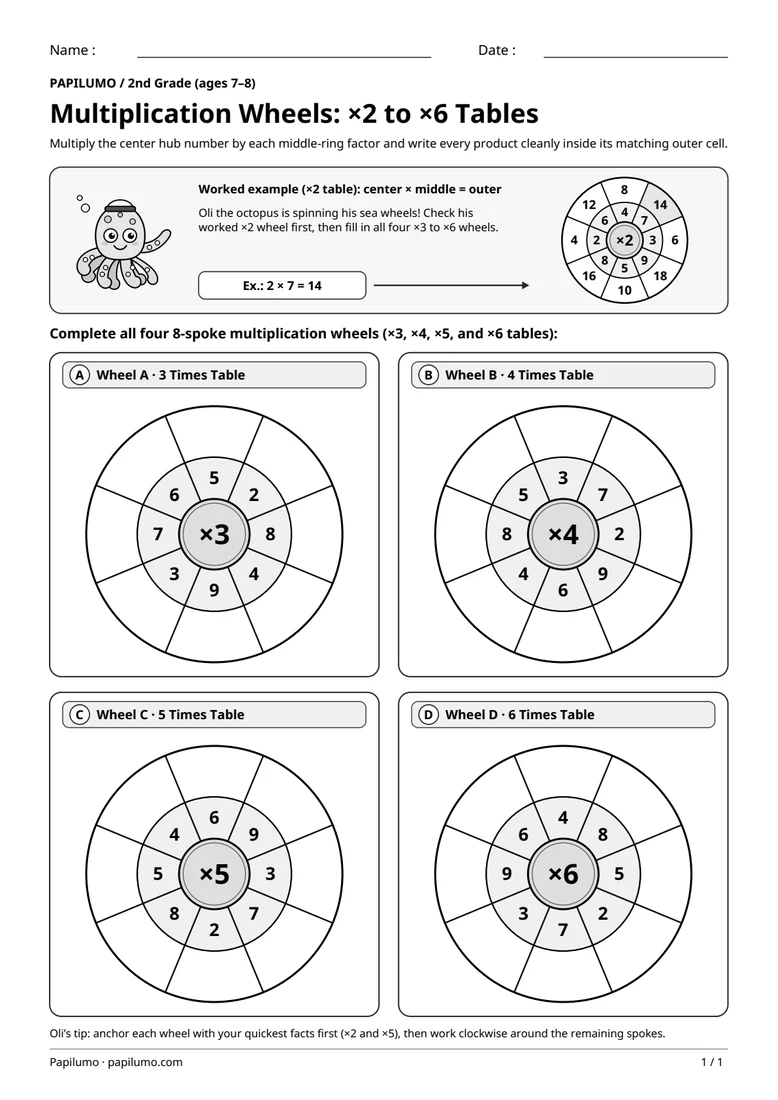
The main 2 × 2 grid arranges twenty-four numbered facts into four balanced rounds of six alternating × and ÷ rows. Round 1 checks tables 2 and 3 with 2 × 8 = 16, 18 ÷ 3 = 6, 3 × 7 = 21, 14 ÷ 2 = 7, 3 × 9 = 27, and 16 ÷ 2 = 8. Round 2 targets tables 4 and 5 through 4 × 6 = 24, 35 ÷ 5 = 7, 5 × 8 = 40, 28 ÷ 4 = 7, 4 × 9 = 36, and 45 ÷ 5 = 9. Round 3 moves to tables 6 and 7 (6 × 7 = 42, 48 ÷ 6 = 8, 7 × 8 = 56, 49 ÷ 7 = 7, 6 × 9 = 54, 63 ÷ 7 = 9), and Round 4 finishes on tables 8 and 9 up to 81 ÷ 9 = 9. To vary the practice, try Multiplication Wheels (2 to 6 Times Tables) with Oli the Octopus: Multiply the center hub number by each middle-ring factor and write every product cleanly inside its matching outer cell.
What to notice and how to check
When reviewing against the separate answer key PDF, celebrate accuracy first before checking elapsed seconds: scoring 22 to 24 out of 24 shows dependable fluency across all tables from 2 to 9. Circle any missed upper facts such as 48 ÷ 6 = 8, 7 × 8 = 56, or 64 ÷ 8 = 8, rebuild them aloud using the inverse multiplication sentence, and record the final score out of 24 to track steady progress over time.
Making the task easier
Complete Rounds 1 and 2 untimed first, take a short breather, and then tackle Rounds 3 and 4.
Keep the learning aim, but reduce how much the child has to handle at once. Cover part of the page with another sheet and reveal one task at a time. Demonstrate a separate example, then leave a real opportunity to work something out. An answer reached with support is still a useful attempt; it does not yet show that the same task can be completed independently.
Taking the idea beyond the worksheet
On scratch paper, write the matching inverse fact for every equation in Round 4, such as 48 ÷ 6 = 8 for 8 × 6 = 48.
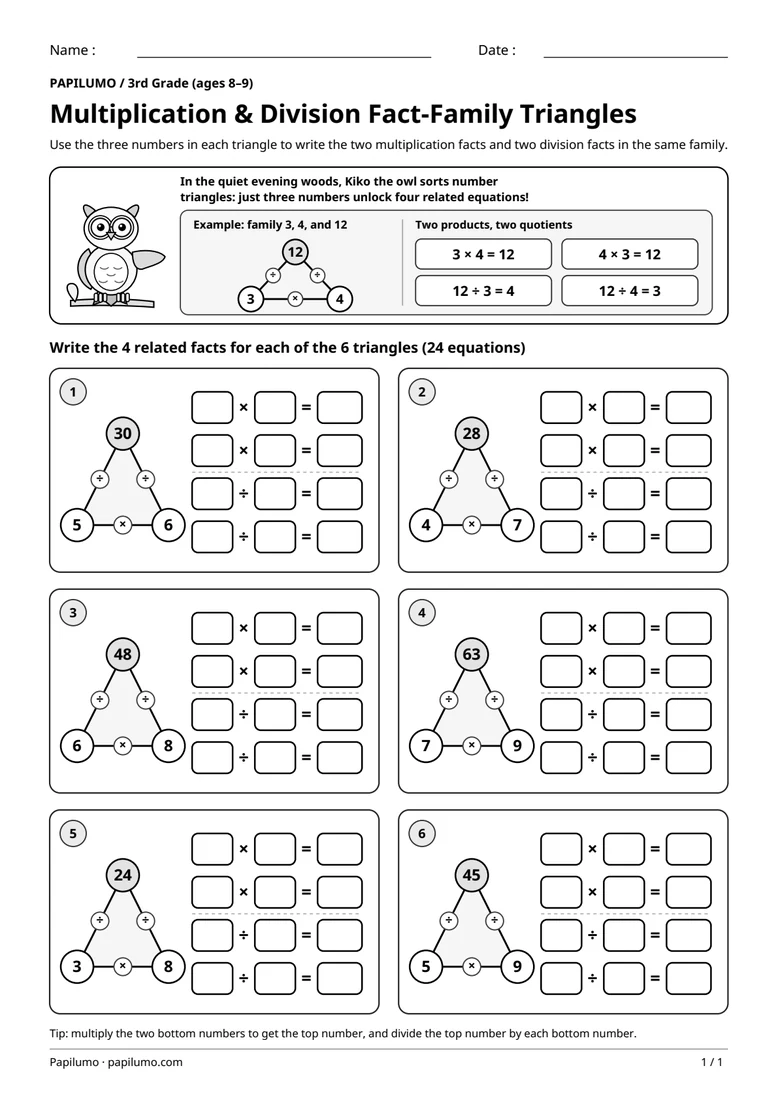
Use the follow-up to meet the same idea in a different setting. Offer it once the first task makes sense, without insisting that the whole page must be perfect. The child might explain a strategy, make an example or set a challenge for an adult. Return to the worksheet only when it helps connect the two situations. A short conversation or a practical activity can be enough to finish the session. To continue exploring, use Multiplication and Division Fact Families: Triangles with Kiko the Owl: Use the three numbers in each triangle to write the two multiplication facts and two division facts in the same family.
Downloading and printing the PDF
This free PDF contains one worksheet designed for A4 paper. Download the file using the button on this page and open it in your PDF reader. Choose actual size or a 100% scale, check the orientation in the print preview and turn off any browser headers or footers. The illustrations use vector lines, so their outlines stay sharp when printed. Check the margins on one copy before preparing several sheets for a group. The level shown on the page is a guide, rather than a requirement to complete the activity at a particular age.