What this worksheet helps children practise
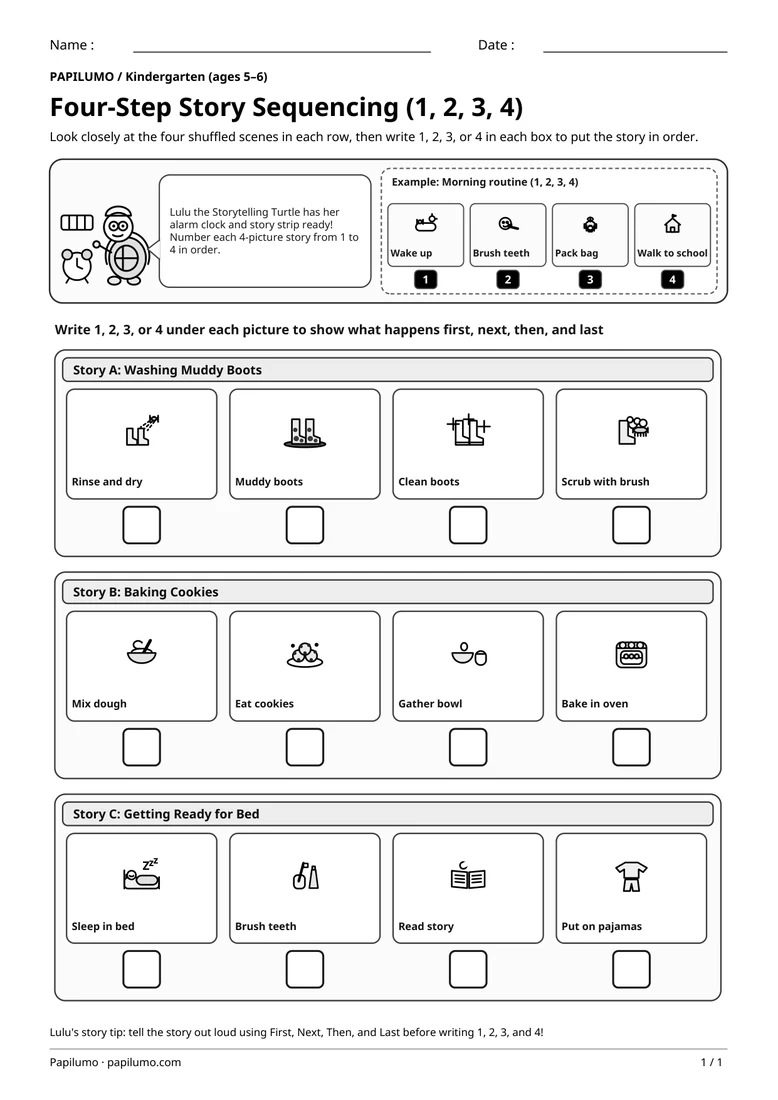
Find what happens very first (1) and very last (4) on the row, then decide which frame belongs at 2 and 3.
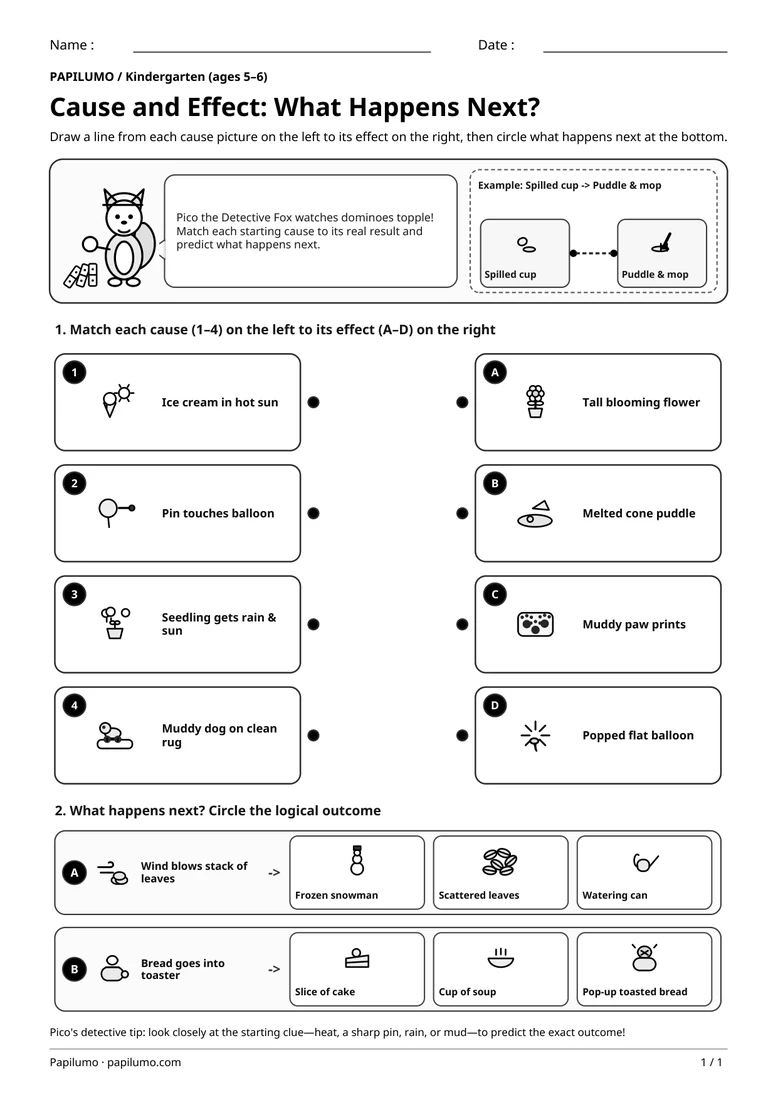
Sequencing four-step daily routines builds narrative comprehension, temporal reasoning, and spoken language structure in Kindergarten. As five- and six-year-olds examine why muddy boots need scrubbing before rinsing, why cookie dough gets mixed before baking, and why pajamas and tooth-brushing come before sleep, they practice connecting visual clues across time using transition words like first, next, then, and last. Writing digits 1 through 4 cleanly inside all twelve square boxes also reinforces steady numeral formation, spatial organization, and independent attention to story details. For a related skill, use Cause and Effect Picture Stories: What Happens Next? with Pico: Draw a line from each cause picture on the left to its effect on the right, then circle what happens next at the bottom.
Preparing a short session
Print the student worksheet at actual size (100%) on plain white A4 paper and sit at an uncluttered table with a sharp pencil and soft eraser. Keep the separate one-page answer key PDF out of view while your child works. Before writing any numbers in Story A, pause together to look across all four shuffled frames and describe aloud what happens at the very start and at the very end so the sequence makes intuitive sense before picking up the pencil or marking any box.
A concrete example to get started
Inside the rounded top banner beside Lulu the Storytelling Turtle and her speech bubble, a clear worked-example box shows a complete four-step warm-up model. Four mini illustrated scenes depict a morning routine in sequence—1 Wake up, 2 Brush teeth, 3 Pack bag, and 4 Walk to school—with bold digits 1, 2, 3, and 4 printed right underneath each frame. Seeing this finished warm-up strip helps Kindergarten children grasp immediately how the square boxes below each frame work across the whole sheet.
Supporting the activity
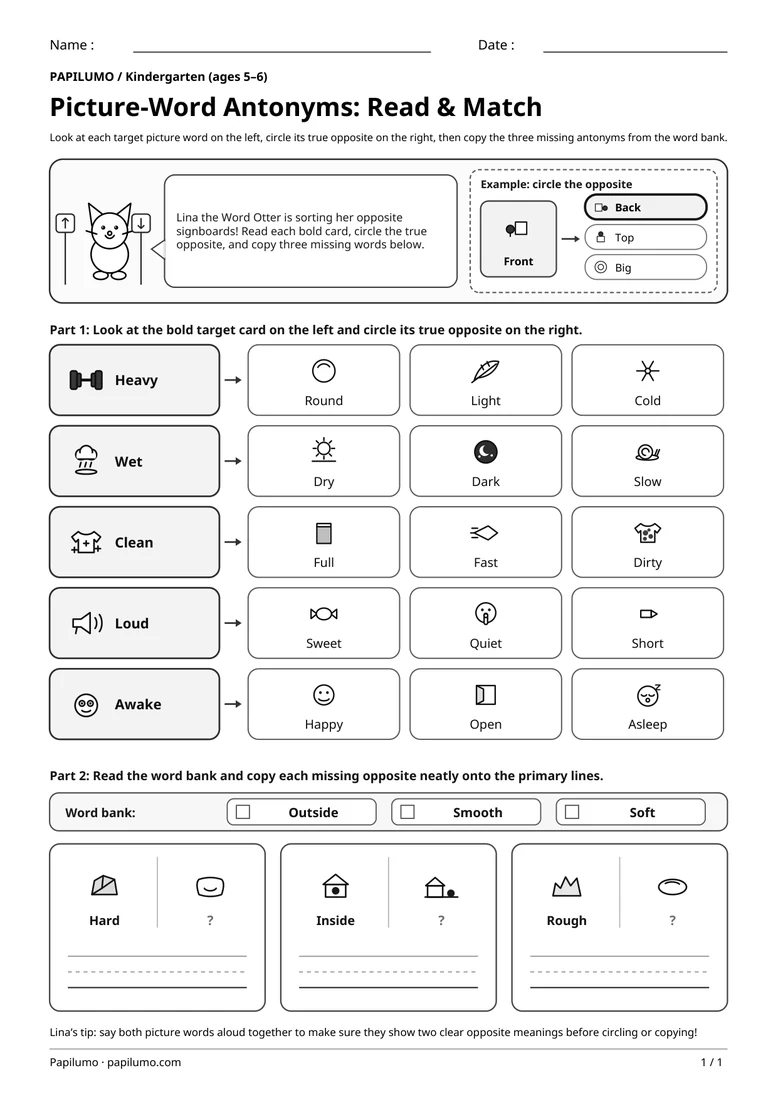
Below the banner sit three spacious horizontal story rows containing twelve large writing boxes in total. Story A (Washing Muddy Boots) shuffles Rinse and dry (3), Muddy boots (1), Clean boots (4), and Scrub with brush (2). Story B (Baking Cookies) shuffles Mix dough (2), Eat cookies (4), Gather bowl (1), and Bake in oven (3). Story C (Getting Ready for Bed) shuffles Sleep in bed (4), Brush teeth (2), Read story (3), and Put on pajamas (1), each with a roomy square box printed cleanly below. To vary the practice, try Picture-Word Antonyms: Read and Circle the Opposite with Lina (Kindergarten): Look at each target picture word on the left, circle its true opposite on the right, then copy the three missing antonyms from the word bank.
What to notice and how to check
Once all twelve boxes are numbered, place the separate one-page answer key PDF beside your child’s worksheet to read each story from 1 to 4 together calmly. The answer key displays all three 4-panel rows with bold digits 1, 2, 3, and 4 printed inside the twelve boxes alongside chronological labels (First, Next, Then, Last) underneath each row. Invite your child to retell all three stories smoothly aloud from step 1 through step 4 with pride before coloring the friendly black-and-white cartoon scenes together.
Making the task easier
Point to the four pictures in story order and retell them aloud with “First, Next, Then, Last” before picking up a pencil.
Keep the learning aim, but reduce how much the child has to handle at once. Cover part of the page with another sheet and reveal one task at a time. Demonstrate a separate example, then leave a real opportunity to work something out. An answer reached with support is still a useful attempt; it does not yet show that the same task can be completed independently.
Taking the idea beyond the worksheet
Act out or tell a brand-new four-step routine from your own day—like planting a seed or making a sandwich.
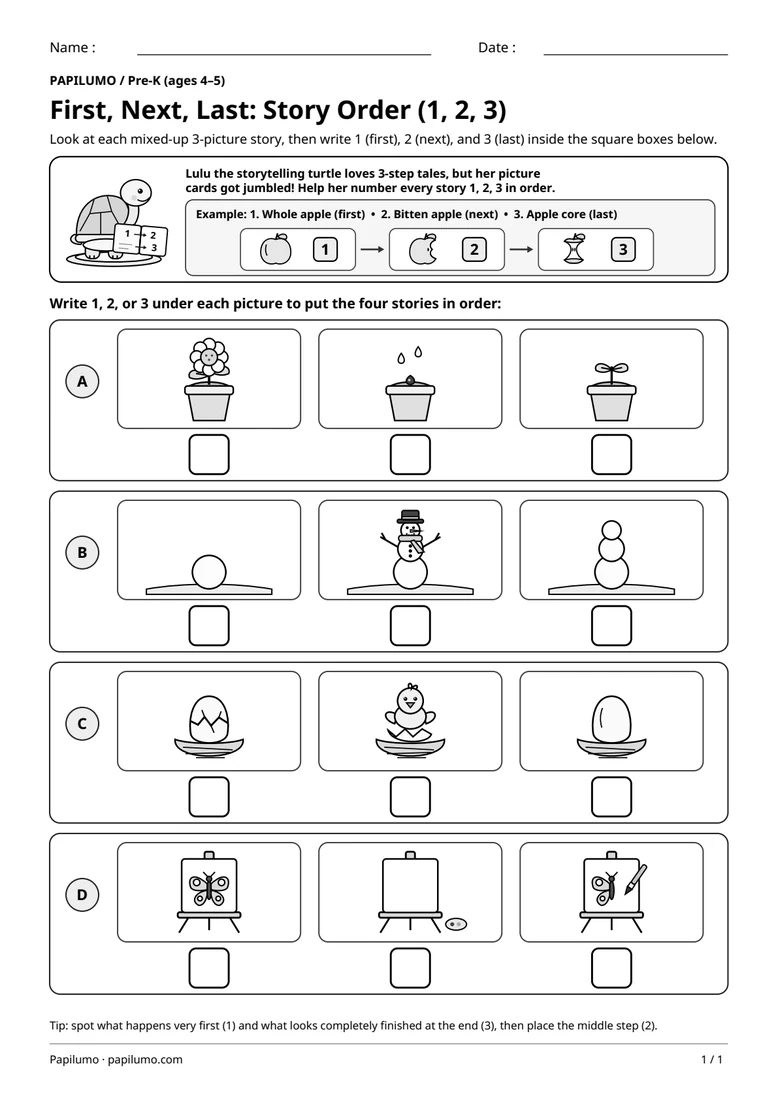
Use the follow-up to meet the same idea in a different setting. Offer it once the first task makes sense, without insisting that the whole page must be perfect. The child might explain a strategy, make an example or set a challenge for an adult. Return to the worksheet only when it helps connect the two situations. A short conversation or a practical activity can be enough to finish the session. To continue exploring, use First, Next, Last Picture Sequencing with Lulu the Turtle: Look at each mixed-up 3-picture story, then write 1 (first), 2 (next), and 3 (last) inside the square boxes below.
Downloading and printing the PDF
This free PDF contains one worksheet designed for A4 paper. Download the file using the button on this page and open it in your PDF reader. Choose actual size or a 100% scale, check the orientation in the print preview and turn off any browser headers or footers. The illustrations use vector lines, so their outlines stay sharp when printed. Check the margins on one copy before preparing several sheets for a group. The level shown on the page is a guide, rather than a requirement to complete the activity at a particular age.