

What this worksheet helps children practise
Tap the signpost letter on the left first, then check every flower one by one to find both matching letters!
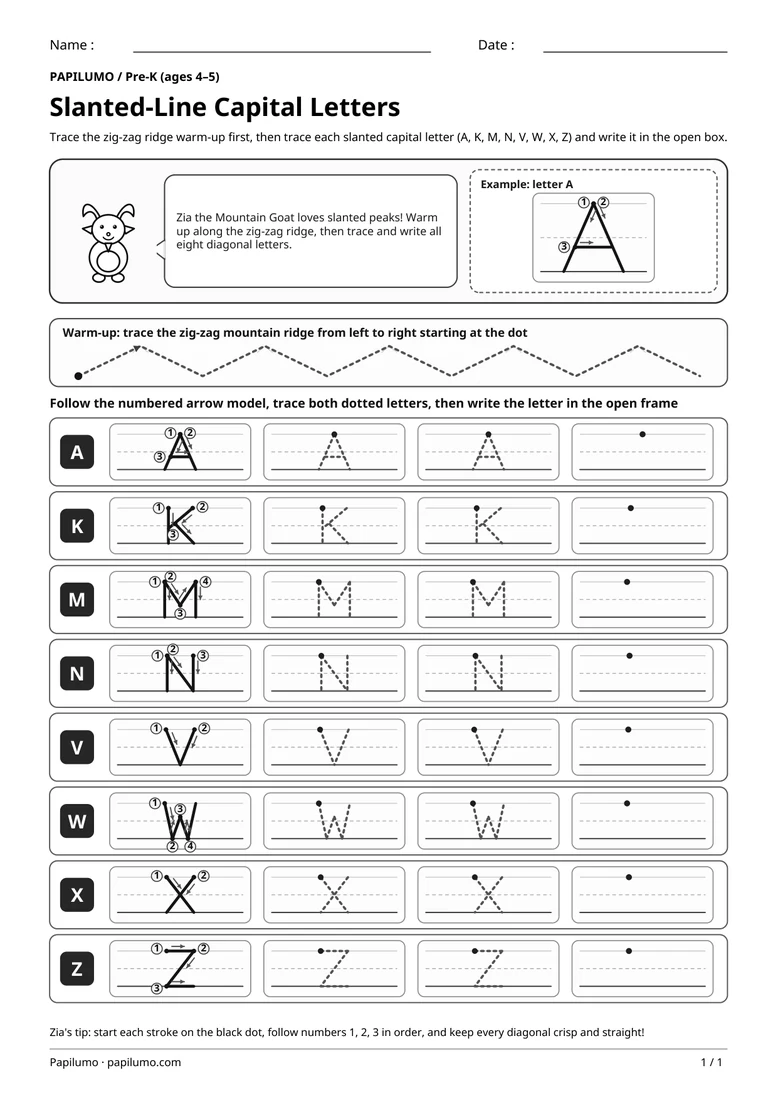
Comparing a target uppercase letter against carefully chosen look-alike distractors in preschool builds visual discrimination, systematic left-to-right scanning, and early print awareness. Telling M apart from W and N, O from Q and C, S from Z and B, or L and T from I and F teaches three- and four-year-olds to notice closed curves, diagonal legs, and crossbar placements. Circling two matching targets on every row also builds controlled curved wrist movements and steady focus without tedious cutting or tiny handwriting lines. For a related skill, use Slanted-Line Capital Letters (A, K, M, N, V, W, X, Z) with Zia (Pre-K): Trace the zig-zag ridge warm-up first, then trace each slanted capital letter (A, K, M, N, V, W, X, Z) and write it in the open box.
Preparing a short session
Print the student worksheet at actual size (100%) on crisp white A4 paper and sit comfortably together at a clear, bright table with a chunky triangular pencil, soft wax crayon, or thick washable marker. Keep the separate one-page answer key PDF neatly out of sight while your child hunts. Before circling, ask your child to tap the target letter on each garden signpost, say its letter name aloud, and slide one pointer finger gently underneath all five flower medallions to locate both matching twins.
A concrete example to get started
Inside the framed top banner beside Coco the Bunny and the friendly speech bubble, a miniature A signpost previews clearly how matching medallions get circled. Even better, Row 1 on the main worksheet itself serves as a full-size worked example: the garden signpost displays uppercase A followed by five flower medallions reading A, V, A, H, and M, with both matching A medallions already clearly circled so preschool children understand the exact ten-circle hunt immediately without guessing.
Supporting the activity
Below Row 1, five spacious practice rows numbered 2 through 6 challenge young learners to spot M, O, S, L, and T—making ten circles to draw across the page. Each row pairs a left-hand garden signpost with five oversized flower medallions holding two exact target letters and three tempting visual distractors. Children carefully hunt for two M medallions among W, M, N, M, and H; two O medallions among Q, O, C, G, and O; and then S, L, and T. To vary the practice, try Mixed Straight and Curved Letters (B, D, J, P, R, U) with Basile (Pre-K): Warm up with the vertical stems and half-loops, then trace B, D, J, P, R, and U and write each letter in the blank boxes.
What to notice and how to check
When all five practice rows are circled, place the separate one-page answer key right beside your child's completed worksheet to celebrate careful looking and calm patience together. Check across all six rows that both matching flower medallions are cleanly circled and marked with small check marks right above them: two A, two M, two O, two S, two L, and two T medallions. If a look-alike distractor such as Q or C slipped in, point gently to its little tail or open gap beside the signpost and enjoy coloring Coco the Bunny and every blooming garden flower.
Making the task easier
Cover the lower rows with a blank sheet of paper so your child scans just one row of five flowers at a time.
Keep the learning aim, but reduce how much the child has to handle at once. Cover part of the page with another sheet and reveal one task at a time. Demonstrate a separate example, then leave a real opportunity to work something out. An answer reached with support is still a useful attempt; it does not yet show that the same task can be completed independently.
Taking the idea beyond the worksheet
Say the letter names A, M, O, S, L, and T aloud, then color Coco the Bunny and every circled flower medallion.
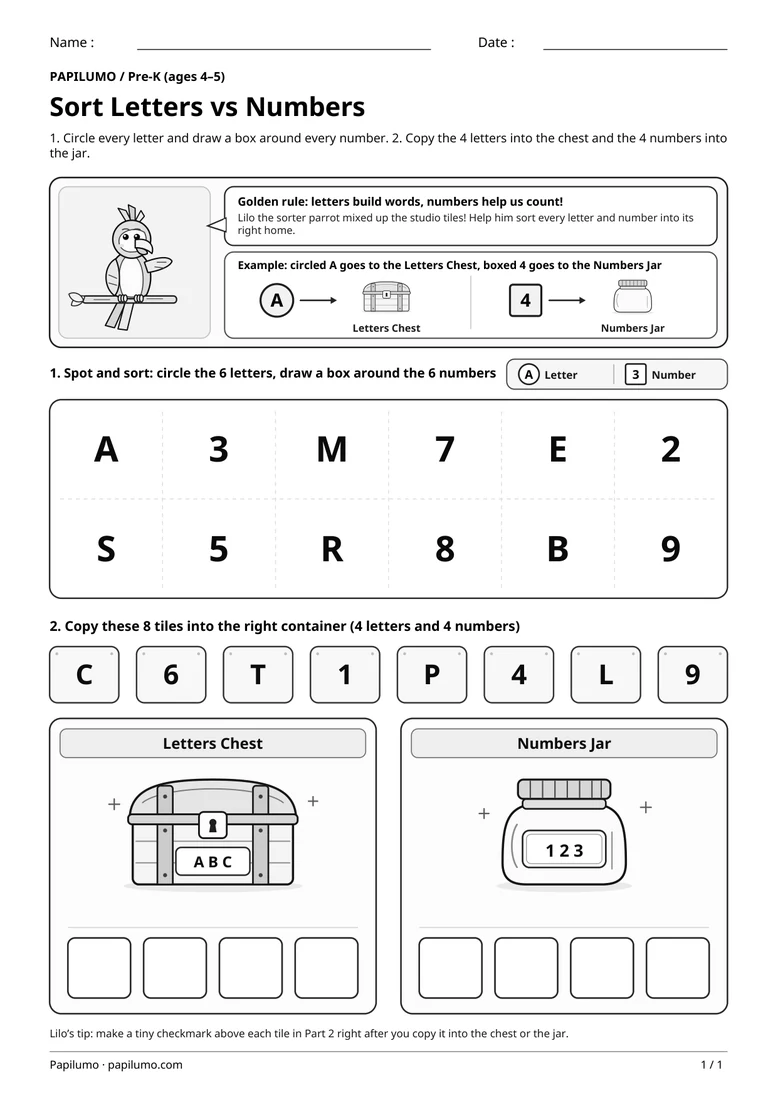
Use the follow-up to meet the same idea in a different setting. Offer it once the first task makes sense, without insisting that the whole page must be perfect. The child might explain a strategy, make an example or set a challenge for an adult. Return to the worksheet only when it helps connect the two situations. A short conversation or a practical activity can be enough to finish the session. To continue exploring, use Sort Letters vs Numbers (Circle, Box, and Copy) with Lilo: 1. Circle every letter and draw a box around every number. 2. Copy the 4 letters into the chest and the 4 numbers into the jar.
Downloading and printing the PDF
This free PDF contains one worksheet designed for A4 paper. Download the file using the button on this page and open it in your PDF reader. Choose actual size or a 100% scale, check the orientation in the print preview and turn off any browser headers or footers. The illustrations use vector lines, so their outlines stay sharp when printed. Check the margins on one copy before preparing several sheets for a group. The level shown on the page is a guide, rather than a requirement to complete the activity at a particular age.