
What this worksheet helps children practise
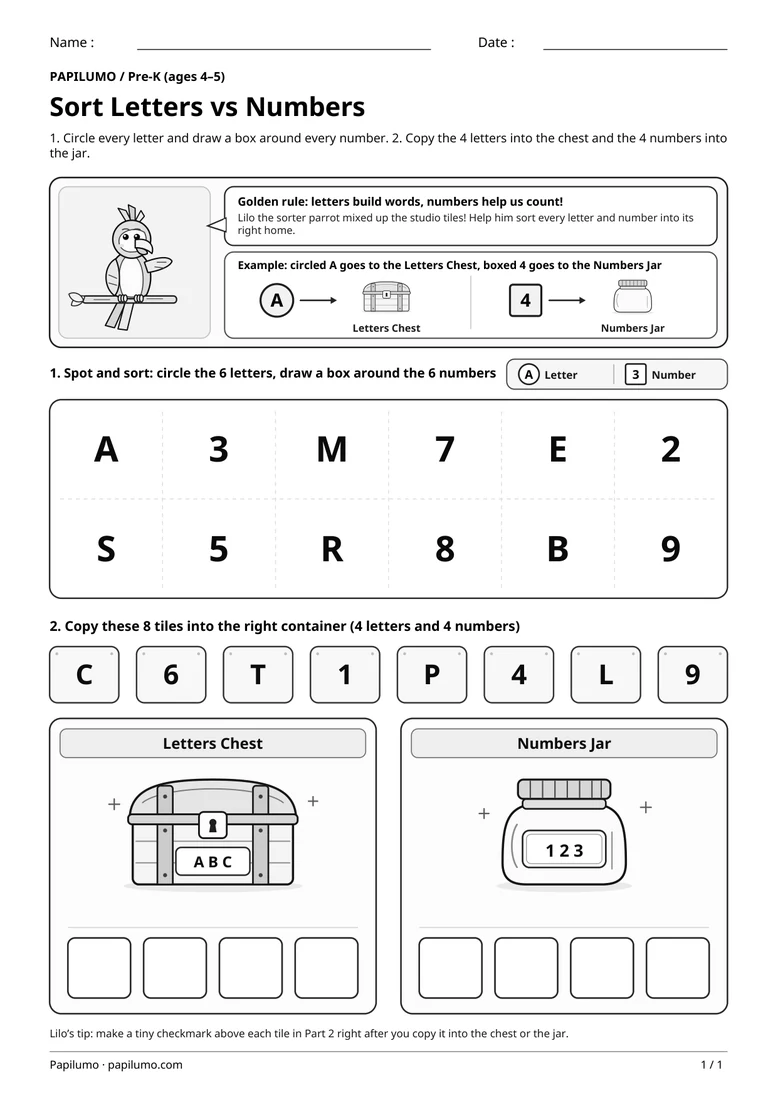
Say each sign aloud first: if you use it to count, draw a box; if it belongs in a word, draw a circle!
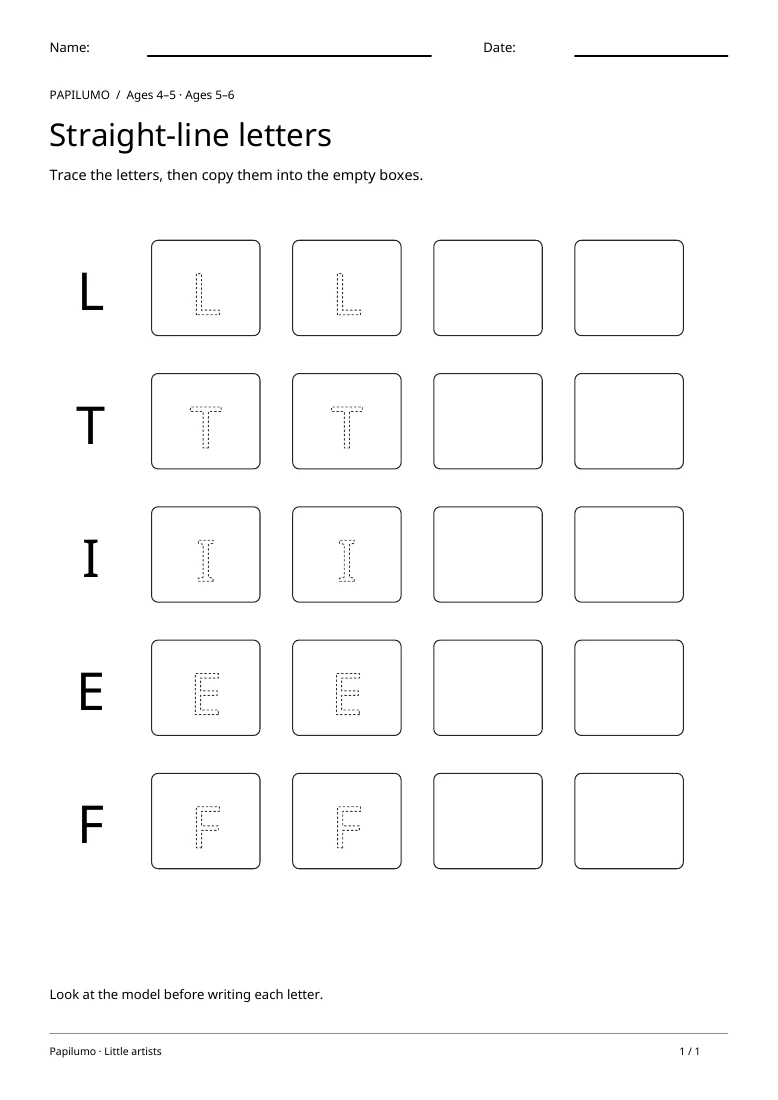
Telling letters apart from numbers is a cornerstone print-awareness milestone in preschool and Pre-K. Even before decoding phonics or solving simple sums, children ages four and five learn that letters spell names and stories while numerals show quantities and counting order. Switching deliberately between a smooth round circle for letters and a four-cornered box for numbers strengthens visual discrimination, inhibitory pencil control, shape contrast awareness, and neat handwriting inside generous boxes without needing scissors or glue. For a related skill, use Uppercase Letter Tracing: Straight-Line Letters: Trace the letters, then copy them into the empty boxes.
Preparing a short session
Print the student worksheet at actual size (100%) on plain white A4 or letter paper and offer a sharpened pencil and a soft eraser. Keep the separate one-page answer key tucked out of sight during independent work. Before making the first mark, look together at the tiny visual key above Part 1 showing a circle around A for Letter and a square box around 3 for Number. Then invite your child to point across the twelve tiles and name each familiar letter or numeral out loud.
A concrete example to get started
Inside the framed top banner beside Lilo the sorter parrot, his pointing speech bubble states the golden rule directly above two mini worked examples. On the left, a circled uppercase A points by arrow to the mini Letters Chest icon. On the right, a boxed numeral 4 points with a matching arrow to the mini Numbers Jar icon. Seeing both shapes and containers side by side helps pre-readers lock in the sorting code right away before starting the twelve tiles below.
Supporting the activity
In Part 1, children scan two rows of six bold characters carefully from left to right: A, 3, M, 7, E, 2 above and S, 5, R, 8, B, 9 below. They draw a round circle around the six letters (A, M, E, S, R, B) and a crisp square box around the six numerals (3, 7, 2, 5, 8, 9). In Part 2, eight fresh tokens (C, 6, T, 1, P, 4, L, 9) wait above two roomy containers: children copy C, T, P, and L into the Letters Chest, and 6, 1, 4, and 9 into the Numbers Jar. To vary the practice, try Alphabetical Order: Letters & Words with Lilo the Postman Parrot: Use the A–Z strip to write the letter before and after, then sort each group of four picture words from A to Z.
What to notice and how to check
When finished, place the separate one-page answer key beside your child’s worksheet to celebrate careful sorting and clear writing. Verify first that all six letters (A, M, E, S, R, B) have clear circles and all six numbers (3, 7, 2, 5, 8, 9) have crisp boxes without missed tiles. Then check the eight copied tokens below: C, T, P, L inside the Letters Chest and 6, 1, 4, 9 inside the Numbers Jar. If lookalikes like B and 8 or E and 3 were swapped, compare their curves and corners together.
Making the task easier
Sweep through Part 1 once to circle only the six letters first, then go back a second time to box the six numbers.
Keep the learning aim, but reduce how much the child has to handle at once. Cover part of the page with another sheet and reveal one task at a time. Demonstrate a separate example, then leave a real opportunity to work something out. An answer reached with support is still a useful attempt; it does not yet show that the same task can be completed independently.
Taking the idea beyond the worksheet
On the back of the sheet, write two uppercase letters from your name and two favorite numbers, then circle and box them.
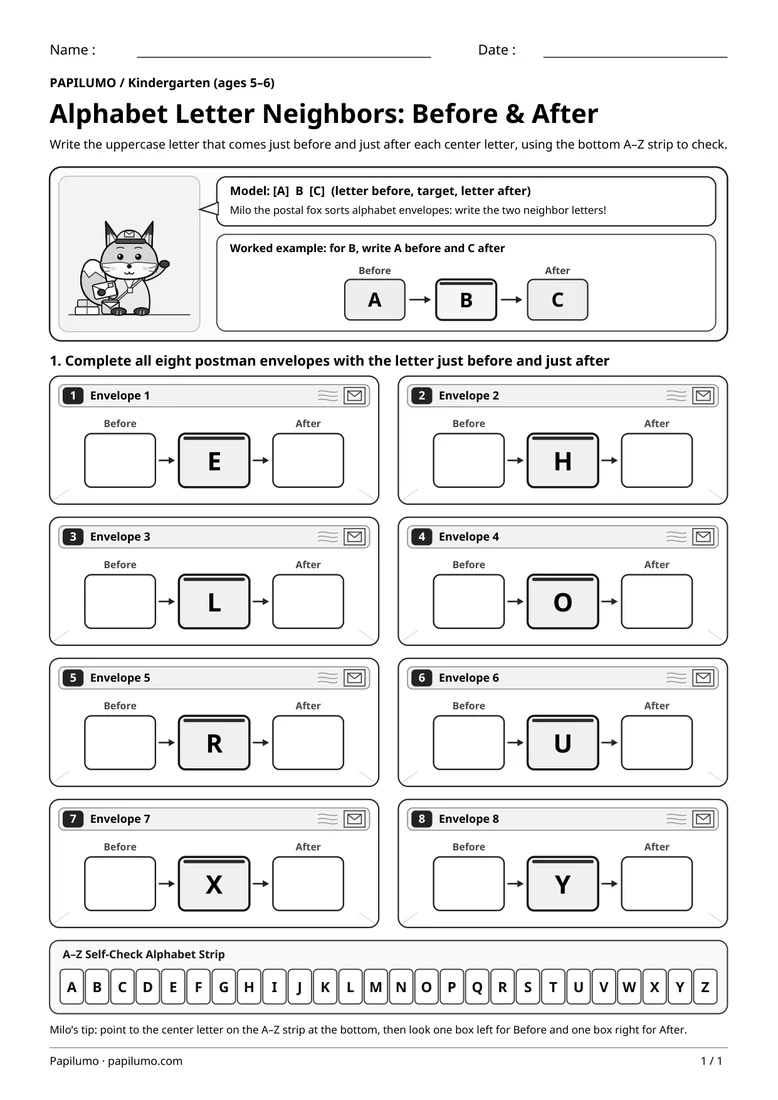
Use the follow-up to meet the same idea in a different setting. Offer it once the first task makes sense, without insisting that the whole page must be perfect. The child might explain a strategy, make an example or set a challenge for an adult. Return to the worksheet only when it helps connect the two situations. A short conversation or a practical activity can be enough to finish the session. To continue exploring, use Alphabet Letter Neighbors (Before and After) with Milo: Write the uppercase letter that comes just before and just after each center letter, using the bottom A–Z strip to check.
Downloading and printing the PDF
This free PDF contains one worksheet designed for A4 paper. Download the file using the button on this page and open it in your PDF reader. Choose actual size or a 100% scale, check the orientation in the print preview and turn off any browser headers or footers. The illustrations use vector lines, so their outlines stay sharp when printed. Check the margins on one copy before preparing several sheets for a group. The level shown on the page is a guide, rather than a requirement to complete the activity at a particular age.