


What this worksheet helps children practise
Always ask yourself: if this shape were a snack shared with friends, would everyone get the exact same amount?
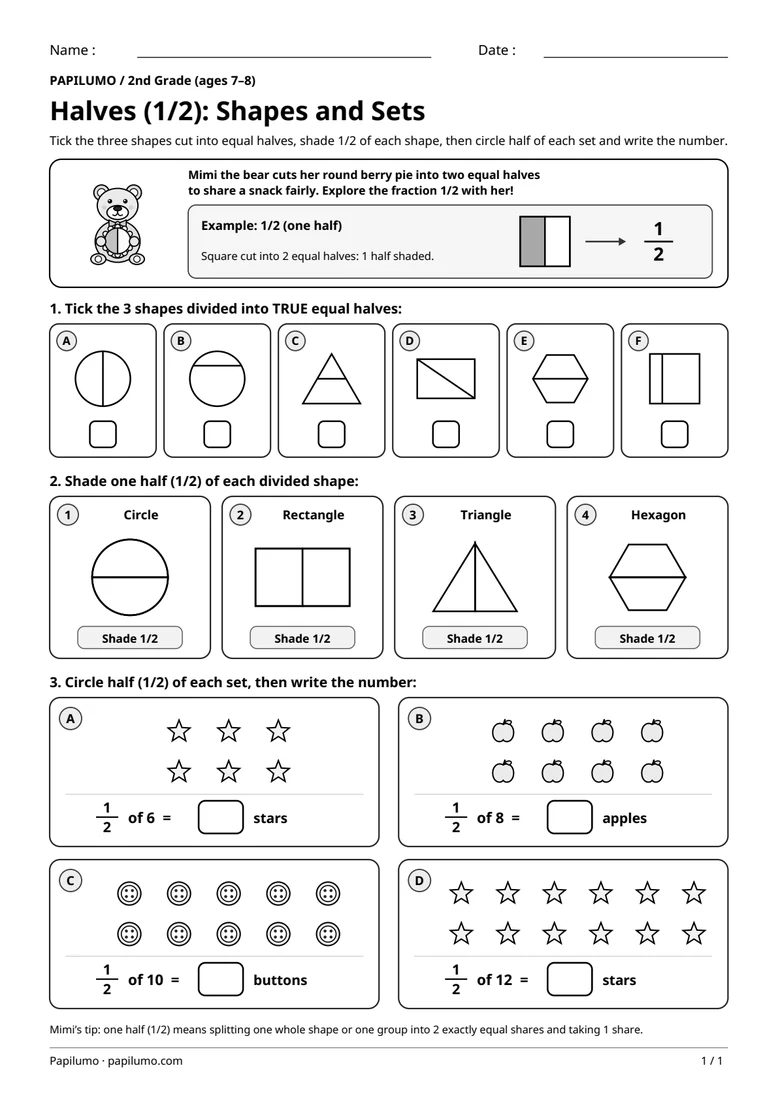
Before reading symbols like one half or one fourth, first graders need to grasp that partitioning a shape is not just cutting it into several pieces—every piece must cover the exact same area. By comparing symmetric partitions against tricky off-center cuts across squares, rectangles, triangles, circles, and a hexagon, students sharpen visual estimation, build fairness reasoning, and avoid the common mistake of counting pieces without checking whether they are truly the same size. For a related skill, use Fractions: Halves (1/2) on Shapes and Sets with Mimi the Bear: Tick the three shapes cut into equal halves, shade 1/2 of each shape, then circle half of each set and write the number.
Preparing a short session
Print the student worksheet at actual size (100%) on plain white A4 or letter paper without cropping margins, and set out a sharpened pencil, a soft eraser, and a short straight ruler for Part 2. Keep the separate PDF answer key out of sight while working. Before ticking any box, ask your child whether it would feel fair to receive the smallest slice of a tilted cookie cut—this everyday picture makes equal area immediately meaningful.
A concrete example to get started
In the top banner beside Mimi the bear cub, two round cookies illustrate the rule at a glance. The left cookie is sliced straight down the center into two matching halves, so Equal parts is ticked. The right cookie is sliced close to its right edge into one tiny sliver and one huge piece, so Unequal parts is ticked. This clear visual contrast guides every comparison in Part 1.
Supporting the activity
In Part 1, students examine all eight numbered cards and tick one checkbox per shape: 1. square split into four identical small squares (equal parts), 2. triangle sliced horizontally into three bands that grow wider toward the base (unequal parts), 3. rectangle cut vertically into three strips of very different widths (unequal parts), 4. circle divided into three matching 120-degree wedges (equal parts), 5. hexagon cut straight across into two symmetric halves (equal parts), 6. circle sliced by two outer chords into narrow side caps and a wide center strip (unequal parts), 7. square divided by an off-center cross into one small corner and one large square (unequal parts), and 8. rectangle cut into four matching vertical strips (equal parts). In Part 2, pupils use a ruler to draw one straight midline splitting the rectangle and circle into two equal parts, and two crossing lines dividing the square and diamond into four equal parts. To vary the practice, try Fractions in Fourths on Shapes with Sammy the Fox: Shade each given fourth in Part 1, write the fractions in Part 2, and spot the two equalities.
What to notice and how to check
When reviewing together with the separate answer key, check all eight Part 1 ticks first and ask your child to explain why cards 2, 3, 6, and 7 are unequal even though each has multiple straight cuts. On triangle card 2, point out how tiny the top tip is compared with the wide bottom strip. Then inspect Part 2 to verify that every dividing line passes straight through the center and creates two or four matching halves or quarters.
Making the task easier
Point to the smallest piece and the largest piece on each card—if they look different in size, tick Unequal parts.
Keep the learning aim, but reduce how much the child has to handle at once. Cover part of the page with another sheet and reveal one task at a time. Demonstrate a separate example, then leave a real opportunity to work something out. An answer reached with support is still a useful attempt; it does not yet show that the same task can be completed independently.
Taking the idea beyond the worksheet
Draw another square on the back of the sheet and find a different way to split it into four equal parts.
Use the follow-up to meet the same idea in a different setting. Offer it once the first task makes sense, without insisting that the whole page must be perfect. The child might explain a strategy, make an example or set a challenge for an adult. Return to the worksheet only when it helps connect the two situations. A short conversation or a practical activity can be enough to finish the session. To continue exploring, use Equal sharing within 12: Mimo’s cookies: Draw one dot for each cookie on the plates. Put the same number on every plate.
Downloading and printing the PDF
This free PDF contains one worksheet designed for A4 paper. Download the file using the button on this page and open it in your PDF reader. Choose actual size or a 100% scale, check the orientation in the print preview and turn off any browser headers or footers. The illustrations use vector lines, so their outlines stay sharp when printed. Check the margins on one copy before preparing several sheets for a group. The level shown on the page is a guide, rather than a requirement to complete the activity at a particular age.